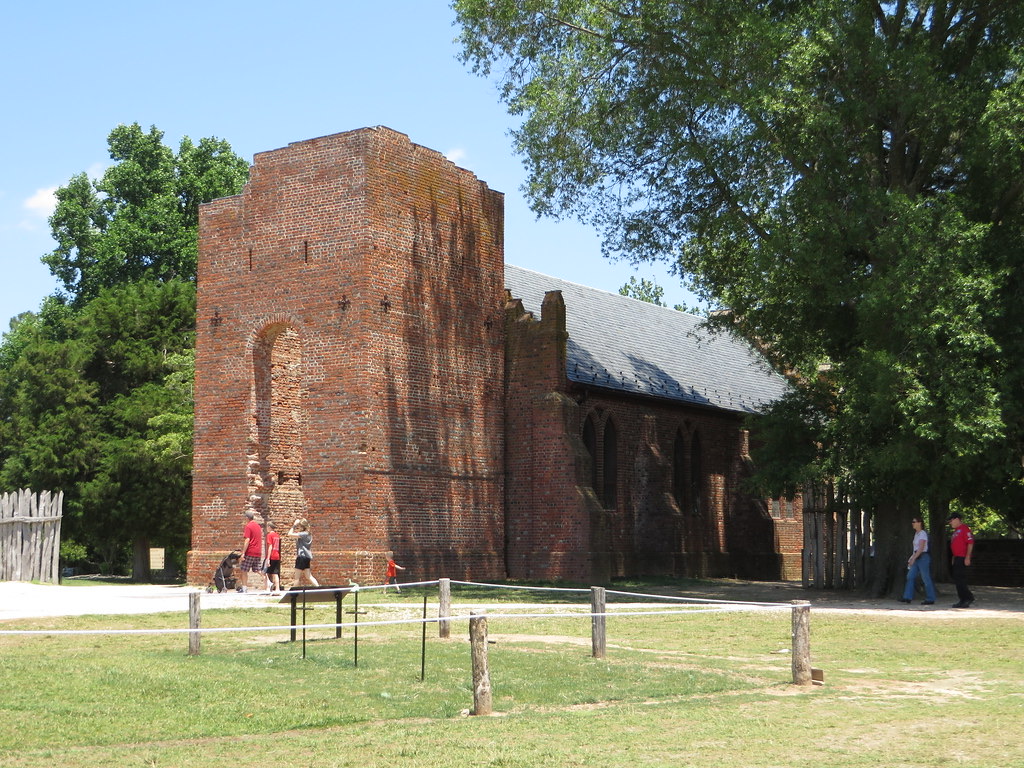
What a building is made of in Virginia depends mostly on what lies under it. East of the fall line the ground is soft sand and clay, so the colonists built with timber and, when they could afford it, brick. Good stone was rare there and had to be shipped in, sometimes from England. Farther west, where hard rock reaches the surface, builders could cut sandstone, granite, slate and limestone from nearby hills. Even today the walls of a courthouse, a church or a college campus can tell you which part of Virginia you are standing in.
Quick answer: Native Virginians made pottery from local clay but built their houses from saplings, bark and reeds. English colonists began with timber and clay (wattle and daub) and soon made brick; Bacon’s Castle in Surry County, built in 1665, is the oldest brick dwelling in North America. Coastal Plain builders had almost no local stone, so they imported English paving stone and later used soft Aquia Creek sandstone from Stafford County, the stone of the first White House and the early Capitol. West of the fall line, builders used red Triassic sandstone, Potomac bluestone, granite, slate and limestone; Virginia Tech still clads its buildings in local dolomite called Hokie Stone. Today Virginia mines common clay and shale for brick and tile and fuller’s earth for cat litter.[2][3][7][9]
Contents
- Clay: the first building material
- Timber, clay and the first bricks at Jamestown
- Why the Coastal Plain had no stone
- English stone in colonial churches
- Aquia Creek sandstone and Government Island
- Red sandstone, Potomac marble and bluestone
- Limestone and Hokie Stone west of the Blue Ridge
- Lime mortar and why cement can hurt old brick
- Clay mining today
- Timeline
- Frequently asked questions
Clay: the first building material
Clay forms when rock breaks down at the surface. Its minerals, mostly kaolinite, illite and montmorillonite, are made of very fine sheets of aluminum silicate, which is why wet clay is plastic and can be shaped and then hardened by fire. Shale is the same fine material pressed into rock.[9] In Virginia most clay is reddish, colored by iron that has oxidized as the parent rock weathered.
Native peoples were using that clay long before Europeans arrived. They dug it from riverbanks, tempered it with sand, crushed shell or crushed stone, and fired it into cooking and storage pots. They did not, however, make bricks. Houses were frames of bent saplings covered with bark mats or bundles of marsh reeds, light enough to be rebuilt when a town moved to fresh fields. (For more on early pottery and stone tools, see Quarries in Virginia and Soapstone in Virginia.)
Timber, clay and the first bricks at Jamestown
The English who landed in 1607 built in the same spirit: with what was close at hand. The fort walls were tree trunks set upright in a trench. Inside, many buildings had walls of woven wooden strips plastered with clay, the old European method called wattle and daub, and roofs of thatched reeds.
Water was the first engineering problem. Archaeologists at Historic Jamestowne have identified a well in the center of James Fort, probably dug in late 1608 or early 1609, that went down about 14 feet and was lined with stacked barrels; trash in it dates from the “Starving Time” winter of 1609–1610.[1] Later wells on the island were lined with brick.
Brick soon became the mark of a permanent, prosperous household. Clay was everywhere in Tidewater, and a brickmaker needed only a clay pit, molds, fuel and a kiln. The oldest brick house that still stands is Bacon’s Castle in Surry County, built for Arthur Allen in 1665. It was first known as Allen’s Brick House and got its present name in 1676, when followers of Nathaniel Bacon held it for about four months during Bacon’s Rebellion.[2]
In the 1700s the great planters of the Northern Neck and the James River built brick mansions and brick parish churches. Christ Church in Lancaster County, built between about 1728 and 1732 and still essentially intact, is one of the finest examples of colonial brickwork in America.[7]
Why the Coastal Plain had no stone
The reason Tidewater builders relied on brick lies deep underground. Hard crystalline bedrock does exist under the Coastal Plain, but it is buried under a thick wedge of sand, silt, clay and shell that washed off older mountains to the west. The layers thicken toward the ocean, from almost nothing at the fall line to thousands of feet at the coast. Most were never squeezed hard enough to turn into solid rock, so builders east of Interstate 95 can still dig basements with a backhoe rather than with drills and dynamite.
Along the rivers, the only hard rock a Jamestown colonist could reach easily was the granite at the falls, many miles upstream. River cobbles served for foundations and floors. Anything better had to come from elsewhere.
English stone in colonial churches
So the wealthiest Virginians imported it. Ships from England brought flagstones for the floors of important buildings, and some of the finest came from the Purbeck quarries on the south coast of England, a fossil-rich limestone laid down in the age of dinosaurs.
The floor of Christ Church in Lancaster County shows how far a planter would go to display his status. Robert “King” Carter, the richest man in the colony, ordered Purbeck paving stone for his mansion, Corotoman, in 1721. The house burned in 1729, and geologists who matched the fossil clams and oysters in the church’s aisle stones to the Purbeck beds concluded that much of the paving was probably salvaged from the ruined mansion and relaid in the church Carter was building.[8]
Some coastal builders tried local marl, a soft shelly sediment that can be cut when damp. It worked for foundations, but it was too soft to travel far over rough colonial roads. (See Fossils and Marl in Virginia.)
Aquia Creek sandstone and Government Island
The first Virginia building stone of real importance came from the western edge of the Coastal Plain, where Cretaceous sands had been just barely cemented into a soft, pale sandstone. The best outcrops were along Aquia Creek, a Potomac River tributary in Stafford County. The stone was easy to saw and carve when fresh and could be loaded onto boats right at the quarry. Builders in the 1700s used it for steps, door surrounds and the decorative corner blocks called quoins, pale accents that stood out against red brick.
Its greatest moment came with the founding of the national capital. In 1791 Pierre (Charles) L’Enfant bought Brent’s Island in Aquia Creek for the federal government as a source of stone for the new city. Stone from the island was cut in quantity for the U.S. Capitol, the White House and other federal buildings, and architect Benjamin Henry Latrobe used it for the early wings of the Capitol. The 17-acre island, now called Government Island, holds five known quarry sites; work there stopped in the 1820s. It was added to the National Register of Historic Places in 2007.[3]
Aquia sandstone has one great weakness: it is porous. Water soaks in, freezes and flakes the surface away. The U.S. Geological Survey points to the Capitol gatehouses and gateposts designed by Charles Bulfinch around 1829, now standing at 15th and 17th Streets NW in Washington, as a lesson in how fast poor-quality Aquia stone decays when left unprotected. Better blocks, kept indoors, still look fine in the older rooms of the Capitol and in the courtyard of the National Portrait Gallery.[4]
Red sandstone, Potomac marble and bluestone
West of the fall line, the rift basins of the Triassic period hold red and brown sandstone, colored by rusting iron. Builders in Northern Virginia quarried it for bridges, toll houses and farm buildings. Across the river, red “Seneca” sandstone of the same age, which geologists call Manassas Sandstone, was the fashionable building stone of Washington from about 1840 to 1880, and it was used for the masonry locks of George Washington’s Potowmack Canal at Great Falls.[5]
The same basins produced the oddest building stone in the region. “Calico Rock,” a limestone conglomerate from the Leesburg Member of the Balls Bluff Siltstone, was sold as Potomac marble even though it is not marble. Latrobe chose it in 1815 for columns in the rebuilt Capitol, but the hard pebbles kept popping out of the softer matrix, and the columns of the Old Hall of Representatives had to be pieced together from drums of uneven length.[4]
Upriver from Washington, hard Piedmont rock called Potomac bluestone was quarried on both banks of the Potomac. In Arlington, a small settlement of Italian quarrymen, known locally as Little Italy or Little Sicily, lived beside a bluestone quarry near today’s Potomac Overlook Regional Park; rusting quarry equipment still sits along the Potomac Heritage Trail.[6] Granite, slate and other hard Piedmont rocks were quarried the same way wherever they reached the surface (see Quarries in Virginia).
Limestone and Hokie Stone west of the Blue Ridge
In the Great Valley the bedrock itself is limestone and dolomite, and settlers used it for houses, mills, springhouses and public buildings. (See Limestone, Caves and the Geology of Natural Bridge.)
The best-known Virginia building stone is Hokie Stone. Virginia Tech’s first buildings were brick, and by the early 1900s the school’s leaders felt they looked like cotton mills and shoe factories; President Joseph D. Eggleston called them “poverty-stricken mills.” The first campus building of native limestone was the YMCA of 1899, and the first in the Collegiate Gothic style with that stone was the first McBryde Hall in 1914. After a modernist interlude in the late 1960s and early 1970s, the Board of Visitors made Hokie Stone official policy for central campus buildings in 2010.[10]
Hokie Stone is dolomite from the Chepultepec and Kingsport formations, in shades of pink, gray, brown and black; the pinkish stone formed under dry, bleaching conditions and the darker stone in wetter, swampier ones. The university’s own 40-acre quarry supplies about 80 percent of it, using black powder to break out large clean blocks with less noise and dust, and buys the rest from a farm in Montgomery County to keep the colors mixed.[10]
Lime mortar and why cement can hurt old brick
Brick walls need mortar, and colonial mortar was made with lime. On the coast the lime came from burning oyster shells; inland it came from limestone. Lime mortar is softer than brick and lets moisture escape, so walls can flex with heat and cold.
The University of Virginia shows what happens when modern materials are used instead. Thomas Jefferson’s Tuscan columns on the Lawn have cores of handmade brick under a lime render. In the 20th century, loose render was patched with Portland cement and painted, which trapped water inside; freezing then opened small cracks and caused more damage. UVA’s historic masons have since gone back to lime render, as on the columns of Pavilion II.[11]
Clay mining today
Clay is still an important Virginia resource, though few people think of it as mining. In 2025, 31 mines in 19 counties produced about 363,000 short tons of common clay and shale, worth an estimated $6.4 million, for brick, tile, pottery, cement, lightweight aggregate and road material. Because clay is heavy and cheap, most of it is used within 25 to 30 miles of the pit.[9]
A special clay, fuller’s earth, comes from the Calvert Formation in King and Queen and King William counties. Three mines there produced about 385,700 short tons in 2025, worth about $30.8 million, sold mostly as cat litter and also as an absorbent for oil and chemical spills.[9]
Timeline
- Before 1607: Native Virginians make clay pottery and build houses of saplings, bark and reeds.
- 1608–1609: A barrel-lined well about 14 feet deep is dug in James Fort.[1]
- 1665: Arthur Allen builds the brick house now called Bacon’s Castle.[2]
- 1721: Robert Carter orders Purbeck paving stone for Corotoman.[8]
- c. 1728–1732: Christ Church, Lancaster County, is built of brick.[7]
- 1791: The federal government buys Brent’s Island (Government Island) in Aquia Creek for building stone.[3]
- 1815: Latrobe begins using Potomac marble in the Capitol.[4]
- c. 1829: Aquia sandstone Capitol gatehouses are built.[4]
- 1899: Virginia Tech’s first native limestone building, the YMCA, is built.[10]
- 2007: The Public Quarry at Government Island is listed on the National Register.[3]
- 2010: Virginia Tech makes Hokie Stone official policy for central campus.[10]
Frequently asked questions
What is the oldest brick house in Virginia? Bacon’s Castle in Surry County, built in 1665, is described as the oldest brick dwelling in North America.[2]
Where did the stone for the White House and Capitol come from? Much of the early stone was Aquia Creek sandstone from Government Island in Stafford County, bought for the federal government in 1791.[3]
Why are there so few old stone buildings in Tidewater? The Coastal Plain is built of loose sediment, and hard rock lies far below the surface, so brick was easier and cheaper than stone.
What is Hokie Stone made of? It is dolomite, a calcium-magnesium carbonate rock, quarried near Blacksburg from the Chepultepec and Kingsport formations.[10]
Is clay still mined in Virginia? Yes. In 2025 Virginia had 31 common clay and shale mines and three fuller’s earth mines.[9]
References
- Historic Jamestowne (Jamestown Rediscovery), “James Fort’s First Well.” https://historicjamestowne.org/archaeology/map-of-discoveries/james-forts-first-well/
- Preservation Virginia, “Bacon’s Castle.” https://preservationvirginia.org/historic-sites/bacons-castle/
- Virginia Department of Historic Resources, “089-0103 Public Quarry at Government Island.” https://www.dhr.virginia.gov/historic-registers/089-0103/
- U.S. Geological Survey, “Building Stones of Our Nation’s Capital: Washington’s Building Stones (3 of 4).” https://pubs.usgs.gov/gip/stones/stones3.html
- U.S. Geological Survey, “Building Stones of Our Nation’s Capital: Washington’s Building Stones (4 of 4).” https://pubs.usgs.gov/gip/stones/stones4.html
- David Constine, “The Little Italy Under the Parkway,” Boundary Stones (WETA), June 13, 2017. https://boundarystones.weta.org/2017/06/13/little-italy-under-parkway
- SAH Archipedia, “Christ Church, Lancaster.” https://sah-archipedia.org/node/878
- Marcus M. Key Jr., Robert J. Teagle and Treleven Haysom, “Provenance of the stone pavers in Christ Church, Lancaster County, Virginia,” Dickinson College. https://www.dickinson.edu/download/downloads/id/1648/provenancestonepaversvirginia
- Virginia Energy, Geology and Mineral Resources, “Clay Materials.” https://energy.virginia.gov/geology/ClayMaterials.shtml
- Virginia Tech, “All about Hokie Stone.” https://vt.edu/about/traditions/hokie-stone.html
- Matt Kelly, “Historic masons revive centuries-old techniques to repair UVA’s iconic structures,” UVA Today, July 20, 2026. https://news.virginia.edu/content/historic-masons-revive-centuries-old-techniques-repair-uvas-iconic-structures