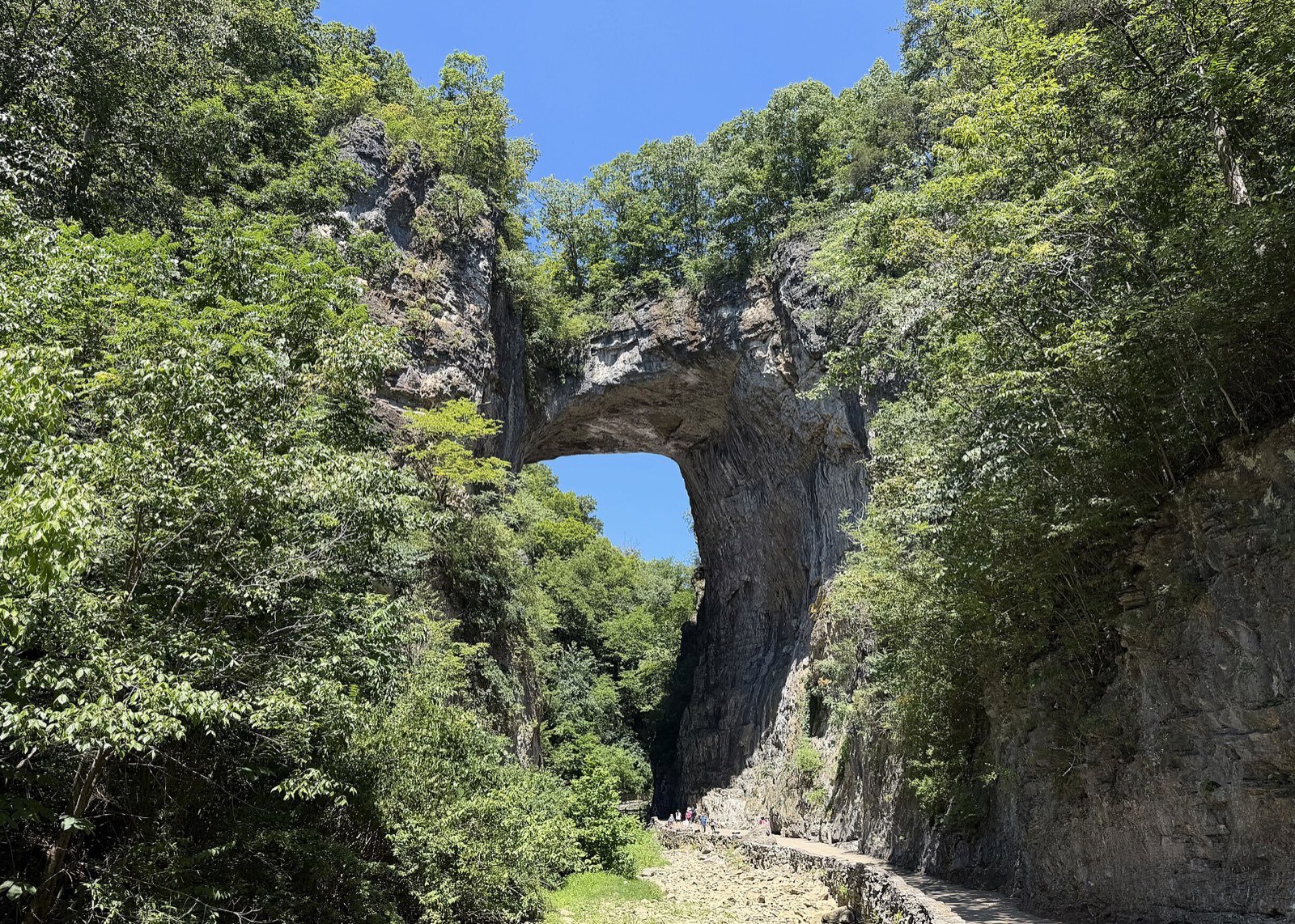
The geology of Virginia spans more than a billion years. The oldest rocks lie in the Blue Ridge, while the youngest sediments cover the Coastal Plain near the Atlantic.
Quick answer: The geology of Virginia is divided into six geologic provinces: the Coastal Plain, Piedmont, Mesozoic basins, Blue Ridge, Valley and Ridge, and Appalachian Plateau. The oldest rocks, in the Blue Ridge, formed about 1.0 to 1.2 billion years ago. The youngest are sand, silt and clay laid down in the last few million years.
Contents
- Six Geologic Provinces
- From Oldest to Youngest
- The Chesapeake Bay Impact Structure
- Fossils of Virginia
- Frequently asked questions
Six Geologic Provinces
Virginia has five physiographic provinces. Counting the Mesozoic basins, it has six geologic provinces.[1]
| Province | Main rocks |
|---|---|
| Coastal Plain | Clay, sand, gravel and silt, from the late Jurassic to the present[2] |
| Piedmont | Igneous and metamorphic rock of the Proterozoic and Paleozoic, under saprolite[3] |
| Mesozoic basins | Sedimentary rock, diabase and basalt in rift basins inside the Piedmont[3] |
| Blue Ridge | Igneous and metamorphic core 1.0 to 1.2 billion years old; greenstone lava flows[4] |
| Valley and Ridge | Folded Paleozoic sedimentary rock, about 520 to 300 million years old[5] |
| Appalachian Plateau | Mostly flat-lying Paleozoic sedimentary rock with coal[6] |
From Oldest to Youngest
The story of the rocks follows the building and breaking of continents.
- About 1.0 to 1.2 billion years ago, continental collision formed the igneous and metamorphic core of the Blue Ridge, part of the supercontinent Rodinia.[4]
- About 750 to 700 million years ago, the continent began to rift, and granites intruded the older rock.[4]
- From about 520 to 300 million years ago, layers of limestone, sand and mud built up on the edge of ancient North America. They became the rocks of the Valley and Ridge.[5]
- About 300 million years ago, swamps of the Pennsylvanian period laid down the coal of the Appalachian Plateau.[6]
- In the late Paleozoic, the collision of Africa and North America folded the Valley and Ridge and pushed the Blue Ridge northwest.[4]
- In the early Mesozoic, the crust pulled apart and rift basins opened in the Piedmont.[3]
- From the late Jurassic onward, sediment built the wedge of the Coastal Plain.[2]
The Chesapeake Bay Impact Structure
About 35 million years ago a meteorite struck a shallow sea in what is now southeastern Virginia. It formed a crater more than 90 kilometers across, now buried under more than 1,000 meters of younger sediment. The structure was discovered in the early 1990s.[2]
Fossils of Virginia
| Province | Typical fossils |
|---|---|
| Coastal Plain | Corals, Turritella snails, shark teeth, the scallop Chesapecten jeffersonius (the state fossil) |
| Valley and Ridge | Brachiopods, trilobites, corals, graptolites |
| Blue Ridge | Worm tubes |
| Appalachian Plateau | Fern impressions in coal beds |
| Mesozoic basins | Fish, footprints, petrified wood |
Source for the table: Virginia Energy.[1] No dinosaur body fossils have been found in Virginia, only footprints.[1]
Frequently asked questions
How many geologic provinces does Virginia have? Six: the five physiographic provinces plus the Mesozoic basins.
What are the oldest rocks in Virginia? The core rocks of the Blue Ridge, about 1.0 to 1.2 billion years old.
What is Virginia’s state fossil? Chesapecten jeffersonius, a fossil scallop of the Coastal Plain.
Have dinosaur fossils been found in Virginia? Dinosaur footprints have been found, but no dinosaur body fossils.
References
- [1] Virginia Energy, Geology and Mineral Resources: Virginia Provinces and Fossils – last checked 11/08/2026
- [2] The Geology of Virginia (William and Mary), Coastal Plain – last checked 11/08/2026
- [3] The Geology of Virginia (William and Mary), Piedmont – last checked 11/08/2026
- [4] The Geology of Virginia (William and Mary), Blue Ridge – last checked 11/08/2026
- [5] The Geology of Virginia (William and Mary), Valley and Ridge – last checked 11/08/2026
- [6] The Geology of Virginia (William and Mary), Appalachian Plateau – last checked 11/08/2026
Each province has its own page, starting from The Regions of Virginia.