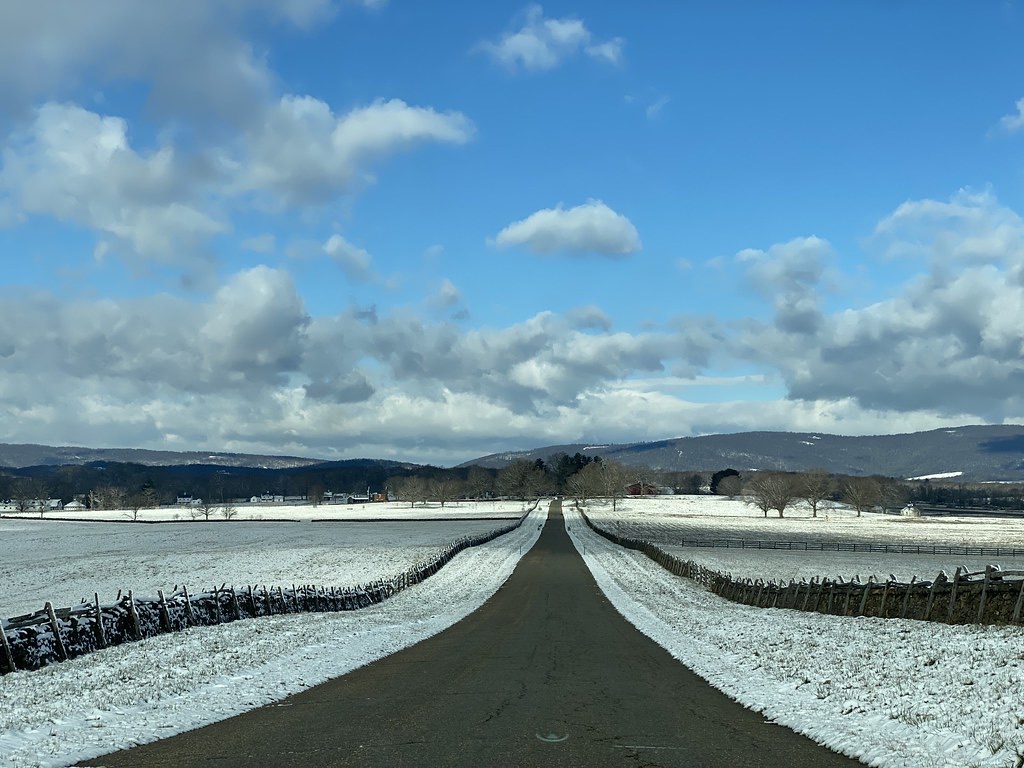
Snow in Virginia is unpredictable. The mountains of the southwest can see snow on the ground for weeks, while Virginia Beach may go several winters with barely a dusting and then be buried by a foot of it. Because big storms are uncommon in most of the state, they tend to paralyze it when they come, and they are remembered for generations.
Quick answer: Average yearly snowfall in Virginia ranges from more than 45 inches in the Appalachian Mountains to less than 10 inches on the Coastal Plain and in parts of Southside.[1] The state’s greatest 24-hour snowfall, 33 inches, and its greatest single-storm total, 42 inches, were both recorded at Big Meadows on the Blue Ridge during the Ash Wednesday Storm of March 1962. The deepest snow of the colonial era, about three feet, fell in January 1772 and was recorded by both George Washington and Thomas Jefferson.[2]
Contents
- Why snowfall varies so much
- How snow forms
- Sleet, freezing rain and the Blue Ridge wedge
- Where the storms come from
- The snowiest places in Virginia
- Historic storms
- Modern blizzards
- Clearing the roads
- Snow, water and a changing climate
- Timeline
- Frequently asked questions
Why snowfall varies so much
Three things decide how much snow a place in Virginia gets: elevation, distance from the ocean and latitude.
Air cools as it rises, by roughly 3 to 5°F for every thousand feet. A storm that brings cold rain to Richmond or Lynchburg can bring heavy snow to the ridges of the Blue Ridge and the Alleghenies at the same moment. Mountain slopes also squeeze moisture out of passing air as it is forced upward, so they get more precipitation overall.
The Atlantic Ocean and the Chesapeake Bay hold their warmth into winter, so the air over Hampton Roads and the Eastern Shore is usually a few degrees warmer than the air inland. Many coastal storms produce rain at the shore and snow fifty miles to the west. Northern Virginia, closer to the paths of storms that track up the coast and farther from the warm water, gets more snow than Southside.
How snow forms
Snow begins high in clouds where the air is below freezing. Pure water droplets can stay liquid well below 32°F; to freeze, they usually need a tiny particle to start the ice crystal. Dust, pollen and even certain bacteria can play that role. Once a crystal forms, it grows by drawing water vapor from the droplets around it.[3]
The shape of a snowflake depends on the temperature and humidity it meets. Some conditions produce flat plates and six-armed stars with branching arms (called dendrites), the classic snowflake shape. Others produce long needles or hollow columns. Because every crystal takes its own path through the cloud, rising and falling through different conditions, no two follow exactly the same history, and that is why no two snowflakes look exactly alike.[3]
Machine-made snow at Virginia’s ski areas is different. Snow guns spray water droplets into cold air, where they freeze into small, dense pellets rather than branching crystals. That snow is harder and more durable than natural powder, which is why resorts can build a long-lasting base with it.[4]
Sleet, freezing rain and the Blue Ridge wedge
Snow is only one kind of winter precipitation. What reaches the ground depends on the layers of air the flakes fall through:
- Snow falls when the air is below freezing all the way down.
- Sleet forms when snowflakes melt in a warm layer aloft and then refreeze into ice pellets in a deep cold layer near the ground.
- Freezing rain forms when the cold layer near the ground is too shallow for the drops to refreeze in the air. They land as liquid and freeze on contact, coating trees, power lines and roads with ice.
The Blue Ridge plays a special role in Virginia. Cold, dense air from the north often gets trapped against the eastern side of the mountains, a pattern meteorologists call cold-air damming or a “wedge.” When warmer, moist air from the south or the Gulf of Mexico rides up over the wedge, the Piedmont can get sleet and freezing rain for hours while the Shenandoah Valley, on the other side of the mountains, is above freezing. The depth of the cold air east of the mountains often decides whether Charlottesville and Northern Virginia get snow, sleet or ice.
Where the storms come from
Virginia’s biggest snowstorms are usually nor’easters: low-pressure systems that form near the Gulf Coast or off the Carolinas and move up the coast. Their counterclockwise winds pull moisture from the Atlantic and wrap it around into cold air on the storm’s western side. A storm that tracks just offshore can dump heavy snow on the Piedmont and Northern Virginia; a track a little closer to the coast brings rain to the east and snow only in the mountains. Fast “Alberta clippers” from western Canada bring lighter snow, mostly to the north and the mountains.
The snowiest places in Virginia
The snowiest parts of Virginia are its highest ridges and the Appalachian Plateau. Grayson County, home of Mount Rogers, is sometimes called the roof of Virginia, but places in the coalfields of the far southwest, such as Wise County, also average heavy snow because storms crossing the Ohio Valley hit those mountains first. NOAA’s snowfall extremes database lists the greatest one-, two- and three-day snowfalls recorded in every Virginia county; the highest totals cluster in the Blue Ridge counties of Madison, Page and Warren and in the northwestern part of the state, and the lowest along the coast.[5]
Big Meadows, at about 3,500 feet in Shenandoah National Park, holds the state’s two best-known snow records. During the Ash Wednesday Storm of March 1962, the nor’easter that flooded Chincoteague and Assateague and pushed the tide to nine feet at Norfolk, Big Meadows measured 33 inches of snow in 24 hours and 42 inches for the storm.[2]
Historic storms
The Washington and Jefferson Snow (January 1772). Long before official weather records, the most famous Virginia snowstorm was recorded in the diaries of two future presidents. Thomas Jefferson and his bride, Martha, set out from her family’s home in Charles City County for Monticello just as the storm hit, and finished the trip on horseback through deep snow; they spent their first night at Monticello in a small brick outbuilding. In his Garden Book Jefferson wrote that no one in Albemarle County had ever seen a deeper snow; it measured about three feet. At Mount Vernon, Washington noted a similar depth.[2][6]
The Great Blizzard of January 1857. More than a foot of snow fell with temperatures near zero. Richmond was cut off from Washington for a week, drifts in Norfolk were said to reach twenty feet, Virginia’s rivers froze, and the Chesapeake Bay was solid ice more than a mile from shore.[2] In central Virginia the storm was long remembered as “Cox’s Snow.”
The Great Arctic Outbreak of 1899. In February 1899 snow and extreme cold reached the coast. Quantico recorded −20°F, and a blizzard on Valentine’s Day piled drifts ten feet high around Washington.[2] Even Norfolk had more than a foot of snow that month.
The Knickerbocker Storm (January 27–28, 1922). Exactly 150 years after the Washington and Jefferson Snow, a storm dropped 19 inches on Richmond and 28 inches on Washington. The weight of the snow brought down the roof of Washington’s Knickerbocker Theater during a movie, killing nearly 100 people, and the disaster led to stricter building codes.[2]
The Ash Wednesday Storm (March 1962). Mostly remembered as a coastal disaster, it also set the state’s snow records in the mountains (see above).[2]
February 1983. A storm covered much of Virginia and Maryland with more than a foot of snow, setting 24-hour records of 14.6 inches at Lynchburg and 18.6 inches at Roanoke.[2]
The Superstorm of March 1993. The “Storm of the Century” stretched from Florida to New England, killing about 200 people. Its heaviest snow in Virginia fell in the western half of the state, along the mountains.[2]
Modern blizzards
The Blizzard of 1996 (January 6–8). This nor’easter buried the Mid-Atlantic and Northeast. Many Virginia locations received more than two feet, and the heaviest totals fell along the Blue Ridge. NOAA’s Northeast Snowfall Impact Scale ranks it the second most severe Northeast snowstorm on record, behind only the 1993 Superstorm. The deep snowpack stayed on the ground until a warm spell with heavy rain later in January melted it quickly, causing major river flooding.[7]
Snowmageddon (February 5–6, 2010). The first of two back-to-back blizzards in February 2010 brought 32.4 inches to Washington Dulles International Airport over two days, by far the airport’s biggest two-day total since its records began in 1963. Dulles received 45.7 inches in the first ten days of the month, making February 2010 its snowiest month on record, and much of Northern Virginia shut down for days.[2]
January 2016. A blizzard on January 22–23 dropped about two feet across much of Northern Virginia, only weeks after a record-warm December.[2]
January 2022. On January 3, 2022, snow and ice fell on Interstate 95 between Richmond and Washington. After a crash involving several tractor-trailers, hundreds of drivers were stranded overnight along about 50 miles of the highway near Fredericksburg in freezing temperatures. U.S. Senator Tim Kaine was among them; his trip from Richmond to the Capitol took 27 hours.[11]
January 2026. A storm on January 24, 2026, was followed by about two weeks of deep cold. Snow packed down into hard ice on sidewalks and side streets, and crews had trouble breaking it up; in places it lingered for weeks.
Clearing the roads
Virginia is unusual in how it handles roads. In most of the state, the Virginia Department of Transportation (VDOT) is responsible for all state-maintained roads in the counties, including neighborhood streets. Two counties, Arlington and Henrico, maintain their own roads, as do the independent cities and many towns.[9]
VDOT plows in order of priority: first the interstates and primary highways (routes numbered below 600), then major secondary roads, and finally neighborhood streets. Crews pre-treat roads with salt brine before storms, and use salt, sand and other materials during them. VDOT does not clear sidewalks or shared-use paths; local ordinances usually make property owners responsible for sidewalks.[9]
The cost of being ready for rare storms is a constant debate. In eastern and southern Virginia, a big snowstorm may come only once every few years, and buying enough trucks to clear every street quickly would mean paying for equipment that sits idle most winters. Coastal cities therefore concentrate their plows on main roads and emergency routes and accept that side streets may wait until the snow melts.
Snow, water and a changing climate
Snow matters for water supply. Because it melts slowly, a snowpack lets water soak into the ground instead of running off, recharging groundwater and the springs that feed Virginia’s streams (see groundwater in Virginia). A sudden thaw with rain, on the other hand, can cause floods, as in January 1996.
Virginia’s winters are warming. The state climate summary prepared for NOAA reports that Virginia’s average temperature has risen more than 1.5°F since 1900, and projects fewer intense cold waves.[1] A warmer climate generally means fewer days with snow on the ground and more winter precipitation falling as rain, especially in the east. At the same time, warmer air holds more moisture, so the storms that do come can still bring heavy snow.
NOAA rates the impact of major snowstorms with its Regional Snowfall Index, which combines snowfall amounts with the population affected.[8] By NOAA’s count, winter storms make up 19 of the 116 billion-dollar weather disasters that affected Virginia between 1980 and 2024.[10]
Timeline
| Date | Storm |
|---|---|
| January 1772 | Washington and Jefferson Snow, about three feet |
| January 1857 | Great Blizzard (“Cox’s Snow”); bay frozen near shore |
| February 1899 | Great Arctic Outbreak; −20°F at Quantico |
| January 1922 | Knickerbocker Storm; 19 inches at Richmond |
| March 1962 | Ash Wednesday Storm; state records at Big Meadows |
| February 1983 | Record 24-hour snow at Lynchburg and Roanoke |
| March 1993 | Superstorm (“Storm of the Century”) |
| January 1996 | Blizzard of 1996 |
| February 2010 | Snowmageddon |
| January 2016 | Blizzard of 2016 |
| January 2022 | Drivers stranded on I-95 |
| January 2026 | Snow followed by two weeks of ice |
Frequently asked questions
Where does it snow the most in Virginia? In the high mountains and the Appalachian Plateau of the southwest; the mountains average more than 45 inches a year.[1]
What is Virginia’s snowfall record? Big Meadows recorded 33 inches in 24 hours and 42 inches in one storm in March 1962.[2]
Does it snow in Virginia Beach? Yes, but not often; the Coastal Plain averages less than 10 inches a year.[1]
Who plows the roads in Virginia? VDOT, for state roads in most counties; Arlington and Henrico counties and the independent cities maintain their own roads.[9]
Why does Northern Virginia get so much sleet and freezing rain? Cold air trapped east of the Blue Ridge sits under warmer air moving in from the south, so precipitation melts aloft and refreezes near the ground.
See also: climate of Virginia, hurricanes and nor’easters, the Blue Ridge.
References
- NOAA National Centers for Environmental Information and NCICS, “State Climate Summaries: Virginia.” https://statesummaries.ncics.org/chapter/va/
- National Weather Service Baltimore/Washington, “Washington’s Historic Winter Storms and Cold Waves.” https://www.weather.gov/lwx/winter_DC-Winters
- The Conversation, “How is snow made? An atmospheric scientist describes the journey of frozen ice crystals from clouds to the ground,” February 26, 2024. https://theconversation.com/how-is-snow-made-an-atmospheric-scientist-describes-the-journey-of-frozen-ice-crystals-from-clouds-to-the-ground-222851
- The Conversation, “What Olympic athletes see that viewers don’t: Machine-made snow makes ski racing faster and riskier – and it’s everywhere,” February 5, 2026. https://theconversation.com/what-olympic-athletes-see-that-viewers-dont-machine-made-snow-makes-ski-racing-faster-and-riskier-and-its-everywhere-274806
- NOAA National Centers for Environmental Information, “Snowfall Extremes: Virginia.” https://www.ncdc.noaa.gov/snow-and-ice/snowfall-extremes/VA/3
- Massachusetts Historical Society, Thomas Jefferson Papers, “Garden Book, page 8.” https://www.masshist.org/thomasjeffersonpapers/doc?id=garden_8&archive=garden&query=snow&tag=text&num=10&rec=7&numRecs=11#firstmatch
- NOAA National Weather Service Heritage, “The Blizzard of ’96: In Retrospect 25 Years Later.” https://vlab.noaa.gov/web/nws-heritage/-/the-blizzard-of-96-in-retrospect-25-years-later
- NOAA National Centers for Environmental Information, “Regional Snowfall Index (RSI).” https://www.ncei.noaa.gov/access/monitoring/rsi/
- Virginia Department of Transportation, “Don’t get complacent: With more wintry weather on the way and refreeze possible, stay off roads and use caution,” January 6, 2025. https://www.vdot.virginia.gov/news-events/news/statewide/dont-get-complacent-with-more-wintry-weather-on-the-way-and-refreeze-possible-stay-off-roads-and-use-caution-.php
- NOAA National Centers for Environmental Information, “Billion-Dollar Weather and Climate Disasters: Virginia Summary.” https://www.ncei.noaa.gov/access/billions/state-summary/VA
- PBS NewsHour (Associated Press), “Virginia drivers snowed in all night as major highway shuts down,” January 4, 2022. https://www.pbs.org/newshour/nation/virginia-drivers-snowed-in-all-night-as-major-highway-shuts-down