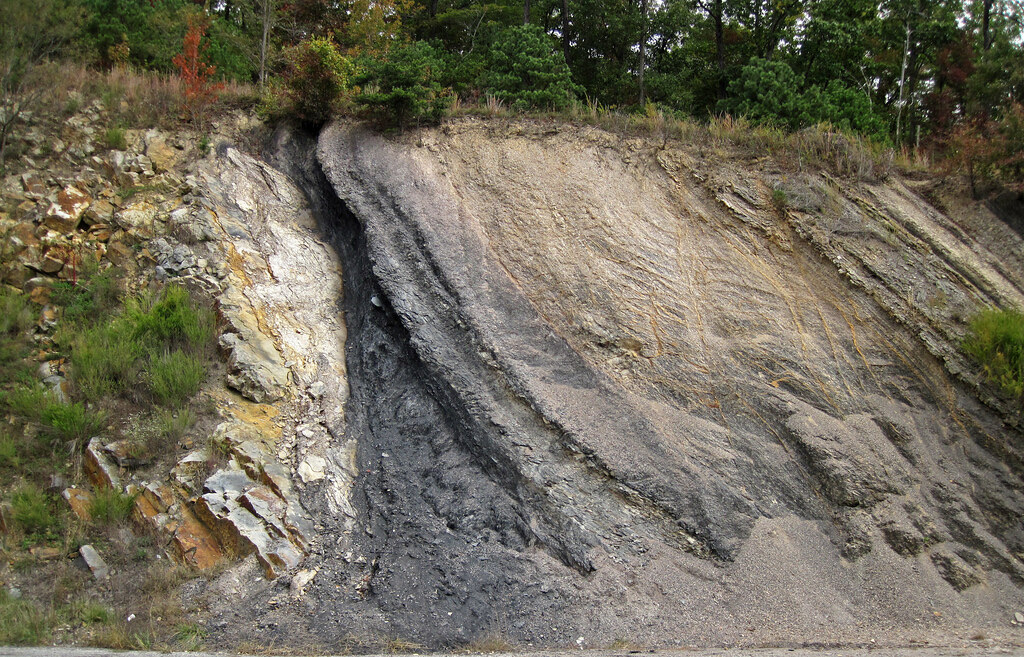
In the coalfields of Southwest Virginia, the person who owns a farm does not always own what lies beneath it. The coal may belong to a land company, the natural gas to someone else, and the gas trapped in the coal seams to a third party. Lawyers call this a split estate.
Quick answer: In Virginia, land ownership can be divided into separate surface and mineral estates. Coal, oil, gas and coalbed methane can each be sold or leased apart from the surface. Under the Virginia Gas and Oil Act, the state Gas and Oil Board can “pool” all owners in a drilling unit once an operator controls at least 25 percent of its acreage, and money owed to owners with conflicting claims goes into escrow until a court, an arbitrator or an agreement settles who is entitled to it. Since 2010 the law says that a sale of coal does not include coalbed methane.[1][2][3]
Contents
- Property as a bundle of rights
- How the surface and the minerals were split
- Leases, landmen and royalties
- The rule of capture and why it fails for gas
- Drilling units and forced pooling in Virginia
- Coalbed methane: coal or gas?
- The escrow scandal and the Pulitzer Prize
- Lawsuits over unpaid royalties
- Mining, the surface and reclamation
- Storage rights and the space underground
- Checklist for owners of land with a split estate
- Frequently asked questions
Property as a bundle of rights
American property law often describes ownership as a bundle of sticks. Each stick is one right: to live on the land, to farm it, to cut its timber, to build on it, to keep others out, to dig under it, to sell it. An owner can hand some sticks to other people while keeping the rest.
Everyday examples are common in Virginia:
- A tenant who rents a house or apartment holds the right to occupy it for the term of the lease, while the landlord keeps ownership.
- A timber company can buy the right to cut trees on a forest tract without buying the land itself.
- A farmer can lease cropland for several years, with enough security to invest in lime and fertilizer.
- A utility usually holds an easement, a permanent right to run power or water lines across private lots.
Mineral rights are simply some of the most valuable sticks in the bundle.
How the surface and the minerals were split
When colonial Virginia patented land, the owner received everything: surface, timber, water and whatever lay underground. The surface and the minerals were one estate.
That changed when coal became valuable. From the late 1800s, as railroads reached the coalfields of the Appalachian Plateau, land agents and coal companies bought mineral rights from mountain families, often by deeds that sold the coal and the right to remove it while leaving the family on the surface. Many of those deeds were written long before anyone imagined modern gas wells or strip mining, and their wording is still argued over in court.
Once separated, each mineral can be divided again. One company may own the coal, another the oil and gas, and the surface owner may still hold timber and farming rights. In Buchanan, Dickenson, Wise, Russell and Tazewell counties, a single tract can carry a long chain of separate deeds for different layers.
Leases, landmen and royalties
Before an energy company spends money on exploration, it needs control of the minerals. Its agents, called landmen, search courthouse records to find who owns each interest and then negotiate leases.
A typical oil and gas lease includes:
- a signing bonus, paid when the lease is signed;
- a primary term, a set number of years in which the company may drill;
- a royalty, a share of the value of production, traditionally one-eighth (12.5 percent) in older leases;
- terms on surface use: roads, well pads, pipelines and compensation for damage.
Many leases are never drilled. The owner keeps the bonus, the lease expires at the end of its term, and the rights return to the owner, who can lease them again. If a well starts producing during the term, the lease usually continues as long as production lasts.
Prices vary widely. Owners next door to each other can sign very different deals depending on the geology under their land, the company’s interest and how hard each owner bargains.
The rule of capture and why it fails for gas
Oil and gas collect in rock formations that pay no attention to property lines. Under the old common-law rule of capture, whoever brought oil or gas to the surface owned it, even if it had flowed from under a neighbor’s land. The neighbor’s only remedy was to drill a well of his own.
That rule encouraged waste. Every owner raced to drill, wells were packed too close together, and more roads, pads and pipelines were built than the field needed. Engineers preferred to space wells by the shape of the reservoir, so that fewer wells could drain it efficiently, and to share the income among all owners above it.
Drilling units and forced pooling in Virginia
Virginia’s answer is the Virginia Gas and Oil Act (now Chapter 16 of Title 45.2 of the Code of Virginia), first passed in 1990, and the Virginia Gas and Oil Board, which applies it.[4]
The board sets drilling units, the area that one well is expected to drain, and decides how far apart wells must be. If some owners in a unit will not sign leases, the board can issue a pooling order that combines all interests in the unit. The operator applying for the order must have the right to operate, or the written consent of owners with that right, on at least 25 percent of the unit’s acreage.[1]
The pooling order:
- fixes each owner’s share of production by the share of the unit’s acreage he or she owns;
- lets each unleased owner choose to become a participating operator, paying a share of drilling costs and taking a share of the profit or loss, or to be carried or deemed to lease on terms the board sets;
- keeps royalties separate from operating costs, so that a royalty owner is not charged for running the well.[1]
The board can pool the gas, but pooling does not hand the operator the right to put a well pad on any particular owner’s land. Where a surface owner objects, wells can be placed on another tract in the unit, and modern directional drilling can reach the gas from a distance.
Coalbed methane: coal or gas?
Coal seams hold large amounts of methane. Miners have always treated it as a danger, because it can explode, and coal operators vent it for safety. From the late 1980s companies began drilling wells to produce this coalbed methane (CBM) as natural gas, and Southwest Virginia became an important CBM producing region.
That raised a new question. If a family sold “the coal” in 1890, did they also sell the gas inside it? Coal owners said yes; surface owners said no. While the question was open, the Gas and Oil Act let wells go forward and required the operator to pay the money for each disputed interest into an escrow account held for the claimants. The board can release escrowed money only after a final court decision on ownership, an arbitrator’s decision, or an agreement among all claimants.[2]
In 2004, in Harrison-Wyatt, LLC v. Ratliff, the Supreme Court of Virginia ruled for the surface owners in a dispute over escrowed CBM royalties: a deed conveying the coal had not conveyed the coalbed methane.[5] In 2010 the General Assembly put the principle into the Code: no conveyance, reservation or exception of coal is deemed to include coalbed methane gas, although coal operators may still vent the gas for safety. The rule does not reopen settlements, judgments or orders made before April 13, 2010.[3]
The escrow scandal and the Pulitzer Prize
By the late 2000s the escrow accounts held tens of millions of dollars, and many owners did not know they were owed anything. In 2009 the Bristol Herald Courier published a series by reporter Daniel Gilbert showing how the state had mismanaged the royalties and how hard it was for owners to collect. The paper, one of the smallest ever to do so, won the 2010 Pulitzer Prize for Public Service.[6]
The series led to action. A November 2010 state review of the Virginia Gas and Oil Board examined how it managed the escrow accounts and recommended collecting deposit details from gas companies, setting time limits for deposits and testing account balances, and the General Assembly passed the 2010 law on coalbed methane ownership described above, signed that spring.[7][3]
Lawsuits over unpaid royalties
Many owners believed they were owed more than had been paid into escrow, and the two largest CBM producers in the region, CNX Gas and EQT Production, faced lawsuits. Because one owner’s claim might be worth only a few thousand dollars, plaintiffs tried to sue together in federal court as class actions.
A federal district court in the Western District of Virginia certified five classes, but on August 19, 2014, the U.S. Court of Appeals for the Fourth Circuit vacated those certifications in EQT Production Co. v. Adair and sent the cases back, holding that the lower court had not examined closely enough whether the classes could be identified and whether ownership questions were common to all members.[8] The cases continued in the district court after that ruling.
Mining, the surface and reclamation
Split estates matter for coal mining as much as for gas. A coal owner’s deed often includes the right to use the surface as needed to remove the coal, which once allowed deep cuts, waste piles and polluted streams with little compensation.
Since the federal Surface Mining Control and Reclamation Act, enacted on August 3, 1977, coal mines must be permitted and the land reclaimed after mining, and a federal fund pays to clean up older abandoned mine lands.[9] Old refuse piles, called “gob” piles, from mines that closed before 1977 can still be seen in parts of the coalfields, some of them eroding into streams of the Clinch, Powell and Big Sandy watersheds.
Storage rights and the space underground
Mineral estates are not only about taking things out. Pipeline companies store natural gas underground for the winter, in depleted gas fields or in caverns dissolved in salt beds, because it is cheaper than building tanks on the surface. To do so they need storage rights from the owners above.
That raises another split estate question: if someone owns the salt and mines it out, who owns the empty space left behind? Courts in other states have generally said that selling a mineral does not automatically sell the cavity it leaves, a question that has become more important as companies look at storing carbon dioxide underground. Virginia’s own salt deposits around Saltville, on the line between Smyth and Washington counties, were worked from colonial times into the twentieth century.
Checklist for owners of land with a split estate
- Check the title. A title search at the county courthouse shows whether earlier owners sold or reserved coal, oil, gas or other minerals.
- Read old deeds closely. Words like “all coal,” “minerals” and “the right to mine” can mean different things in different deeds and years.
- Know the board. Pooling orders and escrow records are public. The Virginia Gas and Oil Board’s dockets list the units and the owners named in each order.
- Ask about escrow. If a well near you produces coalbed methane and ownership was disputed, money may be waiting in escrow.
- Get advice. Leases and pooling elections are legal contracts; an attorney experienced in Virginia mineral law can explain choices before you sign.
This page is general information, not legal advice.
Frequently asked questions
What is a split estate? Land where the surface belongs to one owner and some or all of the minerals underneath belong to someone else.
Can I be forced to lease my gas in Virginia? The Virginia Gas and Oil Board can pool your interest into a drilling unit if the operator controls at least 25 percent of the unit’s acreage. You can then choose to participate in the well or accept the terms the board sets.
Does owning the coal mean owning coalbed methane? Not in Virginia. The Supreme Court of Virginia ruled for surface owners in 2004, and since 2010 the Code says that a conveyance of coal does not include coalbed methane gas.
What is the escrow account? An account set up under board orders where operators deposit money owed for gas interests whose ownership is disputed, until the dispute is settled.
Who won the Pulitzer for reporting on gas royalties? The Bristol Herald Courier, for reporting by Daniel Gilbert, received the 2010 Pulitzer Prize for Public Service.
References
- [1] Code of Virginia, § 45.2-1620, Pooling of interests in drilling units – last checked 11/20/2026
- [2] Code of Virginia, § 45.2-1622, Pooling of interests in coalbed methane gas drilling units; conflicting claims – last checked 11/20/2026
- [3] Code of Virginia, § 45.2-1621, Coalbed methane gas; ownership – last checked 11/20/2026
- [4] Code of Virginia, § 45.2-1601, Virginia Gas and Oil Act, definitions – last checked 11/20/2026
- [5] Washington and Lee University School of Law, Scholarly Commons, Harrison-Wyatt, LLC v. Ratliff (Virginia Supreme Court records, vol. 267) – last checked 11/20/2026
- [6] University of Chicago News, Daniel Gilbert wins Pulitzer for public service journalism (April 12, 2010) – last checked 11/20/2026
- [7] Virginia General Assembly, Review of the Virginia Gas and Oil Board, November 2010 (RD376) – last checked 11/20/2026
- [8] McGuireWoods, Fourth Circuit Vacates Gas Royalties Class Certification (August 20, 2014) – last checked 11/20/2026
- [9] Office of Surface Mining Reclamation and Enforcement, Laws and Regulations (SMCRA, enacted August 3, 1977) – last checked 11/20/2026