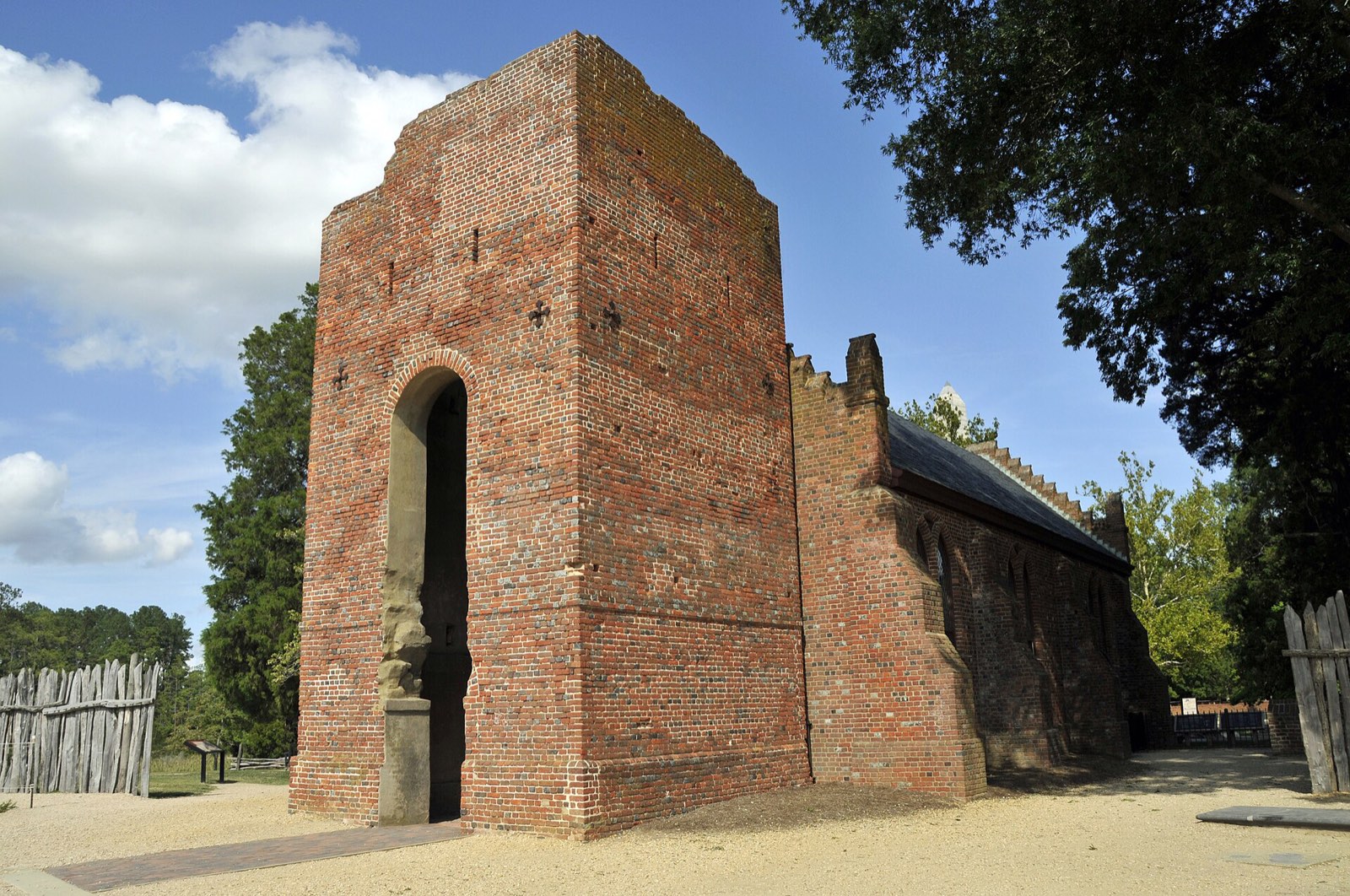
Virginia Colony religion was organized around one established church. The Church of England was supported by law and by taxes until after the Revolution.
Quick answer: The official Virginia Colony religion was the Church of England. Colonists were required to attend its services and to pay a parish levy that supported the minister and the poor. Each parish was run by a vestry of twelve men. The system ended after disestablishment in 1784 and the Virginia Statute for Establishing Religious Freedom of 1786.
Contents
- An Established Church
- Parishes and Vestries
- Church Taxes
- Dissenters
- The End of the Established Church
- Frequently asked questions
An Established Church
Because the Church of England was the established church, colonists were legally required to attend its services and to support its ministers through taxes.[1]
Parishes and Vestries
The parish was a unit of both civil and religious authority. Each parish had one minister, a main church and often two or more chapels of ease (smaller churches in outlying areas) that the minister served on successive Sundays.[2]
A vestry governed each parish. The General Assembly gave vestries the power to choose their ministers in 1642-1643, and in 1662-1663 it set the number of vestrymen at twelve.[2] Many vestries hired ministers on yearly terms instead of for life.[2]
Vestries also had civil duties:
- relief for the poor of the parish;
- “processioning” (walking and marking) property boundaries every four years;
- reporting moral offenders to the county courts through the churchwardens;
- appointing tobacco viewers and, until the 1730s, overseeing roads and ferries.[2]
Church Taxes
An act of 1643 required parishioners to pay the minister ten pounds of tobacco and a bushel of corn for each tithable person.[3] The annual parish levy was often the largest tax colonists paid, and poor relief often took more than 25 to 30 percent of a parish budget.[2]
Dissenters
In the 1600s only members of the Church of England could vote. Quakers gained the vote after the Toleration Act of 1689, and by the 1750s other dissenters voted without official approval.[4]
The End of the Established Church
The Church of England in Virginia was disestablished in 1784, and county overseers of the poor took over the civil work of the vestries.[2]
Thomas Jefferson drafted the Virginia Statute for Establishing Religious Freedom in 1777. James Madison reintroduced it on October 31, 1785, and the General Assembly adopted it on January 16, 1786. The statute ended compelled worship and religious taxes and separated church and state.[5]
Frequently asked questions
What was the religion of the Virginia Colony? The Church of England, which was the established church supported by law and taxes.
Did colonists have to go to church in Virginia? Yes. Attendance at Church of England services was required by law.
What did a vestry do? It ran the parish, hired the minister, cared for the poor and marked property boundaries.
When did Virginia end its established church? The church was disestablished in 1784, and the Statute for Religious Freedom passed on January 16, 1786.
References
- [1] Encyclopedia Virginia (Virginia Humanities), Church of England in Virginia – last checked 11/08/2026
- [2] Encyclopedia Virginia, Edward L. Bond, The Parish in Colonial Virginia – last checked 11/08/2026
- [3] Encyclopedia Virginia, Parishes and Tithes (1643) – last checked 11/08/2026
- [4] Encyclopedia Virginia, John G. Kolp, Elections in Colonial Virginia – last checked 11/08/2026
- [5] Encyclopedia Virginia, John A. Ragosta, Virginia Statute for Establishing Religious Freedom (1786) – last checked 11/08/2026
The government of the colony is described in Virginia Colony Government.