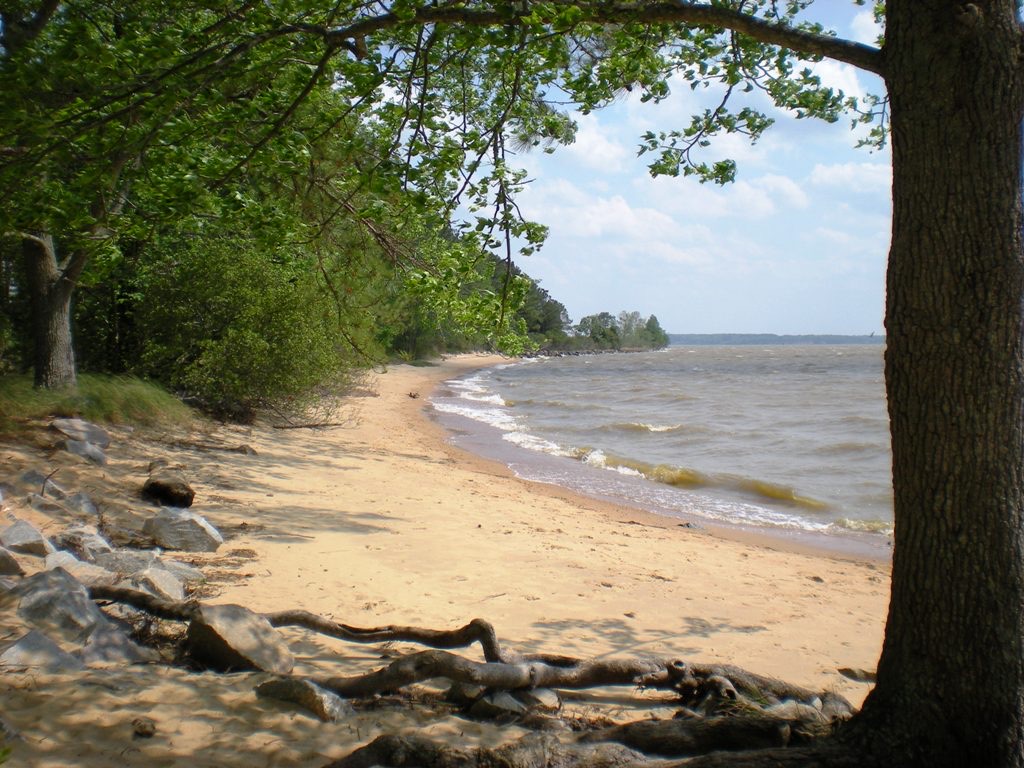
For almost forty years after Jamestown was founded, the English colony and the Powhatan paramount chiefdom fought over who would control Tidewater Virginia. Historians count three wars, separated by uneasy truces. They began with raids and burned cornfields, included two of the most devastating surprise attacks in colonial American history, and ended with the old chiefdom broken and its people confined to small tracts north of the York River.
Quick answer: The First Anglo-Powhatan War (1609–1614) followed years of tension over food and land and ended with the marriage of Pocahontas and John Rolfe. The Second (1622–1632) began when Opechancanough’s warriors struck at least 31 settlements on March 22, 1622, killing 347 colonists, about a quarter of the colony; the English answered with yearly raids and built a palisade across the Peninsula. The Third (1644–1646) began with another coordinated attack on April 18, 1644, and ended when Opechancanough was captured and killed and his successor Necotowance signed the Treaty of 1646.[1][2][3]
Contents
- Tsenacommacah and the English claim
- Trouble from the first day
- The First Anglo-Powhatan War, 1609–1614
- The Peace of Pocahontas
- Opechancanough’s choice
- March 22, 1622
- The Second War, 1622–1632
- The palisade across the Peninsula
- The Third War, 1644–1646
- The Treaty of 1646
- Timeline
- Frequently asked questions
Tsenacommacah and the English claim
The Powhatan homeland, Tsenacommacah, covered the coastal plain from the south side of the James River to the Potomac and parts of the Eastern Shore. Powhatan led more than 30 tribes there, each with its own chief, all paying him tribute.[1]
To the English, the same land lay inside the territory granted to the Virginia Company by King James’s charter of 1606. The company’s backers hoped for profits, a route toward the Pacific and converts to Christianity; the people already living there were expected to adapt. Neither side’s idea of the land left room for the other’s.
Trouble from the first day
The colonists chose Jamestown Island, in the territory of the Paspahegh, without permission. Misunderstandings and suspicion led to fights within weeks. In 2004 archaeologists found a grave inside the 1607 fort holding a teenage boy with a quartzite arrow point beside his thigh, probably one of the first colonists to die in that fighting.[4]
Powhatan’s first strategy was to manage the English. After John Smith’s capture and release in the winter of 1607–1608, Powhatan sent food, and he invited the colonists to move to one of his towns, Capahosick, where they could make metal tools for him.[2] The English, for their part, wanted corn on their own terms and ignored Powhatan’s authority. When Christopher Newport staged a “coronation” of Powhatan as a vassal of King James in 1608, Powhatan accepted the gifts but refused to kneel, and in return gave Newport an old pair of shoes and a mantle.[5]
The First Anglo-Powhatan War, 1609–1614
By the spring of 1609 the Paspahegh were again raiding the fort. That year more colonists arrived, Smith left after a gunpowder accident, and Powhatan moved his capital inland to Orapaks. In November 1609 Powhatan’s men ambushed Captain John Ratcliffe and 32 other colonists who had come to trade for corn, and the English, cut off from food, starved through the winter.[2][1]
When Lord De La Warr arrived as governor in 1610, he turned to open war. His men drove the Kecoughtan from their town at the mouth of the James in July and, in August 1610, burned the main Paspahegh town and its cornfields, killing many people; they also killed the chief’s children. Over the next years Governor Thomas Dale built forts at the falls and seized the Appomattoc town at the mouth of the Appomattox River. The aging Powhatan made no major counterattack, and real power seemed to be passing to his brother Opechancanough.[2]
By 1614 the Powhatan had lost much of their riverfront along the James. The Kecoughtan and Paspahegh were effectively destroyed, and the Arrohattoc and Quiockohannock disappear from the records.[2]
The Peace of Pocahontas
In 1613 Captain Samuel Argall kidnapped Pocahontas on the Potomac to force Powhatan to return English prisoners and weapons. In March 1614 Dale took her and a strong force up the Pamunkey; after fighting near present-day West Point, the two sides agreed to peace, sealed in April by her marriage to John Rolfe.[2] The “Peace of Pocahontas” lasted while she and her father lived. She died in England in 1617, and Powhatan died in 1618.[1] Her life is told in Pocahontas.
Opechancanough’s choice
Leadership passed briefly to Powhatan’s brother Opitchapam and then to Opechancanough.[1] Meanwhile tobacco, first grown for export by Rolfe, turned the colony into a scramble for land. New “hundreds” and plantations spread along the James, taking Native fields and fishing places. The Virginia Company also pushed to convert and absorb the Powhatan, including plans for a college at Henricus.[6]
Opechancanough appeared friendly, even meeting with a minister as if considering conversion.[2] In fact he was planning a blow that would show the English that the Powhatan could not be absorbed or pushed aside.
March 22, 1622
On the morning of March 22, 1622, Powhatan warriors already present in many English homes and fields struck at least 31 settlements and plantations, mostly along the James and as far upriver as Henricus. They killed 347 colonists, roughly a quarter of the colony.[6] The settlers then abandoned Henricus and its planned college, the Falling Creek ironworks and Smith’s Hundred.[6]
Jamestown itself was warned in time, by tradition by a Christian Indian boy. Legend calls him “Chanco,” but that name may be wrong; a letter of April 1623 mentions an Indian named “Chauco.”[6][1]
After the attack, the Powhatan withdrew, expecting the English to give up and leave, as was their way after such a blow.[1] The English did the opposite. The disaster ruined the Virginia Company, which had failed both to make a profit and to protect its settlers; in May 1624 the company lost its charter and King James I made Virginia a crown colony.[6]
The Second War, 1622–1632
English military practice called for revenge. Almost every summer for ten years, colonial militia marched against Powhatan towns, burning houses and, above all, destroying corn so that the Powhatan would face hunger in winter. In 1624 about 800 Powhatan bowmen under Opitchapam faced only 60 colonists in a two-day battle; the English destroyed the cornfields and the bowmen withdrew.[2]
There was treachery on both sides. On May 22, 1623, at a peace meeting on the Potomac, Captain William Tucker’s party offered toasts with wine poisoned by the physician John Pott; about 200 Powhatans died, and the English attacked the rest.[6] A truce was declared in 1628, fighting resumed in 1629, and a final peace was made in 1632.[2]
The palisade across the Peninsula
The English also built a wall. After 1622 colonists settled at Chiskiack on the York, and leaders planned a barrier to keep Native people out of the lower Peninsula between the James and York rivers. By 1634 a palisade about six miles long ran across the Peninsula near the site of later Williamsburg, from creek to creek. Captain Thomas Yonge wrote that it gave the lower part of Virginia a range for cattle nearly forty miles long.[2] The land below it became the core of English settlement.
The Third War, 1644–1646
Twelve years later, Opechancanough, by then very old, launched one more coordinated attack on April 18, 1644. Again roughly 350 to 400 colonists were killed, but the colony now numbered about 8,000, so the loss, though terrible, could not threaten its survival.[1][3]
The English built frontier forts in 1645–1646: Fort Charles at the falls of the James, Fort James on the Chickahominy, Fort Royal at the falls of the York and Fort Henry at the falls of the Appomattox, where Petersburg later grew. In 1646 Governor William Berkeley’s men captured Opechancanough near his town on the Pamunkey. He was paraded through Jamestown and, while a prisoner, shot in the back by an English guard against orders. He was believed to be between 90 and 100 years old.[2][3]
The Treaty of 1646
In October 1646 the General Assembly made peace with Necotowance, Opechancanough’s successor. The Powhatan tribes became tributaries of the English king and agreed to pay a yearly tribute to the governor: 20 beaver skins “att the goeing away of Geese.”[7] The treaty drew a line between Native and English land, generally north of the York River for the tribes, and forbade members of either group to cross it without permission.[2]
The paramount chiefdom did not survive. After Necotowance, the Pamunkey leader Totopotomoi was a chief of his own people rather than of a confederacy, and he died fighting alongside the English at the Battle of Bloody Run in 1656. Treaties of 1646 and 1677 set up the reservations that the Pamunkey and Mattaponi still hold, and both tribes still present tribute to the governor every year.[1][8] The land story continues in Virginia Indian Reservations and Land Claims.
Timeline
| Date | Event |
|---|---|
| May 1607 | Jamestown founded in Paspahegh territory[3] |
| Winter 1607–1608 | John Smith captured and released[1] |
| November 1609 | Ratcliffe and 32 colonists killed; the “Starving Time” follows[2] |
| August 1610 | English destroy the main Paspahegh town[2] |
| 1613 | Pocahontas kidnapped[1] |
| April 1614 | Pocahontas marries John Rolfe; peace[2] |
| 1618 | Death of Powhatan[1] |
| March 22, 1622 | Coordinated attack kills 347 colonists[6] |
| 1624 | Two-day battle with 800 Powhatan bowmen[2] |
| 1632 | Peace ends the second war[2] |
| 1634 | Palisade across the Peninsula completed[2] |
| April 18, 1644 | Opechancanough’s second great attack[3] |
| 1646 | Opechancanough killed; Treaty of 1646 with Necotowance[2] |
Frequently asked questions
How many Anglo-Powhatan Wars were there? Three: 1609–1614, 1622–1632 and 1644–1646.
What happened on March 22, 1622? Powhatan warriors attacked at least 31 English settlements in a single day, killing 347 colonists, about a quarter of the colony.
Who was Opechancanough? Powhatan’s brother, who led the chiefdom from about 1618 and organized the attacks of 1622 and 1644. He was captured and killed in 1646.
How did the wars end? With the Treaty of 1646, which made the Powhatan tribes tributaries of the English Crown and set a boundary between their lands and the colony.
References
- National Park Service, Historic Jamestowne, “Chronology of Powhatan Indian Activity.” https://www.nps.gov/jame/learn/historyculture/chronology-of-powhatan-indian-activity.htm
- “Anglo-Powhatan Wars,” Wikipedia. https://en.wikipedia.org/wiki/Anglo-Powhatan_Wars
- National Park Service, Historic Jamestowne, “A Short History of Jamestown.” https://www.nps.gov/jame/learn/historyculture/a-short-history-of-jamestown.htm
- Historic Jamestowne, “Young Male Settler.” https://historicjamestowne.org/archaeology/young-male-settler/
- John Smith, The Generall Historie of Virginia, New-England, and the Summer Isles (Documenting the American South). https://docsouth.unc.edu/southlit/smith/smith.html
- “Indian massacre of 1622,” Wikipedia. https://en.wikipedia.org/wiki/Indian_massacre_of_1622
- Library of Virginia, “Still Here: Virginia’s Native Peoples Since 1607” (exhibition). https://lva.virginia.gov/exhibits/mandm/stillhere.asp
- “Mattaponi,” Wikipedia. https://en.wikipedia.org/wiki/Mattaponi