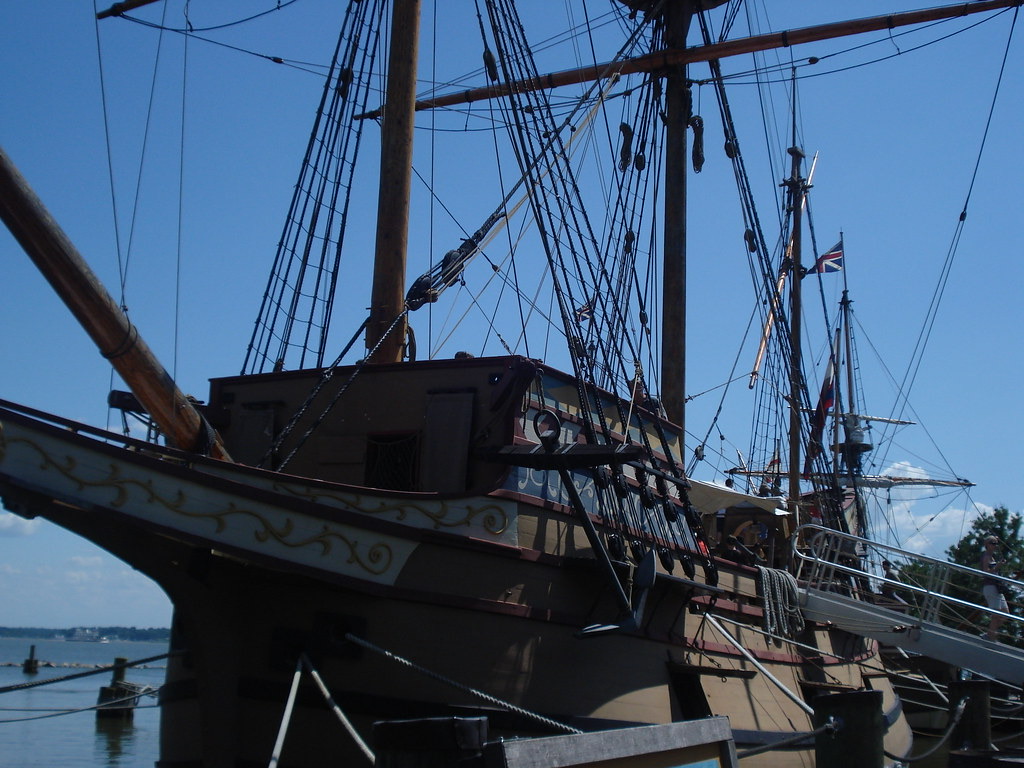
The meeting of Native Virginians and Europeans did not begin with three English ships in 1607. For nearly a century before Jamestown, Spanish, French and English vessels had been sailing along the coast, trading, kidnapping and occasionally settling. By the time the English built their fort on the James, the Powhatan already knew a good deal about Europeans, and some had good reason to distrust them.
Quick answer: The contact period in Virginia ran from the first Spanish voyages along the coast in the early 1500s until the Powhatan paramount chiefdom was broken after 1646. Spanish Jesuits founded the short-lived Ajacán mission in 1570, guided by a Native man baptized Don Luis, who turned against them. English colonists at Roanoke in the 1580s met Algonquian peoples farther south. When 104 English men and boys landed at Jamestown in 1607, they entered the land of Powhatan’s chiefdom of more than 30 tribes. Trade, epidemics and the spread of tobacco farms transformed Native life within a generation.[1][2][3]
Contents
- Virginia in the 1500s
- The Spanish on the Chesapeake
- Don Luis and the Ajacán mission
- Roanoke, Manteo and Wanchese
- Jamestown: the first weeks
- Powhatan’s strategy
- Trade goods and what they changed
- Disease
- Namontack: a Powhatan in London
- Why didn’t Native Americans sail east first?
- After contact: losing the land
- Timeline
- Frequently asked questions
Virginia in the 1500s
On the eve of contact, Native Virginians lived in three broad language groups: Algonquian speakers on the coastal plain, Siouan speakers in the Piedmont and Iroquoian speakers to the south (see Native American Tribes and Languages of Virginia). Coastal towns combined farming of corn, beans and squash with fishing, hunting and gathering through the seasons. Men hunted, fished and fought; women farmed, built the houses and processed food and hides. Towns were linked by trade routes that brought copper from the interior and shell beads from the coast.
How many people lived in Virginia then is uncertain. The National Park Service notes that Powhatan’s chiefdom alone included more than 30 tribes in 1607, and Historic Jamestowne estimates nearly 15,000 people across roughly 8,000 square miles of Tidewater.[1][4]
The Spanish on the Chesapeake
Spanish explorers looking for a passage to Asia were the first Europeans known to have seen the mouth of the Chesapeake Bay, which they called the Bahía de Santa María or Bahía de Madre de Dios. They called the land around it Ajacán. Spain founded St. Augustine in Florida in 1565 and soon pushed missions north along the coast.[2]
Don Luis and the Ajacán mission
In 1561 a Spanish expedition carried a Native boy from the Chesapeake region to Mexico. He was baptized Don Luis, after the viceroy of New Spain, and later taken to Spain. Nearly a decade later he returned as a guide for Jesuit missionaries under Father Juan Bautista de Segura, who wanted to found a mission without soldiers. The party landed on September 10, 1570, probably on the York River side of the Peninsula, and built a small hut where Mass could be said.[2]
Don Luis soon left the Jesuits to live with his own people. Around February 1571 he and other warriors killed the missionaries; only a Spanish boy named Alonso survived. In 1572 a Spanish relief ship rescued Alonso and took revenge by killing a number of Native people.[2] Some historians have suggested that Don Luis was Opechancanough, Powhatan’s brother and later the leader of the 1622 and 1644 attacks; others think he was a relative. The idea cannot be proved, but it shows how long memories of European behavior may have lasted.[5]
Roanoke, Manteo and Wanchese
The English came next, farther south. In 1584 an expedition sent by Sir Walter Raleigh reached Roanoke Island in what is now North Carolina. Two Native men, Manteo, a Croatan, and Wanchese, sailed back with the English and arrived in England in September 1584. Manteo worked closely with the scientist Thomas Harriot, who learned the Carolina Algonquian language from him; Wanchese came to see himself as a captive and turned against the English. Both returned in 1585 with the expedition that founded the Roanoke colony.[6] The colony failed, but the language, maps and drawings it produced shaped what the English expected in Virginia.
Jamestown: the first weeks
In 1607, 104 English men and boys arrived to start a settlement for the Virginia Company.[3] The site they chose, Jamestown Island, lay in the territory of the Paspahegh, who neither invited them nor wanted them to stay.
Archaeology has made those first weeks real. In 2004 Jamestown Rediscovery excavated a grave inside the fort’s palisade dating to 1607. It held a teenage boy, tall for his time, with a small triangular quartzite arrow point beside his left thigh. He may be Richard Mutton, one of four boys on the first ships, and one of the colony’s first casualties of fighting with the Paspahegh.[7]
Powhatan’s strategy
Powhatan did not try to destroy the newcomers at once. He seems to have hoped to use them: their metal tools, copper and guns could strengthen his position against rivals such as the Monacan. In the winter of 1607–1608 his brother Opechancanough captured John Smith and brought him to Werowocomoco, where the two leaders reached an understanding of sorts. Afterward Powhatan sent food to the starving fort, often with his young daughter Pocahontas.[1] For her story, see Pocahontas.
Relations swung between trade and violence. When the English demanded corn the Powhatan could not spare, or seized it, fighting followed. By 1609 Powhatan had moved his capital inland from Werowocomoco to Orapaks, farther from English ships.[1] The wars that followed are covered in The Anglo-Powhatan Wars.
Trade goods and what they changed
European goods traveled faster than Europeans. Copper, glass beads, iron hatchets, knives and kettles moved inland along Native trade routes, sometimes reaching towns that had never seen a ship. Along the Rappahannock, archaeologists working with the Rappahannock Tribe have found caches of European glass beads at the old town site of Leedstown, similar to beads found at Native sites up and down the coast.[8]
Copper had special value as a sign of status, and the English flooded the market with it. Control of the trade was itself a source of power, which is one reason Powhatan wanted the English close but contained.
Disease
The deadliest European import was invisible. Smallpox, measles, influenza and other diseases new to the Americas killed large numbers of Native people across the continent in the century after contact, sometimes spreading ahead of the Europeans themselves. Native Virginians suffered the same losses, which weakened communities just as English settlement expanded.
Namontack: a Powhatan in London
Exchanges went both ways. When Captain Christopher Newport visited Werowocomoco in 1608, he gave an English boy, Thomas Savage, to Powhatan, who called him Newport’s son; Powhatan in return gave Newport his “trustie servant” Namontack, described by John Smith as a man of shrewd and subtle mind.[9] Namontack sailed to England, apparently to observe the English and report back, and Smith later brought him back to Powhatan. At Powhatan’s mock “coronation” that autumn, organized by the English to make him a vassal of King James, it was Namontack who persuaded Powhatan that the English meant him no harm.[9]
Why didn’t Native Americans sail east first?
It is a fair question. People had reached the Americas more than 20,000 years ago, Polynesians had crossed the Pacific, and Norse Greenlanders were active at L’Anse aux Meadows in Newfoundland in 1021, nearly five centuries before Columbus.[10] Native Virginians were skilled boat builders who paddled dugout canoes across the Chesapeake Bay.
One influential answer comes from Jared Diamond’s Guns, Germs, and Steel (1997). Diamond argues that Eurasia’s east-west shape let crops and animals domesticated in one region spread across lands at the same latitude, while the north-south shape of the Americas forced farmers to adapt crops to new climates over thousands of years. Faster spread of food production, he argues, gave Eurasian societies earlier cities, metallurgy, writing and ocean-going ships.[11] Critics warn that such “environmental determinism” can ignore human choices.
Choices clearly mattered. Ming China sent seven huge treasure fleets across the Indian Ocean between 1405 and 1433 and then stopped.[12] Europe’s rival kingdoms, competing for trade and prestige, kept sending ships west. If Europeans had not crossed the Atlantic, no one can say whether Native Americans would eventually have done so themselves. Some, like Manteo, Wanchese and Namontack, made the voyage as soon as ships existed to take them.
After contact: losing the land
English planters chose riverbank land, so that hogsheads of tobacco could go straight from their wharves to ships bound for Europe. Each new plantation took cleared Native fields and fishing places. After the 1622 and 1644 wars, Powhatan’s successors were confined first to the land north of the York River and later to small reserved tracts. By 1700 many coastal tribes had lost their reservations, and English settlement was moving into the Piedmont.[1] That long story continues in Virginia Indian Reservations and Land Claims.
Timeline
| Date | Event |
|---|---|
| Early 1500s | Spanish ships sight the Chesapeake Bay[2] |
| 1561 | A Native boy, later baptized Don Luis, taken from the Chesapeake region[2] |
| 1570–1571 | Ajacán mission founded and destroyed[2] |
| 1584 | Manteo and Wanchese sail to England[6] |
| 1585 | Roanoke colony founded in North Carolina[6] |
| May 1607 | 104 English colonists arrive at Jamestown[3] |
| Winter 1607–1608 | John Smith captured and taken to Werowocomoco[1] |
| 1608 | Namontack sails to England and returns[9] |
| 1609 | Powhatan moves his capital to Orapaks[1] |
| 1646 | Death of Opechancanough; end of the paramount chiefdom[1] |
Frequently asked questions
Who were the first Europeans in Virginia? The Spanish, who sailed into the Chesapeake in the 1500s and founded the Ajacán mission in 1570.
Was Don Luis the same person as Opechancanough? Some historians have suggested it, but there is no proof; others think Don Luis was a relative.
How did Native Virginians first react to the English? With a mix of curiosity, trade and caution. Some groups attacked the newcomers within days, while Powhatan tried to bring them under his influence.
Why did so many Native Virginians die after contact? War and loss of land played a part, but new diseases to which they had no immunity were the biggest killers.
References
- National Park Service, Historic Jamestowne, “Chronology of Powhatan Indian Activity.” https://www.nps.gov/jame/learn/historyculture/chronology-of-powhatan-indian-activity.htm
- “Ajacán Mission,” Wikipedia. https://en.wikipedia.org/wiki/Ajac%C3%A1n_Mission
- National Park Service, Historic Jamestowne, “A Short History of Jamestown.” https://www.nps.gov/jame/learn/historyculture/a-short-history-of-jamestown.htm
- Historic Jamestowne (Jamestown Rediscovery), “Pocahontas.” https://historicjamestowne.org/history/pocahontas/
- “Opechancanough,” Wikipedia. https://en.wikipedia.org/wiki/Opechancanough
- “Manteo (Native American leader),” Wikipedia. https://en.wikipedia.org/wiki/Manteo_(Native_American_leader)
- Historic Jamestowne, “Young Male Settler.” https://historicjamestowne.org/archaeology/young-male-settler/
- Archaeology magazine, “Virginia’s Rappahannock Homeland” (January/February 2021). https://www.archaeology.org/issues/406-2101/features/9259-virginia-rappahannock-homeland
- John Smith, The Generall Historie of Virginia, New-England, and the Summer Isles (Documenting the American South, University of North Carolina). https://docsouth.unc.edu/southlit/smith/smith.html
- “L’Anse aux Meadows,” Wikipedia. https://en.wikipedia.org/wiki/L%27Anse_aux_Meadows
- “Guns, Germs, and Steel,” Wikipedia. https://en.wikipedia.org/wiki/Guns,_Germs,_and_Steel
- “Zheng He,” Wikipedia. https://en.wikipedia.org/wiki/Zheng_He