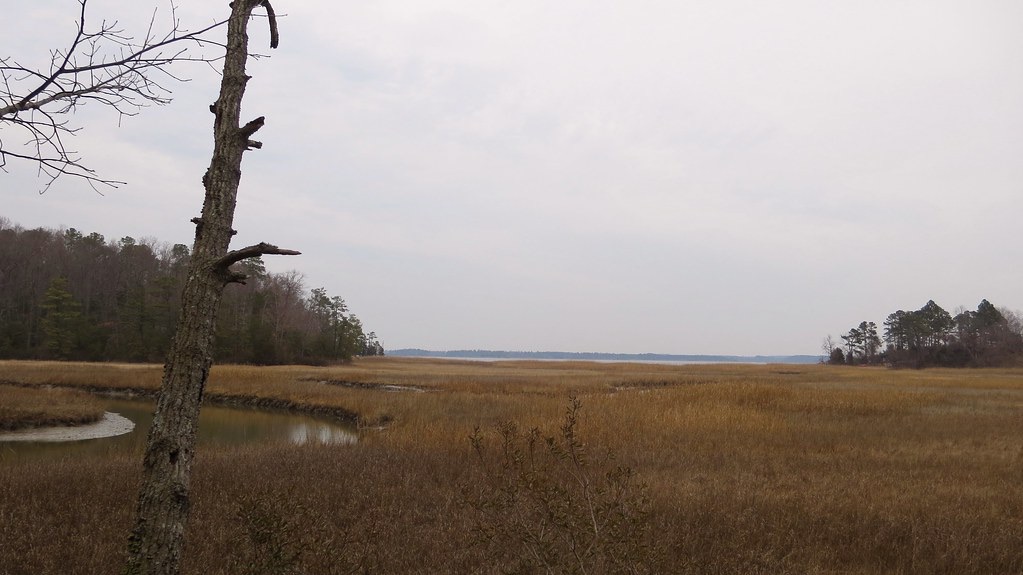
Between the last Paleo-Indian hunters and the arrival of English ships in 1607 lie roughly ten thousand years of Native history in Virginia. Archaeologists divide that span into the Archaic and Woodland periods. The labels are modern conveniences, not names the people used, but they track real changes: new tools, new foods, larger and more settled communities, and finally the chiefdoms that the English met on the James and York rivers.
Quick answer: The Archaic period (about 8000 to 1000 B.C.) began as the Ice Age ended and forests spread. People hunted deer and smaller game with spears thrown by the atlatl, gathered nuts and shellfish, and late in the period carved cooking bowls from soapstone. The Woodland period (about 1000 B.C. to the 1600s) brought pottery, farming that eventually centered on corn, the bow and arrow, villages and palisades. In Southwest Virginia, Mississippian influence produced platform mounds such as Ely Mound in Lee County.[1][2][3]
Contents
- How archaeologists read the past
- A warming world
- Archaic tools: the atlatl and notched points
- The seasonal round and settling down
- Soapstone bowls
- What makes the Woodland period different
- Mississippian mounds in Southwest Virginia
- Burial mounds of the Piedmont and Valley
- From bands to chiefdoms
- Timeline
- Frequently asked questions
How archaeologists read the past
The Native peoples of Virginia left no written records before contact, so the deep past is reconstructed from what survives in the ground. Wood, hides, baskets and most bone have decayed. Stone tools and broken pottery last almost forever, and their styles changed over time, which lets archaeologists sort sites into periods.
Layers help too. In undisturbed soil, deeper deposits are older, and charcoal from a hearth can be radiocarbon dated. But the ground is rarely tidy: pits dug by later people, roots of fallen trees and burrowing animals all move objects up and down. A careful excavation records each layer and looks for organic material found together with tools.
Many Virginia farm families own a jar of “arrowheads” turned up by the plow. Most are really spear or dart points. True arrowheads are small and appear only late in the story, because the bow arrived in the Woodland period.
A warming world
Glaciers never reached Virginia during the last glaciation, since the ice sheet stopped in Pennsylvania and New York, but the climate here was much colder. As the ice melted, pine and spruce forests gave way to hardwoods, the large Ice Age mammals disappeared, and the ocean rose. The rising water slowly flooded the lower Susquehanna valley and created the Chesapeake Bay. People living through those centuries saw coastlines move and familiar hunting grounds change.
Hardwood forests produced more nuts and fruit, and deer, turkey, elk and smaller game became the main targets of hunters. The Archaic period is defined by how people adjusted to that new world.[4]
Archaic tools: the atlatl and notched points
Archaic points were smaller than the fluted Clovis points of the Paleo-Indians and were usually notched or stemmed at the base so they could be lashed to a shaft with sinew or plant fiber. Many were mounted on darts thrown with an atlatl, a spear-thrower that acts as an extension of the arm and sends a projectile faster and farther than a hand-thrown spear.[5]
Archaic people also began grinding and polishing stone, making axes and other heavy woodworking tools. With them they could fell trees, shape dugout canoes and build better shelters. They used a wider range of local rock instead of relying on a few prized quarries.
The seasonal round and settling down
Early Archaic groups were mobile bands, probably of a few related families, that moved between river valleys through the year. They knew when to be at a fishing spot, when acorns and hickory nuts would fall, and where good stone could be found.
Over thousands of years, as the forest filled in and swamps and rivers offered reliable food, people needed to travel less. By the Late Archaic, groups were returning to base camps along major rivers for long parts of the year. On the coast and in the brackish rivers they ate oysters, crabs, fish and turtles; when a whale washed ashore it was a feast. Places with dependable food became worth defending, and territories probably grew sharper.
Seeds dropped around camps sprouted in the disturbed soil, and some plants became more common near people. That slow, partly accidental relationship with useful plants was the beginning of farming.
Soapstone bowls
Before pottery, food was cooked over open fire, on sticks, or in containers of bark and hide into which hot stones were dropped. Late Archaic people found a better answer in soapstone (steatite), a soft rock that can be carved but survives heat. A soapstone bowl can sit directly in the embers, which makes soups and stews of nuts, seeds and meat scraps much easier to cook.[6]
Soapstone occurs in belts across the Virginia Piedmont, and Native workers cut bowl blanks from outcrops with stone picks before finishing them elsewhere. The bowls were heavy, though, which suited people who stayed in one place much of the year. For the stone sources and tool-making methods, see Native American Stone Tools and Pottery in Virginia.
What makes the Woodland period different
Archaeologists mark the start of the Woodland period, around 1000 B.C., by three changes that spread over many centuries:[2]
- Pottery. Fired clay pots replaced soapstone bowls for cooking and storage. Pottery reached Virginia after it appeared farther south.
- Farming. Native plants were cultivated first; corn, beans and squash came later and eventually supported large villages. See Native American Agriculture in Virginia.
- The bow and arrow. Small triangular arrow points replaced the atlatl dart.
With more food grown close to home, people lived in one place for more of the year. Houses clustered into hamlets and villages, and some villages were ringed by palisades of upright posts. Archaeologists find those walls as dark stains in the soil where posts once stood. Leaders took on new roles in assigning fields, settling disputes and dealing with neighbors.
At Werowocomoco on the York River, the National Park Service reports human use stretching back 6,000 to 8,000 years, long before it became the town of Powhatan.[7]
Mississippian mounds in Southwest Virginia
West of the mountains, the far southwest of Virginia was touched by the Mississippian culture that flourished in the Mississippi and Tennessee valleys. Its greatest center, Cahokia, across the river from modern St. Louis, was at its height around A.D. 1100, with about 120 earthworks and an estimated 15,000 to 20,000 people. Monks Mound is the biggest of its earthworks.[8][3]
Mississippian towns were ruled by chiefs, and leaders lived or held ceremonies on top of flat-topped platform mounds built basket by basket by many workers. Ely Mound near Rose Hill in Lee County is considered the best-preserved Mississippian site in Virginia and dates to the Late Woodland-Mississippian period, about A.D. 1200 to 1650.[3]
Burial mounds of the Piedmont and Valley
Farther north and east, along the upper James, the Rivanna and the Shenandoah, people built accretional burial mounds, adding new layers of remains and earth over generations. Many have since been leveled by plowing and floods.
Thomas Jefferson dug into one of these mounds near the Rivanna River and described it in Notes on the State of Virginia. He cut a section straight through it to see its structure, found layers of bones separated by stones and earth, and guessed that it might hold a thousand skeletons. He also wrote that a party of Indians passing through the area about thirty years earlier had gone straight to the mound through the woods and stayed there for some time, showing that it was still remembered.[9] Today Virginia tribes and federal law treat such graves as places to protect; see Native American Burial Sites in Virginia.
The Siouan-speaking Monacan and Manahoac, who lived above the fall line when the English arrived, are linked by many scholars to these mound-building traditions.
From bands to chiefdoms
The long trend of the Woodland period was toward larger and more organized communities. Good farmland became something to protect, groups combined for safety, and leaders gained power over more people. A cooling climate after about 1300, the start of what is often called the Little Ice Age, may have strained harvests across eastern North America.[10]
By the late 1500s, the coastal plain was dominated by Algonquian-speaking chiefdoms, many of them drawn into the paramount chiefdom led by Powhatan. Powhatan inherited six tribes and, through marriage alliances and pressure, came to lead more than 30 by 1607.[1] That world, and the languages spoken in it, is described in Native American Tribes and Languages of Virginia.
Timeline
| Date (approximate) | Event |
|---|---|
| 8000 B.C. | Start of the Archaic period as forests replace Ice Age landscapes |
| Archaic period | Atlatl, notched points and ground-stone axes in wide use[5] |
| Late Archaic | Soapstone bowls carved and used for cooking[6] |
| ~1000 B.C. | Start of the Woodland period: pottery, plant cultivation, later the bow[2] |
| 6,000–8,000 years ago onward | Human use of the Werowocomoco area on the York River[7] |
| ~A.D. 1100 | Cahokia at its peak in the Mississippi valley[8] |
| A.D. 1200–1650 | Ely Mound period in Lee County[3] |
| After ~1300 | Cooler climate of the Little Ice Age begins[10] |
| 1607 | Powhatan leads a paramount chiefdom of more than 30 tribes[1] |
Frequently asked questions
What is the difference between the Archaic and Woodland periods? Archaic people were mostly hunter-gatherers using the atlatl and, late in the period, soapstone bowls. Woodland people made pottery, farmed, used the bow and lived in more permanent villages.
When did Native Virginians start farming? Gradually, during the Woodland period, beginning with native plants; corn became important in the last several centuries before 1607.
Are there Indian mounds in Virginia? Yes. Ely Mound in Lee County is a Mississippian platform mound, and burial mounds once stood in the Piedmont and Shenandoah Valley, including the one Jefferson excavated.
Did Virginia Indians use metal? They used small amounts of copper, mostly for ornaments obtained by trade, but tools were made of stone, bone, shell and wood.
References
- National Park Service, Historic Jamestowne, “Chronology of Powhatan Indian Activity.” https://www.nps.gov/jame/learn/historyculture/chronology-of-powhatan-indian-activity.htm
- “Woodland period,” Wikipedia. https://en.wikipedia.org/wiki/Woodland_period
- “Ely Mound,” Wikipedia (National Register listing). https://en.wikipedia.org/wiki/Ely_Mound
- “Archaic period (North America),” Wikipedia. https://en.wikipedia.org/wiki/Archaic_period_(North_America)
- “Spear-thrower,” Wikipedia. https://en.wikipedia.org/wiki/Spear-thrower
- “Soapstone,” Wikipedia. https://en.wikipedia.org/wiki/Soapstone
- National Park Service, Captain John Smith Chesapeake National Historic Trail, “Werowocomoco.” https://www.nps.gov/cajo/planyourvisit/werowocomoco.htm
- “Cahokia,” Wikipedia. https://en.wikipedia.org/wiki/Cahokia
- Thomas Jefferson, Notes on the State of Virginia, Query XI, “Aborigines” (Avalon Project, Yale Law School). https://avalon.law.yale.edu/18th_century/jeffvir.asp
- “Little Ice Age,” Wikipedia. https://en.wikipedia.org/wiki/Little_Ice_Age