Williamsburg was the capital of Virginia for about eighty years. It took over from Jamestown in 1699 and lost the role to Richmond in 1780. The town then declined. In the 20th century its colonial core was restored and rebuilt. The result is known as Colonial Williamsburg.
Quick answer: Colonial Williamsburg is the restored 18th-century core of Williamsburg, Virginia, the colony’s capital from 1699 until the government moved to Richmond in 1780. Restoration began in 1927 with the support of John D. Rockefeller, Jr. About 100 buildings were restored and about 350 reconstructed on their original sites. The Williamsburg Historic District became a National Historic Landmark on October 9, 1960.
Contents
- From Middle Plantation to capital
- A planned colonial town
- The two Capitols
- Williamsburg and the Revolution
- The move to Richmond and the decline
- Restoring Colonial Williamsburg after 1927
- Landmark status
- Visiting the historic district
- Frequently asked questions
From Middle Plantation to capital
The site began as Middle Plantation, a palisaded barrier built in 1633.[1] It stood inland from Jamestown, the capital of the colony from 1607 until 1699.[2]
Jamestown’s last statehouse burned in 1698. According to the Virginia General Assembly, that fire ended Jamestown’s career as the seat of government.[2] In 1699, colonial leaders chose to relocate to “higher and healthier ground” at Middle Plantation and renamed the place Williamsburg.[2] The new name honored William III, then king of England.[1]
No public buildings existed yet. The General Assembly met for a time in the Wren Building of the College of William & Mary. The college was founded in 1693. It is the second-oldest college in the nation.[1][2]
A planned colonial town
Governor Francis Nicholson laid out the new capital. The Virginia Department of Historic Resources (DHR) calls Williamsburg one of North America’s first planned towns.[3]
The plan placed major institutions at the ends of the main street (Duke of Gloucester Street). The National Park Service (NPS) notes that Old College Yard at the western end balances the Capitol at the other end.[1] Old College Yard includes the Wren Building (1695-1702), Brafferton Hall (1723) and the President’s House (1770). It is a separate National Historic Landmark, yet it is integral to the town plan.[1]
Williamsburg was the social and cultural center of the colony. Its institutions included the college and the Public Hospital.[3] DHR also records that close to half of Williamsburg’s 1775 population, nearly a thousand people, were enslaved.[3]
The two Capitols
Two Capitols stood on the same site at the eastern end of the town.
The first was a brick building in the shape of an H, with two-story wings. It had separate rooms for the House of Burgesses and the Governor’s Council. It was used from 1704 to 1747, when fire destroyed it.[2] During sessions, the town filled with visitors. The Capitol became part of the colony’s social life.[2]
After the fire, lawmakers again met in the Wren Building. A second Capitol then rose on the same plan. It seems to have been plainer than the first.[2] The second Capitol burned in 1832.[2]
The Capitol seen today is a reconstruction of the first building. The Colonial Williamsburg Foundation rebuilt it on the original foundations in the 1930s.[2] The history of colonial institutions is covered in Virginia colony government.
Williamsburg and the Revolution
For about eighty years, Williamsburg was a center of American political life. George Washington, Patrick Henry, George Wythe, Thomas Jefferson and George Mason all studied, taught or held office there.[1]
Several key events took place in the town:[1][2]
| Event | Place |
|---|---|
| Patrick Henry’s “Caesar-Brutus” speech and his Stamp Act Resolutions | House of Burgesses, Capitol |
| George Mason’s Virginia Declaration of Rights | Williamsburg, 1776 |
| Resolution for Independence, May 15, 1776 | Williamsburg |
| Declaration of independence from Great Britain and Virginia’s first constitution | Second Capitol, June 1776 |
The NPS states that the May 15 resolution led directly to the declaration of the Continental Congress on July 4. The 1776 Virginia Constitution became a model for many other new states.[1]
The move to Richmond and the decline
In 1779, during the war, the General Assembly approved Thomas Jefferson’s plan to move the capital inland. Richmond was safer and more central. It was also an inland port.[2] Jefferson, then governor, led the move in the spring of 1780.[2] DHR counts Williamsburg as the colonial capital from 1699 to 1776 and as the capital of the Commonwealth until 1780.[3]
The old Capitol found a new use. George Wythe, a law professor at the college, held mock trials and mock legislatures there. His goal was to train young leaders.[2]
The town itself lost influence and wealth after the capital left.[1] DHR describes Williamsburg as dormant until the late 1920s.[3] Later Virginia capitols are described in Virginia State Capitol and Capitol Square.
Restoring Colonial Williamsburg after 1927
Work started in 1927, paid for by John D. Rockefeller, Jr.[1] The NPS calls it one of the most ambitious restoration projects in the country.[1]
The work removed later structures as well as restoring old ones. NPS figures are:[1]
- about 600 buildings razed or removed;
- about 100 buildings restored;
- about 350 buildings reconstructed on their original sites.
DHR counts more than eighty colonial buildings restored and many others rebuilt by the Colonial Williamsburg Foundation.[3] The two counts come from different documents and are not identical.
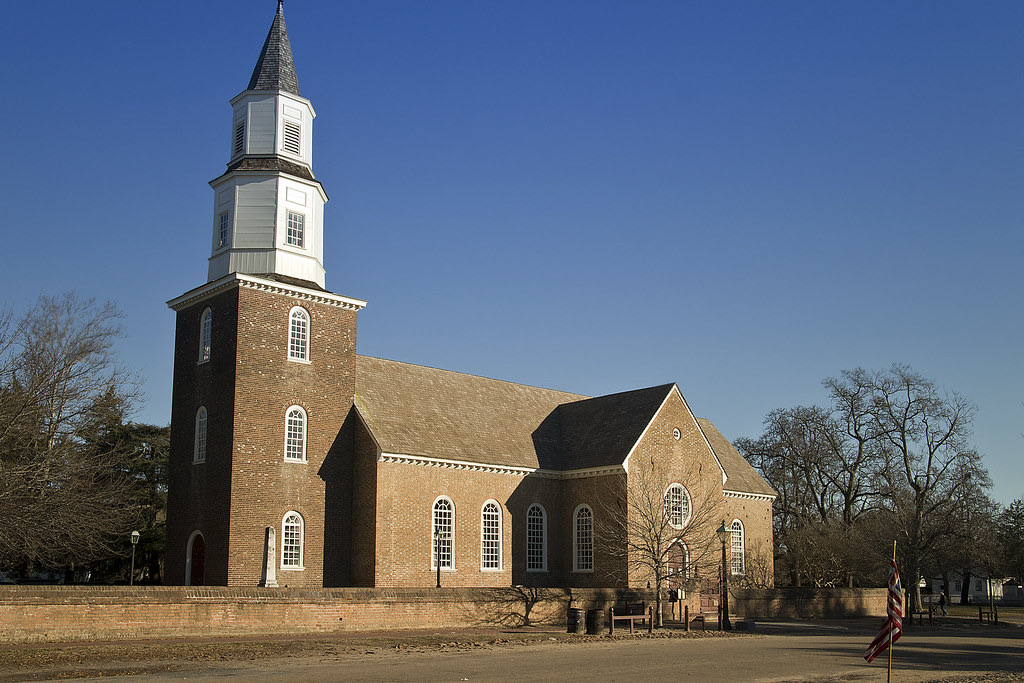
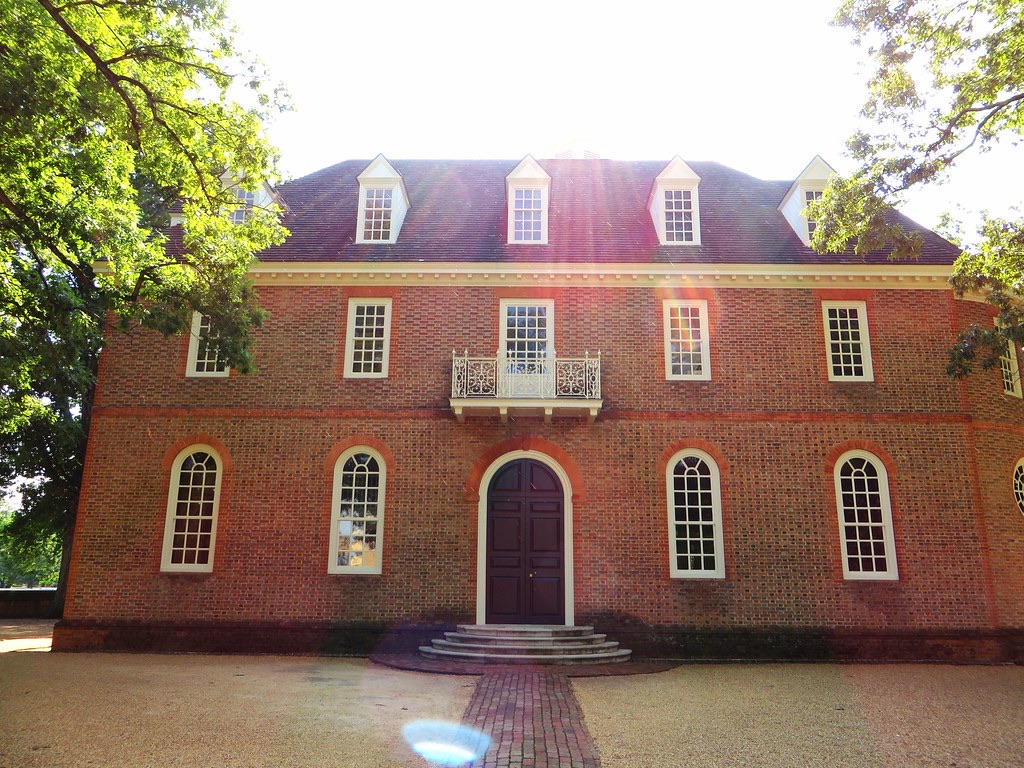
Notable restored buildings include the Public Magazine (1714), the Ludwell-Paradise House (1717), Bruton Parish Church (1710-15), the George Wythe House (1755) and the Old Courthouse (1770). Reconstructions include the Raleigh Tavern (c. 1742) and the Governor’s Palace (1706-20).[1] Most of the buildings follow a rigidly geometric early Georgian design.[1] The church is also described in The Anglican Church in Virginia.
DHR says the project long set a national standard for historic preservation and museum work. The daily life of 18th-century African Americans is a key part of what the foundation presents.[3]
Landmark status
The Williamsburg Historic District was designated a National Historic Landmark District on October 9, 1960. It was listed on the National Register of Historic Places on October 15, 1966.[1] Its DHR file number is 137-0050.[3]
Many buildings of the colonial period were also recorded by the Historic American Buildings Survey, whose documents are held by the Library of Congress.[1]
Visiting the historic district
The historic area lies within the independent city of Williamsburg, profiled in Williamsburg (city). Hours, tickets and programs inside the historic area are set by the Colonial Williamsburg Foundation.
DHR notes that many listed properties are private homes. They are not open to the public, but many can be seen from the street. Visitors are asked to respect owners’ privacy.[3]
Jamestown and Yorktown belong to Colonial National Historical Park. The park’s 23-mile Colonial Parkway runs from the York River at Yorktown to the James River at Jamestown.[4] The NPS recommends at least two to three hours at each of those two sites.[5]
Frequently asked questions
Why was the capital moved from Jamestown to Williamsburg? The last statehouse at Jamestown burned in 1698. In 1699, colonial leaders moved the capital to higher and healthier ground at Middle Plantation, renamed Williamsburg.
How long was Williamsburg the capital of Virginia? From 1699 until the spring of 1780, when the government moved to Richmond.
Are the buildings in Colonial Williamsburg original? Some are. The NPS counts about 100 restored buildings and about 350 rebuilt ones.
Who paid for the restoration of Colonial Williamsburg? John D. Rockefeller, Jr. backed the work, which started in 1927.
Is Colonial Williamsburg a National Historic Landmark? Yes. The district received that status on October 9, 1960.
References
- [1] National Park Service, Williamsburg Historic District, Williamsburg, VA – last checked 11/27/2026
- [2] Virginia General Assembly, Three Capital Cities – last checked 11/27/2026
- [3] Virginia Department of Historic Resources, Williamsburg Historic District (137-0050) – last checked 11/27/2026
- [4] National Park Service, Colonial National Historical Park – last checked 11/27/2026
- [5] National Park Service, Colonial National Historical Park, Plan Your Visit – last checked 11/27/2026