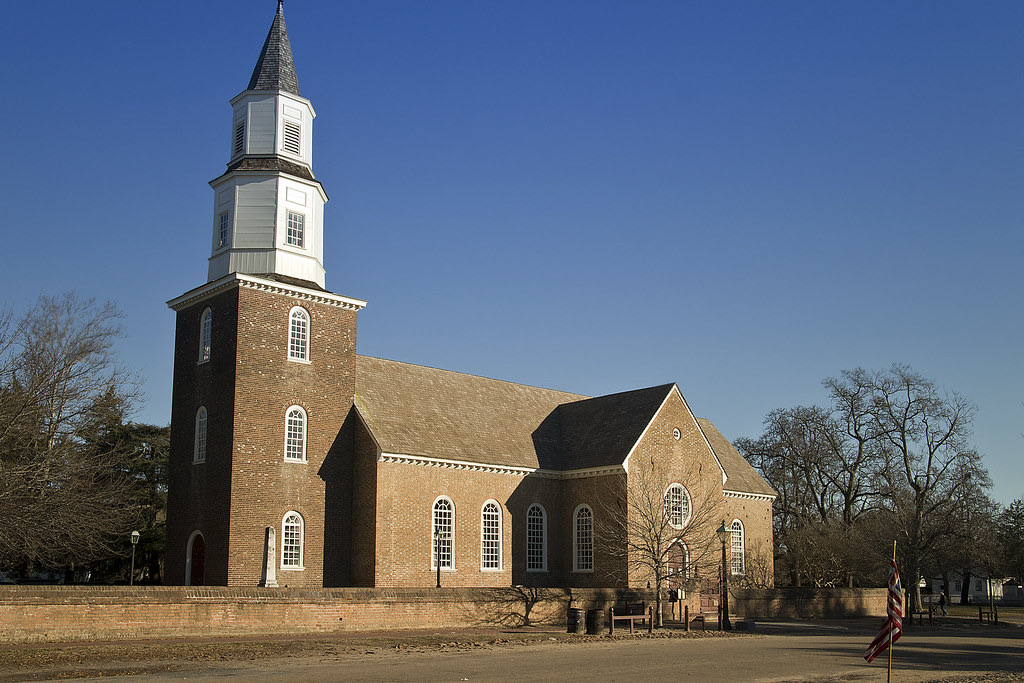
For nearly 180 years, one church held a legal monopoly in Virginia. The Church of England arrived with the first colonists in 1607, and it remained the colony’s “established” church, backed by taxes and by law, until the General Assembly cut the tie in 1786. Along the way the Anglican parish became one of the building blocks of local government, the vestry became a club of the landed gentry, and the clergy found themselves caught between royal officials in London and planters at home. When the Revolution came, the church paid a heavy price for its link to the Crown.
Quick answer: The Church of England (Anglican Church) was Virginia’s official church from the founding of Jamestown in 1607 until 1786. Every household paid parish levies to build churches, pay ministers and support the poor, whatever its own beliefs. Each parish was run by a vestry of twelve leading men, who hired the minister, often on yearly terms. No bishop ever lived in the colony. After independence, the state exempted dissenters from church taxes in 1776 and ended the establishment with the Act for Establishing Religious Freedom in 1786.[1][2][3]
Contents
- Why England had a state church
- Church life at early Jamestown
- Parishes and vestries
- Ministers glebes and tobacco pay
- A church without a bishop
- The Parsons Cause
- Anglicans west of the Blue Ridge
- Revolution and disestablishment
- The Protestant Episcopal Church
- Timeline
- Frequently asked questions
Why England had a state church
The English church broke with Rome in the 1530s, when Henry VIII had Parliament recognize the monarch, not the pope, as supreme head of the church in England. From then on, religion and politics were bound together. The king or queen headed both the government and the church, Parliament approved the Book of Common Prayer, and refusing to conform could look like disloyalty. Catholic Spain was England’s great rival, so a subject who looked to Rome could be suspected of siding with the enemy.
Virginia inherited that outlook. The Virginia Company sent Anglican clergy with its colonists, and the colony’s leaders saw a shared church as a tool for keeping order among servants, soldiers and settlers far from home. For other faiths in the colony, see religious toleration and intolerance in colonial Virginia.
Church life at early Jamestown
The first services at Jamestown were held in the open, under an old sail stretched between trees. After a fire swept the fort in January 1608, the settlers put up a simple timber church, which John Smith compared to a barn. Pocahontas and John Rolfe were married in that first church building in 1614. Between 1617 and 1619 Governor Samuel Argall had a new church built, 50 feet by 20, on a foundation of cobblestones; the first General Assembly met inside it in 1619, so America’s oldest elected legislature began its life in a house of worship.[4]
Under the harsh military code imposed after 1610, church attendance was compulsory, with services morning and evening and two sermons on Sunday. Brick churches followed at Jamestown from the late 1630s; one burned in Bacon’s Rebellion in 1676, and the brick tower added around 1680 still stands.[4][5] For the church buildings themselves, see the oldest churches in Virginia.
Parishes and vestries
As settlement spread, the General Assembly divided the colony into counties for civil government and parishes for church government. A parish often covered the same ground as a county, but large parishes had a main church plus smaller “chapels of ease” for families who lived far away.
Each parish was governed by a vestry of twelve men. At St. Mary’s Whitechapel in Lancaster County, for example, the vestry was made up of leading men of the parish, who swore allegiance to the king, collected tithes to pay the rector and maintain the church, and handled other parish business; when a seat fell vacant, the remaining vestrymen chose the replacement.[2] That self-renewing system kept the vestries in the hands of the same planter families for generations.
The vestry was part of government as well as church. It set the parish levy, which the sheriff collected along with county taxes, and it used the money for the minister’s pay, church repairs and relief of the poor, orphans and the sick. Vestries also oversaw “processioning,” the periodic walking of property lines by neighbors so that boundaries stayed clear and disputes were avoided, a duty that tied the church to land records described in surveying in colonial Virginia.
Ministers glebes and tobacco pay
Virginia rarely had enough clergymen. Ordination required a trip to England, and many able ministers preferred to stay there. Those who came were paid in tobacco, the colony’s money, so their income rose and fell with the crop and with the quality of leaf the parish handed over. Each parish was also expected to provide a glebe, a farm set aside for the minister, which could add a good deal to his living or very little, depending on its soil and labor.
The vestry held the real power over a minister’s career. In England a priest “inducted” into a parish could keep it for life, and only a bishop could remove him. In Virginia many vestries avoided presenting their minister for induction and kept him on short contracts, so they could let him go if he displeased them. In 1716 Governor Alexander Spotswood tried to force his own choice, John Bagge, on St. Anne’s Parish in Essex County over the vestry’s candidate; Spotswood got his way, but the clash was serious enough that Virginia soon recognized the right of vestries to choose their own ministers.[7]
In 1748 the General Assembly fixed every minister’s yearly salary at 16,000 pounds of tobacco.[8] That law set the stage for the bitterest church quarrel of the colonial period.
A church without a bishop
The Church of England never sent a bishop to colonial America. Virginia fell under the Bishop of London, who after 1689 named a “commissary” in the colony as his agent. The longest serving, James Blair, used the post to found the College of William and Mary, which received its royal charter from William III and Mary II in 1693 and was dedicated in part to training ministers.[9] The commissary could advise and admonish, but he could not ordain new priests or remove bad ones, and the governor, not a bishop, inducted ministers into parishes. The result was a church run largely by laymen, which suited the planters well.
The Parsons Cause
In 1755 and again in 1758, drought cut the tobacco crop and the price of a pound tripled, from about two pence to six. Because ministers were paid a fixed weight of tobacco, their salaries jumped in value. The House of Burgesses passed “Two Penny Acts” allowing tobacco debts, including clergy salaries, to be paid in money at two pence a pound. The clergy protested, and in 1759 the Crown disallowed the 1758 act.[8]
Several ministers then sued for the difference. The Rev. James Maury brought his case in Hanover County in 1762. The court, presided over by John Henry, ruled in November 1763 that Maury’s claim was valid and called a jury in December to set the damages. Defending the parish, the young lawyer Patrick Henry, the judge’s son, attacked the king’s veto as a breach of the colonists’ rights, and the jury awarded Maury a single penny.[8] The verdict made Henry famous and showed how far ordinary Virginians, and many of the gentry, had drifted from the clergy’s cause. Ministers who appealed to London against the colonial legislature came to be seen as allies of royal power.
Anglicans west of the Blue Ridge
In the 1730s and 1740s the colony’s governors encouraged Presbyterian Scots-Irish and German-speaking settlers from Pennsylvania to take up land in the Shenandoah Valley, where they would form a buffer against the French and their Native allies. The law still created Anglican parishes there, and the dissenters who made up most of the population had to pay for them. In some Valley parishes it was hard to find enough Anglicans to fill a vestry, and dissenters ended up serving. For those newcomers, see Baptists and Presbyterians in colonial Virginia and Amish, Mennonites and Brethren in Virginia.
Revolution and disestablishment
The Revolution hit the established church hard. Its prayer book asked blessings for the king, who was also its head, and many clergymen were loyal to the Crown. Some went home to England, and congregations dwindled.
In June 1776 the Virginia Convention adopted the Declaration of Rights. Its sixteenth article declared that religion “can be directed only by reason and conviction, not by force or violence,” and that all men are equally entitled to its free exercise.[1] Dissenters quickly tested those words. On October 16, 1776, a petition with close to 10,000 signatures, more than a hundred pages sewn together, asked the new legislature to end the ecclesiastical establishment.[10] In response, the General Assembly passed a law exempting dissenters from contributing to the established church, so Virginians no longer paid taxes to support it.[10] In the same session, on George Mason’s motion, the legislators voided every old English statute that had made it a crime to hold religious opinions, stay away from church or worship in another way.[11]
The final break came in January 1786, when the Assembly passed Thomas Jefferson’s bill, steered through by James Madison, declaring that no one could be compelled to attend or support any church.[3] The full story is told in the Virginia Statute for Religious Freedom.
The Protestant Episcopal Church
After the war the old Church of England in Virginia took a new name, the Protestant Episcopal Church.[10] It was now one denomination among several, with no tax support, a damaged reputation for loyalty to the Crown, and many empty pulpits. Rivals were growing fast: Baptists, Presbyterians and the Methodists, a revival movement that had started inside the Church of England and soon became a separate church.
The state then went after the church’s land. Laws passed between 1799 and 1802 declared that the property acquired under the colonial establishment belonged to the public and ordered vacant glebes sold, with the money going to the poor; the story is told in the Virginia Statute for Religious Freedom. Recovery came slowly in the 19th century. In 1823 Episcopal leaders including Bishop William Meade and Francis Scott Key founded the Virginia Theological Seminary in the sacristy of St. Paul’s Church in Alexandria.[12]
The suspicion of state favoritism lasted remarkably long. Virginia’s constitution barred the legislature from chartering any church, so congregations had to hold property through court-appointed trustees. Only in 2002 did a federal judge strike down the ban in a suit brought by the Rev. Jerry Falwell, ordering a corporate charter for Thomas Road Baptist Church.[13]
Timeline
| Year | Event |
|---|---|
| 1607 | Church of England arrives with the Jamestown settlers |
| 1610 | Martial law makes church attendance compulsory |
| 1617–1619 | Argall’s church built at Jamestown; first General Assembly meets in it |
| 1693 | Royal charter for the College of William and Mary |
| 1716 | Governor Spotswood’s dispute with St. Anne’s Parish over a minister |
| 1748 | Clergy salaries fixed at 16,000 pounds of tobacco |
| 1758 | Second Two Penny Act; disallowed by the Crown in 1759 |
| 1763 | Parsons’ Cause verdict in Hanover County: one penny |
| 1776 | Declaration of Rights; dissenters exempted from church taxes |
| 1786 | Act for Establishing Religious Freedom ends the establishment |
| 1802 | Law orders the sale of vacant glebes |
| 1823 | Virginia Theological Seminary founded in Alexandria |
| 2002 | Federal court strikes down the ban on church incorporation |
Frequently asked questions
Was Virginia an Anglican colony? Yes. The Church of England was the legally established church from 1607 until 1786, and everyone paid parish levies to support it.[3]
What was a vestry in colonial Virginia? A board of twelve leading men in each parish that hired the minister, set the parish tax and cared for the poor; vacancies were filled by the vestry itself.[2]
What was the Parsons’ Cause? A 1763 lawsuit in Hanover County in which the Rev. James Maury sought back pay after the Crown disallowed the Two Penny Act; Patrick Henry’s speech led the jury to award him one penny.[8]
What happened to the Anglican Church after the Revolution? It became the Protestant Episcopal Church, lost its tax support and later most of its glebe lands, and had to rely on voluntary giving.
See also: religion in Virginia, religion in the Virginia colony, oldest churches in Virginia.
References
- National Archives, “The Virginia Declaration of Rights.” https://www.archives.gov/founding-docs/virginia-declaration-of-rights
- St. Mary’s Whitechapel, “History.” https://www.stmaryswhitechapel.org/history
- The Founders’ Constitution, University of Chicago Press, “Virginia, Act for Establishing Religious Freedom” (1786). https://press-pubs.uchicago.edu/founders/documents/amendI_religions44.html
- Historic Jamestowne, “Jamestown Churches.” https://historicjamestowne.org/archaeology/map-of-discoveries/jamestown-churches/
- National Park Service, Historic Jamestowne, “Jamestown Churches.” https://www.nps.gov/jame/learn/historyculture/jamestown-churches.htm
- Exploresouthernhistory.com, “Aquia Episcopal Church - Stafford, Virginia.” http://www.exploresouthernhistory.com/aquiachurch.html
- Vauter’s Church, “The History of St. Anne’s Parish.” https://vauterschurch.com/our-history
- Historic St. John’s Church, “1763 The Parsons’ Cause.” https://www.historicstjohnschurch.org/parsons-cause
- William & Mary, “History.” https://www.wm.edu/about/history/
- Library of Virginia, UncommonWealth blog, “That the Oppressed May Go Free: A Petition to the Virginia General Assembly for Religious Freedom” (2022). https://uncommonwealth.virginiamemory.com/blog/2022/09/21/that-the-oppressed-may-go-free-a-petition-to-the-virginia-general-assembly-for-religious-freedom/
- The Founders’ Constitution, “George Mason, Amendment to the Bill Exempting Dissenters from Contributions to the Established Church” (1776). https://press-pubs.uchicago.edu/founders/documents/amendI_religions33.html
- Virginia Theological Seminary, “History.” https://www.vts.edu/about/history
- American Civil Liberties Union, “In Win for Rev. Falwell (and the ACLU), Judge Rules VA Must Allow Churches to Incorporate” (2002). https://www.aclu.org/press-releases/win-rev-falwell-and-aclu-judge-rules-va-must-allow-churches-incorporate