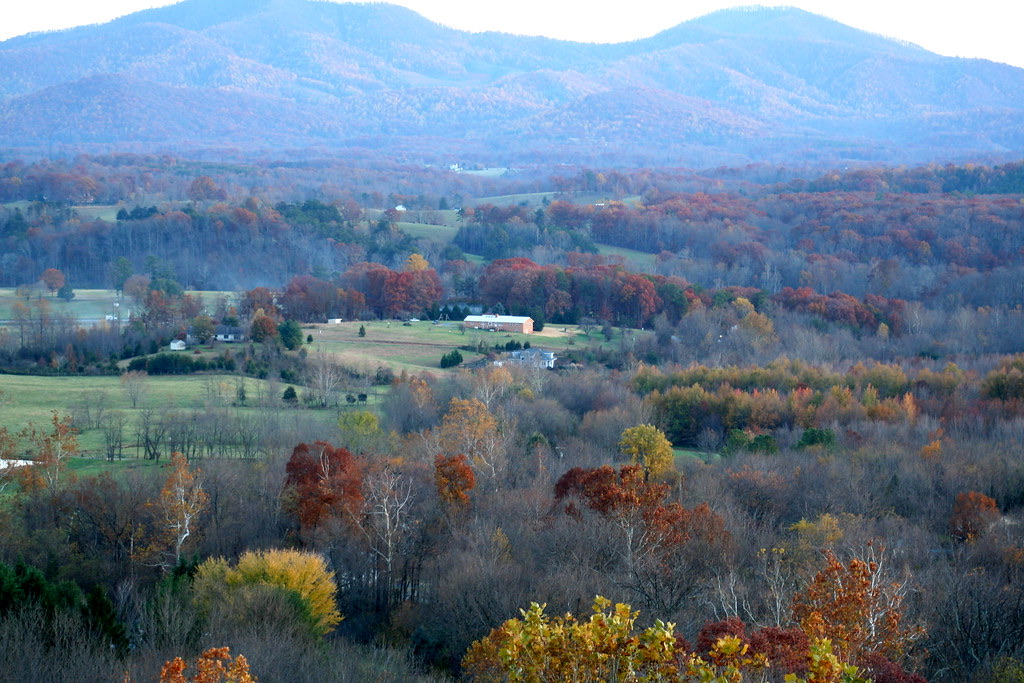
Monticello was the home of Thomas Jefferson, author of the Declaration of Independence and third president of the United States. The house stands on a leveled hilltop in Albemarle County, just outside the city of Charlottesville.[1] Jefferson designed it himself and kept changing it for more than forty years. The property links Virginia architecture, plantation slavery, western exploration and early historic preservation.
Quick answer: Monticello is Thomas Jefferson’s house on a hilltop just outside Charlottesville, in Albemarle County, Virginia. Jefferson began building it in 1770 and finished a major rebuilding in 1809. It was designated a National Historic Landmark in 1960. Together with the University of Virginia, it is on the World Heritage List. A private foundation has owned it since 1923.
Contents
- Location and setting
- The first house and the rebuilding
- Monticello and the Lewis and Clark Expedition
- Mulberry Row and the enslaved community
- After Jefferson: sale, the Levy family and the foundation
- Landmark and World Heritage status
- Frequently asked questions
Location and setting
The house sits on what the Virginia Department of Historic Resources (DHR) calls the “Little Mountain,” just outside Charlottesville. It lies inside the Southern Albemarle Rural Historic District.[1] The National Park Service (NPS) gives the address as 931 Thomas Jefferson Parkway, Charlottesville.[3]
The 1970s landmark nomination describes the view from the top. Rolling fields fall away below, and the crest of the Blue Ridge and many miles of the Piedmont stand in the distance.[4] The setting places Monticello on the western edge of the Piedmont, close to the Blue Ridge. More on the county is in the profile of Albemarle County.
The first house and the rebuilding
Jefferson leveled the top of the hill in 1768.[1] Construction followed in stages over four decades:
| Year | Event | Source |
|---|---|---|
| 1768 | Jefferson levels the hilltop | DHR[1] |
| 1770 | Construction begins, from Jefferson’s own design | NPS[2] |
| 1771 | After his family home, Shadwell, burns, Jefferson moves into the first finished pavilion | NHL nomination[4] |
| 1775 | The western part, with a two-tiered portico, is complete | NPS[2] |
| 1796 | A major rebuilding and enlargement begins | NPS[2][3] |
| 1809 | The rebuilding is finished | DHR[1], NPS[3] |
The landmark nomination dates the start of the second building campaign to 1793 instead of 1796.[4]
Before 1795 the house had a Palladian form, with three parts and porticoes on two levels.[1] The rebuilding changed it into a Neoclassical house in the style Jefferson had seen in France. The NPS describes an original eight-room villa that became a 21-room house.[3] The DHR also gives 21 rooms.[1] A different NPS page gives 35 rooms, so the sources do not count the rooms the same way.[2]
The finished front looks low and horizontal. A columned portico and a low dome sit at its center.[3] The nomination lists Jefferson’s devices inside the house: dumbwaiters, disappearing beds, a duplicate-writing machine and a clock driven by weights and pulleys. Two narrow staircases are hidden in alcoves, because Jefferson regarded stairs as unattractive.[4] Jefferson called the house “my essay in architecture.”[1]
Jefferson also laid out the gardens. The NPS describes them as a botanic showpiece, a source of food and a testing ground for plants from around the world.[3]
Monticello and the Lewis and Clark Expedition
On January 18, 1803, Jefferson wrote to Congress from Monticello. He asked for $2,500 to pay for an expedition up the Missouri River to the Pacific Ocean. It became the Lewis and Clark Expedition.[2]
During the enlargement, Jefferson planned a two-story Entrance Hall to display what the expedition sent back. In 1805 Lewis and Clark shipped animal skins, bones, horns and American Indian objects east. The fate of the American Indian objects after Jefferson’s death is unknown.[2] In January 2003 Monticello hosted the first signature event of the Lewis and Clark Bicentennial.[2]
Mulberry Row and the enslaved community
Monticello was a working plantation that depended on enslaved labor. Archaeological work that began in the 1970s found more than a score of houses, light industrial buildings and yards tied to the enslaved African American population. According to the DHR, that population numbered more than fifty servants and laborers at its peak.[1]
Most of these remains lie along Mulberry Row. The DHR states that no other excavations in Virginia have produced as much information on slave life on a Virginia plantation.[1] The NPS notes that visitors can walk Mulberry Row, once the hub of plantation activity.[3] Background on enslaved labor in the colonial period is in Virginia Colony Economy.
After Jefferson: sale, the Levy family and the foundation
Jefferson died in 1826. According to the landmark nomination, the house and estate were sold soon afterward for $7,000, about one tenth of their real value. Jefferson’s generosity and heavy entertaining in his last years had left him in debt.[4]
The later history, as summarized in the nomination:[4]
- 1834: Uriah Levy buys the house and tries to restore it. After 1839 it passes to tenants and falls into decline.
- 1861: The house is confiscated and its furnishings are sold.
- After the Civil War: The property returns to Levy, who tries to leave it to the nation or to the people of Virginia. His will is broken.
- Later: His nephew, Jefferson Levy, gains full possession, restores the house and enlarges the estate to about 2,000 acres.
- 1923: Jefferson Levy sells Monticello and 650 acres for $500,000 to the Thomas Jefferson Memorial Foundation.
The foundation has kept Monticello open as a place of pilgrimage since 1923.[1] The NPS lists the site as managed by Thomas Jefferson’s Monticello, not by the federal government.[2]
Landmark and World Heritage status
Monticello holds several historic designations, according to the DHR register entry 002-0050:[1]
| Designation | Date |
|---|---|
| National Historic Landmark | December 19, 1960 |
| National Register of Historic Places | October 15, 1966 |
| Virginia Landmarks Register | September 9, 1969 |
Monticello and the “academical village” at the heart of the University of Virginia are also on the World Heritage List. The NPS explains that both were included for their architecture. Jefferson founded the university in 1819, and its Rotunda is based on the Pantheon in Rome. The Rotunda was rebuilt in 1899 after a fire.[3]
Frequently asked questions
Where is Monticello? On a hilltop just outside Charlottesville, in Albemarle County, Virginia. The NPS lists the address as 931 Thomas Jefferson Parkway.
When was Monticello built? Jefferson began construction in 1770 and completed the first house by 1775. He rebuilt and enlarged it from 1796 to 1809.
How many rooms does Monticello have? The DHR and one NPS page give 21 rooms for the house as rebuilt by 1809. Another NPS page gives 35 rooms, so the count depends on how rooms are counted.
Who owns Monticello today? A private foundation. The Thomas Jefferson Memorial Foundation bought the house and 650 acres in 1923.
Is Monticello a World Heritage Site? Yes. It is listed together with the University of Virginia, for the architecture of both.
The longer story of the region around Charlottesville is told in The Regions of Virginia.
References
- [1] Virginia Department of Historic Resources, 002-0050 Monticello – last checked 11/20/2026
- [2] National Park Service, Monticello – last checked 11/20/2026
- [3] National Park Service, Monticello and the University of Virginia in Charlottesville: World Heritage Site – last checked 11/20/2026
- [4] National Park Service, National Register of Historic Places, Monticello National Historic Landmark nomination (PDF) – last checked 11/20/2026