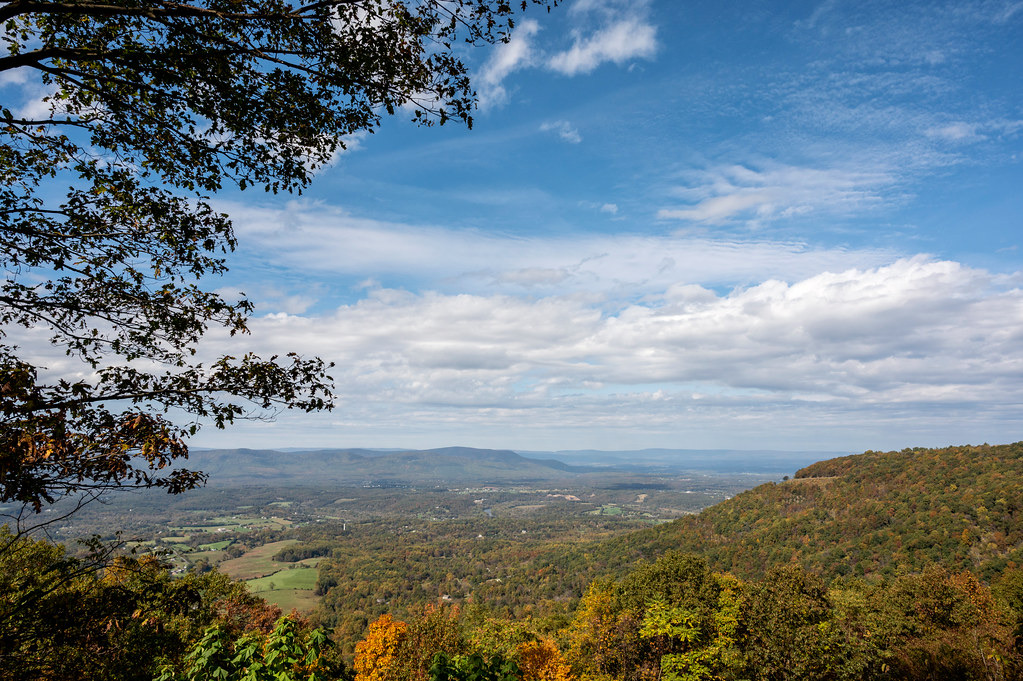
Every October, traffic backs up on Skyline Drive and the Blue Ridge Parkway as visitors head for the mountains to see the leaves, and Sunday evening traffic returning toward Northern Virginia on Interstate 66 is notoriously slow. Virginia’s fall color is a geography lesson as much as a botany lesson: the season moves down the mountainsides and across the state from west to east, following elevation, temperature and distance from the ocean.
Quick answer: In Virginia, leaves usually change first at the highest elevations of the Blue Ridge and the Alleghenies, often beginning in early October, and last on the Coastal Plain and the Eastern Shore, where color can linger into November. Mountain air is usually about 10°F cooler than the valleys below, and the slow-cooling Atlantic keeps the coast mild into autumn.[1] Red leaves come from anthocyanin pigments that trees make fresh in the fall; yellows and oranges come from carotenoids that were in the leaf all summer.[2]
Contents
- What triggers the change
- Elevation: the mountains turn first
- The ocean: the coast turns last
- Latitude
- Weather and drought
- The chemistry of fall color
- Why make red leaves?
- Which trees turn which colors
- Spring: the same season in reverse
- Where to see fall color
- Frequently asked questions
What triggers the change
Deciduous trees drop their leaves to survive winter. A broad leaf full of water would freeze and be damaged, and in winter there is too little light and liquid water to make photosynthesis worthwhile. Before they let go, trees pull nitrogen and other valuable nutrients out of their leaves and store them in the twigs and roots for next spring.[2]
Two signals tell a tree that winter is coming. The first is day length. As nights grow longer after the autumn equinox, trees slow and then stop making chlorophyll. The second is temperature: cool nights speed up the process. Day length changes the same way every year, so it sets the general timing; temperature and moisture fine-tune it from place to place and year to year.
Elevation: the mountains turn first
Air cools as you climb. Shenandoah National Park notes that its mountains are usually about 10 degrees cooler than the valleys below.[1] Skyline Drive runs along the crest of the Blue Ridge at elevations up to about 3,680 feet, so its forests feel autumn sooner than the farms of the Shenandoah Valley or the Piedmont.
The result is a wave of color that moves down the mountainsides. The highest ridges may be at their peak while the valleys are still mostly green, and a week or two later the colors have worked their way down to the foothills. Because the park is more than 100 miles long and spans a wide range of elevations, the National Park Service says it is impossible to predict a single peak date; conditions vary from place to place and even hour to hour with the weather.[3] In a typical year the high country is brightest in mid-October.
The ocean: the coast turns last
Water holds heat far longer than land. Through September and October, the Atlantic Ocean and the Chesapeake Bay stay warm and keep nights along the coast mild. Frost comes later to Norfolk and the Eastern Shore than to Richmond, and much later than to the mountains, so trees near the coast hold their leaves longest. Fall color in Hampton Roads often peaks in early to mid-November, weeks after the Blue Ridge.
Latitude
Day length also varies with latitude. In autumn, days shorten faster in the north, so trees in Frederick County, at Virginia’s northern tip, get the signal a little earlier than trees at the same elevation along the North Carolina line. In practice, latitude matters less than elevation and the ocean within Virginia, because the state spans only about three degrees from north to south but rises from sea level to more than 5,700 feet at Mount Rogers.
Weather and drought
Weather decides how bright the colors will be. The most brilliant reds come after a growing season with enough rain, followed by an autumn of sunny days and cool, but not freezing, nights. Sunny days let leaves keep making sugar, and cool nights keep that sugar in the leaf, where it fuels the production of red pigments.
A dry late summer is bad for color. Drought-stressed trees may drop their leaves early or turn a dull brown, as the leaves die before they can develop their pigments. An early hard freeze can kill leaves before they color, and strong winds or heavy rain from a passing storm can strip trees bare in a day. Very warm autumns delay the season and can mute the colors.
The chemistry of fall color
Three groups of pigments create the colors of autumn.[2]
- Chlorophyll is green and does the work of photosynthesis. All summer, trees break it down and replace it continuously. In autumn, they stop replacing it and begin dismantling it to recover its nitrogen, and the green fades.
- Carotenoids are yellow and orange. They are in the leaf all summer, helping capture light and protecting the leaf from too much sun, but the green chlorophyll hides them. When the chlorophyll disappears, the yellows and oranges show through. That is why hickories, tulip poplars and birches turn gold so reliably every year.
- Anthocyanins are red and purple. Unlike carotenoids, they are not in the leaf all summer. Many trees make them new in autumn, just before the leaves fall. At Harvard Forest in Massachusetts, scientists found that about 70 percent of shrubs and trees produce anthocyanins as their leaves age.[2]
Mixtures produce the in-between shades. Anthocyanins combined with leftover carotenoids look orange; anthocyanins with remaining chlorophyll look brownish. Tannins, bitter compounds that remain after the other pigments break down, give oak leaves their brown and russet tones. The same species can vary from tree to tree, and a single red maple can show red, orange and yellow leaves at once.[2]
Why make red leaves?
Making new pigments costs energy, so scientists have wondered why a tree would bother just before dropping its leaves. There are several explanations, and they are not mutually exclusive:
- Sunscreen. Anthocyanins may protect the leaf’s machinery from bright light and cold while the tree finishes recovering nutrients, letting it reclaim more nitrogen before the leaf falls.
- Antifreeze and antioxidant. The pigments may help leaves tolerate cold and stress in their last weeks.
- A signal to insects. One hypothesis holds that bright red leaves warn aphids and other insects looking for a place to lay eggs that the tree is healthy and well defended.
- Chance. Some biologists argue that the colors are partly a byproduct of pigments breaking down at different rates, with no special advantage at all.
Which trees turn which colors
Virginia’s mix of trees gives its fall color a long season and a wide palette.
| Tree | Typical fall color |
|---|---|
| Red maple | Scarlet, orange or yellow; often the first to turn |
| Sugar maple | Orange, red and gold (common in the mountains) |
| Black gum (blackgum) | Brilliant red, early in the season |
| Sassafras | Orange, red and yellow, sometimes on one tree |
| Dogwood | Deep red to purple |
| Sourwood | Bright red |
| Tulip poplar (yellow-poplar) | Clear yellow |
| Hickories | Golden yellow to bronze |
| White and red oaks | Red, russet and brown, late in the season |
| American beech | Golden bronze; young trees hold dry leaves all winter |
| Virginia creeper (vine) | Brilliant red |
Oaks, the most common trees in many Virginia forests, turn late and keep their leaves longest, which is why the mountainsides take on a russet tone in early November after the maples have finished.
Spring: the same season in reverse
In spring, the pattern runs backward. Leaves open first on the coast and in the warm lowlands and last on the high ridges. In late April, when the lawns and forests of Northern Virginia are fully green, the trees along Skyline Drive may still be bare.
Latitude shows up more clearly in spring. Daffodils, azaleas and dogwoods bloom first in southern Virginia and Hampton Roads and gradually spread north. Petersburg, about 100 miles south of Manassas, typically sees spring blossoms several days to a week earlier. And the ocean, slow to warm, now works in the other direction: cool water keeps the immediate coast a little later than inland areas at the same latitude.
As Virginia’s climate warms, both seasons are shifting, with spring arriving earlier and autumn color coming later than it did decades ago (see climate change in Virginia).
Where to see fall color
- Skyline Drive in Shenandoah National Park, along the crest of the Blue Ridge, with dozens of overlooks. The park posts weekly fall color updates and runs webcams so visitors can check conditions.[3]
- The Blue Ridge Parkway, which continues south from Shenandoah through central and southwestern Virginia to North Carolina.
- The Allegheny Highlands of Highland, Bath and Alleghany counties, where some of the state’s highest valleys turn early.
- Mount Rogers and Grayson Highlands in the far southwest, Virginia’s highest country.
- State parks such as Douthat, Hungry Mother, Natural Tunnel and Fairy Stone, and the George Washington and Jefferson National Forests.
The busiest days are October weekends, when the overlooks and parking areas fill early. Weekday trips and early mornings avoid most of the crowds.
Frequently asked questions
When is peak fall color in Virginia? It varies by elevation and year. The highest mountains usually peak in mid-October, the Piedmont in late October and the coast in early November. The National Park Service says it cannot predict a single peak date for Shenandoah.[3]
Why do leaves change color first in the mountains? Because mountain air is cooler, often about 10°F cooler than the valleys, and cool temperatures speed up the breakdown of chlorophyll.[1]
What makes leaves red? Anthocyanin pigments that many trees produce in the fall, especially after sunny days and cool nights.[2]
Why are some years better than others? Good color follows a growing season with enough rain and an autumn of sunny days and cool nights. Drought, early frost or storms can dull the season.
See also: the Blue Ridge, parks and forests of Virginia, forestry in Virginia, climate of Virginia.
References
- National Park Service, Shenandoah National Park, “Weather.” https://www.nps.gov/shen/learn/nature/weather.htm
- Harvard Forest, Harvard University, “The Process of Leaf Color Change.” https://harvardforest.fas.harvard.edu/leaf-process
- National Park Service, Shenandoah National Park, “Fall in Shenandoah.” https://www.nps.gov/shen/planyourvisit/fall.htm