Virginia’s colleges grew out of very different moments in the state’s history: Thomas Jefferson’s plan for a public university, a medical school in Richmond, a class taught to freedom seekers under an oak tree during the Civil War, a federal land grant, a biracial political coalition, and a push to train women as teachers. Seven of their stories follow, in the order they began.
Quick answer: The University of Virginia was founded by Thomas Jefferson in 1819. VCU traces its roots to a medical department of Hampden-Sydney College opened in Richmond in 1838. Hampton University began with classes for freedom seekers near Fort Monroe in 1861 and became Hampton Normal and Agricultural Institute in 1868. Virginia Tech opened as Virginia Agricultural and Mechanical College in 1872 under the federal Morrill Act. the charter of Virginia State University dates from March 6, 1882, and Radford University was founded in 1910 as a teacher-training school for women.[1][2][3]
Contents
- University of Virginia (1819)
- Virginia Commonwealth University (1838)
- Hampton University (1861 and 1868)
- Christiansburg Institute (1866)
- Virginia Tech (1872)
- Virginia State University (1882)
- Radford University (1910)
- Comparison table
- Frequently asked questions
University of Virginia (1819)
Thomas Jefferson spent much of his retirement founding the University of Virginia, chartered in 1819 a mile west of Charlottesville. He designed its “Academical Village,” a lawn lined with pavilions for professors and rooms for students, closed at one end by the domed Rotunda.[4]
The university stayed open during the Civil War, though with few students; most of its young men left to join the Confederate army, and the Rotunda briefly held patients of a military hospital in Charlottesville.[4]
Virginia Commonwealth University (1838)
Virginia Commonwealth University in downtown Richmond began on October 20, 1838, as the medical department of Hampden-Sydney College, a college in Prince Edward County that set up its medical school in the state capital. In 1854 the medical department became the independent Medical College of Virginia (MCV).[5]
In 1968 the General Assembly merged MCV with Richmond Professional Institute, a school founded in 1917, to create Virginia Commonwealth University. In 2025 VCU enrolled more than 29,000 students in more than 200 academic programs.[5]
Hampton University (1861 and 1868)
Hampton University’s story begins in the first months of the Civil War. In May 1861 the Union army held Fort Monroe at the mouth of Hampton Roads, and enslaved people from nearby farms began escaping to the fort. The Union commander declared them “contraband of war” and refused to return them, and a large camp of freedom seekers grew up outside the fort.[1]
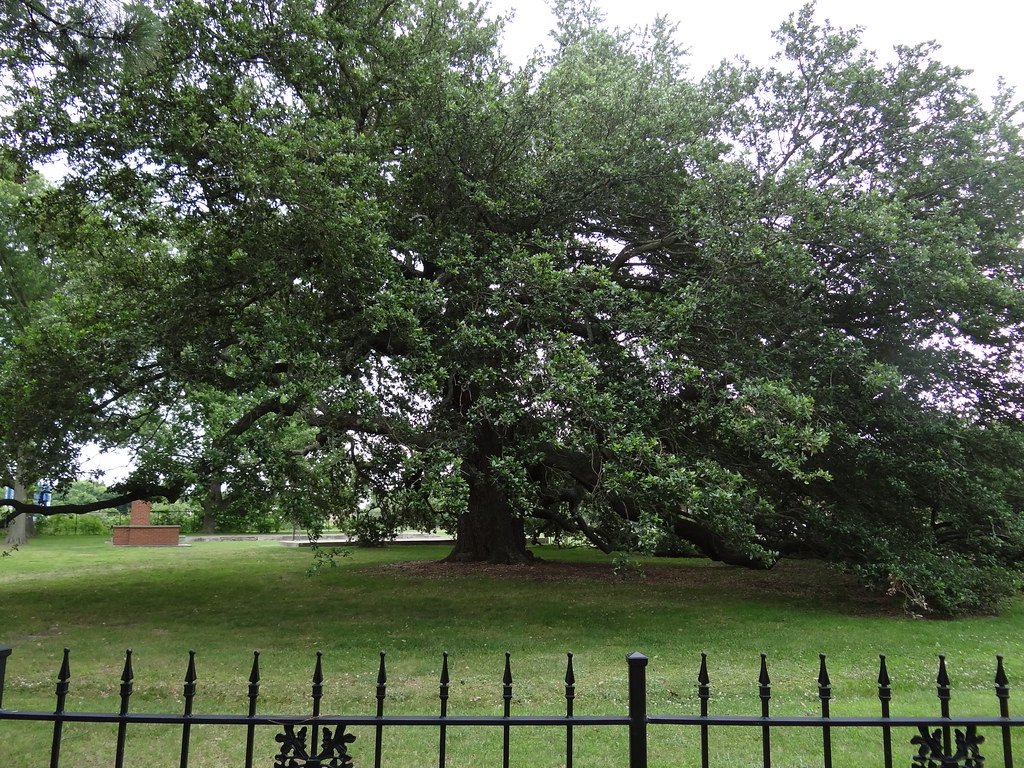
Few of the refugees could read, because an 1831 Virginia law forbade teaching enslaved and free Black people to read and write. Mary Smith Peake, a free Black woman, agreed to teach anyway. Her classes met under a large live oak near the camp, and in 1863 the Emancipation Proclamation was read to the community beneath the same tree. Known today as the Emancipation Oak, it still stands on the Hampton University campus.[1]
After the war, Samuel Chapman Armstrong, a former Union officer working for the Freedmen’s Bureau, founded Hampton Normal and Agricultural Institute, which opened its doors on April 1, 1868. Its purpose, in Armstrong’s words, was “to train selected Negro youth who should go out and teach and lead their people.”[1]
In 1872 a young man named Booker T. Washington arrived at Hampton, worked his way through the school and later taught there, before leaving to found Tuskegee Institute in Alabama in 1881. In April 1878 Hampton also began admitting Native American students, starting with prisoners of the Red River War brought from Fort Sill; its Indian program lasted until 1923.[1][6]
The school became Hampton Institute on July 1, 1930, and Hampton University in 1984.[1]
Christiansburg Institute (1866)
In the mountains of Montgomery County, Captain Charles S. Schaeffer, a Union veteran from Philadelphia working for the Freedmen’s Bureau, began teaching twelve formerly enslaved people in a rented room in Christiansburg in 1866 or 1867. From 1870 a Quaker group, the Friends’ Freedmen’s Association, helped fund the growing school after the Freedmen’s Bureau withdrew its support, and in the 1880s Schaeffer turned the school over to an entirely African American staff.[7]
In 1896 Booker T. Washington agreed to serve as an adviser to the school, which developed a strong program of industrial and vocational training. Christiansburg Institute served Black students from fifteen counties until it closed in 1966, when public schools in the area were integrated.[7]
Virginia Tech (1872)
The federal Morrill Act of 1862 gave each loyal state proceeds from the sale of public land to support colleges teaching agriculture and the mechanical arts. After the war, in 1872, the Reconstruction-era General Assembly used Virginia’s share to buy the buildings of the Preston and Olin Institute, a small Methodist school in Blacksburg, and opened Virginia Agricultural and Mechanical College.[3]
The first student, Addison “Add” Caldwell, registered on October 1, 1872, after hiking more than 25 miles from his home in Craig County; a statue on the campus Upper Quad remembers his walk. The school’s names tell its later story: Virginia Agricultural and Mechanical College and Polytechnic Institute from 1896, Virginia Polytechnic Institute (VPI) from 1944, and Virginia Polytechnic Institute and State University, Virginia Tech, from 1970.[3]
From 1872 to 1920, Virginia’s federal land-grant money for Black students went to the private Hampton Institute; in 1920 it was moved to the state school that became Virginia State University.[2]
Virginia State University (1882)
Virginia State University was founded on March 6, 1882, when the General Assembly chartered the Virginia Normal and Collegiate Institute. The bill was sponsored by Delegate Alfred W. Harris, a Black legislator, and passed during the years when the Readjuster coalition of white and Black voters controlled state government. A lawsuit delayed the opening until October 1, 1883, at Ettrick in Chesterfield County, across the Appomattox River from Petersburg. In its first year the school had 126 students and seven faculty members, all of them Black.[2]
Its first president, John Mercer Langston, was one of the best-known Black leaders of his time. Elected to Congress in 1888, he was until 1992 the only Black person ever sent to Congress from Virginia, and he was the great-uncle of the poet Langston Hughes.[2]
The school’s names follow the politics of the times. In 1902, as Virginia wrote segregation into a new constitution, the legislature cut back the college program and renamed the school Virginia Normal and Industrial Institute. The college program was restored after the land-grant funds arrived in 1920, and the school became Virginia State College for Negroes in 1930, Virginia State College in 1946 and Virginia State University in 1979. Its Norfolk branch, added in 1944, became independent as Norfolk State College in 1969, today’s Norfolk State University.[2]
Radford University (1910)
In the spring of 1910 the General Assembly founded the State Normal and Industrial School for Women at Radford, part of a statewide effort to train teachers for Virginia’s growing public schools. Its first building was dedicated on August 9, 1913, just before the first session opened on September 17, 1913.[8]
The school was renamed State Teachers College in 1924. During World War II, in 1943, it was merged with Virginia Polytechnic Institute as part of a statewide plan to consolidate colleges; the union was dissolved in 1964, and the school became Radford College. Men were admitted as undergraduates in the summer of 1972, and in 1979 the General Assembly granted it university status. In the 1970s Radford adopted the nickname “Highlanders.”[8]
Comparison table
| School | Began | City or county | First name | Current name since |
|---|---|---|---|---|
| University of Virginia | 1819 | Charlottesville | University of Virginia | 1819 |
| Virginia Commonwealth University | 1838 | Richmond | Medical department of Hampden-Sydney College | 1968 |
| Hampton University | 1868 (classes from 1861) | Hampton | Hampton Normal and Agricultural Institute | 1984 |
| Christiansburg Institute | 1866-1867 | Christiansburg, Montgomery County | Freedmen’s Bureau school | closed 1966 |
| Virginia Tech | 1872 | Blacksburg, Montgomery County | Virginia Agricultural and Mechanical College | 1970 |
| Virginia State University | 1882 (opened 1883) | Ettrick, Chesterfield County | Virginia Normal and Collegiate Institute | 1979 |
| Radford University | 1910 (opened 1913) | Radford | State Normal and Industrial School for Women | 1979 |
Frequently asked questions
What is the oldest public university in Virginia? Among the schools on this page, the University of Virginia, founded in 1819. The College of William & Mary, chartered in 1693, is older and is also public today.
What is the Emancipation Oak? A live oak on the Hampton University campus where Mary Peake taught freedom seekers in 1861 and where the Emancipation Proclamation was read in 1863.
Why did Virginia Tech start as an agricultural college? It was founded with federal Morrill Act funds, which supported colleges teaching agriculture and the mechanical arts.
When did Radford admit men? In the summer of 1972.
References
- [1] Hampton University, HU History – last checked 11/20/2026
- [2] Virginia State University, History – last checked 11/20/2026
- [3] Wikipedia, Virginia Tech (history and sources) – last checked 11/20/2026
- [4] Encyclopedia Virginia, University of Virginia During the Civil War – last checked 11/20/2026
- [5] Wikipedia, Virginia Commonwealth University (history and sources) – last checked 11/20/2026
- [6] Library of Virginia, Uncommonwealth blog, Indigenous Education in Virginia (April 17, 2024) – last checked 11/20/2026
- [7] Virginia Tech, Virginia Center for Civil War Studies, Christiansburg Institute – last checked 11/20/2026
- [8] Radford University, History – last checked 11/20/2026