For more than three centuries, schools for Native Americans in Virginia were tied to the goals of the people who ran them: converting students to Christianity, training interpreters for trade, keeping the peace with neighboring nations, or, after the Civil War, keeping races apart. The story runs from a Spanish mission in 1570 to the end of segregated Indian schools in the 1950s.
Quick answer: One of the first colleges planned in English America, at Henricus near present-day Richmond, was meant partly to educate Powhatan boys, but it was never built and its charter was revoked in 1624. Formal schooling for Native children in Virginia really began in 1714 at Fort Christanna, where Governor Alexander Spotswood paid a schoolmaster and over 100 children studied before the school closed in 1717. The Brafferton Indian School at the College of William & Mary, funded from the estate of the scientist Robert Boyle, taught Native boys until the American Revolution. After 1870, Native children attended separate Indian schools in Virginia until segregation ended after 1954.[1][2]
Contents
- Learning each other’s languages
- Don Luis and the Spanish mission of 1570
- Interpreters, captives and Pocahontas
- The college that was never built: Henricus
- After 1622: separation instead of schooling
- Robert Boyle’s money and the College of William & Mary
- Governor Spotswood and Fort Christanna
- The Brafferton Indian School
- Indian schools after the Civil War
- Hampton Institute and its Indian program
- Timeline
- Frequently asked questions
Learning each other’s languages
When Europeans first sailed into the Chesapeake Bay, neither side could understand the other. Early encounters were managed with gestures, signs and the exchange of goods: food and water for the sailors, metal tools, copper and glass beads for the Native people. Real communication needed interpreters, and both sides found ways to create them, often by taking young people to live among strangers.
That pattern, learning by living in the other culture, came before any school. When schools arrived, they were almost always one-way: Native children were expected to learn English ways, while very few colonists learned Algonquian or Siouan languages.
Don Luis and the Spanish mission of 1570
The first attempt to educate a Virginia Indian in European ways was Spanish. In 1561 a young man from the Chesapeake region, Paquiquineo, met Spanish explorers on the bay and went back with them, either willingly or as a captive. He lived in Spain and New Spain, was baptized as Don Luis de Velasco and was taught the Catholic faith and the Spanish language.[3]
In September 1570 he guided a small group of Jesuits led by Father Juan Baptista de Segura back to his homeland, near the mouth of the Chesapeake Bay, to found a mission the Spanish called Ajacán. Soon after they landed, Don Luis returned to his own people and left the missionaries without support. In February 1571 he and a group of warriors attacked the mission and killed Segura and all his men except one boy, Alonso de Olmos.[4][3]
The exact site of the mission is still unknown. Its failure showed something that later English planners ignored: a person educated abroad could use that knowledge for his own people’s purposes.
Interpreters, captives and Pocahontas
The English who settled Jamestown in 1607 also needed interpreters. The Virginia Company placed English boys such as Thomas Savage and Henry Spelman in Powhatan towns, where they learned the language and customs and later served as go-betweens. Experience, not classrooms, was their school.
The most famous case of cultural education went the other way. Pocahontas, a daughter of the paramount chief Powhatan, was captured by the English in 1613 and held at Jamestown and Henricus. There a minister trained her in the Anglican faith; she was baptized with the name Rebecca, and in 1614 she married the colonist John Rolfe. The marriage, approved by Powhatan, ended the First Anglo-Powhatan War. She visited London in 1616 and died at Gravesend in March 1617, at the start of her voyage home.[5]
To the Virginia Company, her conversion seemed proof that Native people could be won over by education. It encouraged a much bigger plan.
The college that was never built: Henricus
After Sir Thomas Dale founded the settlement of Henrico in 1611, upriver from Jamestown, the Virginia Company decided to set aside land there for a university that would include a college for Native children. Boys from the Powhatan chiefdom were to be selected to attend. By 1619 the company had approved the project and thousands of acres were reserved to support it, and the English clergyman Thomas Bargrave left his library to the future school.[2][6]
The company sent George Thorpe, a well-connected investor, to manage the college lands. Thorpe sincerely hoped to befriend and convert the Powhatan. He visited Opechancanough, one of the most powerful leaders of Tsenacomoco, and gave him a new English-style house; Opechancanough accepted it and let Thorpe believe he might convert.[6]
Recruiting students proved hard. Few Powhatan families wanted to send their children to live among the English, and the English expected the “college” to turn them into Christian laborers rather than leaders. On March 22, 1622, Opechancanough’s warriors struck settlements up and down the James River in a coordinated attack. Thorpe was among those killed, and Henrico was devastated. The college was never built, and its charter was revoked on June 16, 1624.[6][2]
After 1622: separation instead of schooling
After 1622, and again after a second great attack in 1644, colonial policy changed from conversion to separation. The Treaty of Peace of 1646 and the Treaty of Middle Plantation of 1677, negotiated after Bacon’s Rebellion as a renewal of the 1646 treaty, set the terms of a “tributary” relationship between the colony and the Native nations nearest the English. For the rest of the 1600s there was no school for Native children in Virginia at all.[1]
Robert Boyle’s money and the College of William & Mary
The idea of educating Native Americans came back from England. The scientist Robert Boyle, who died in 1691, left money for charitable and religious purposes. At the same time, the Reverend James Blair was in London seeking a royal charter for a college in Virginia, which was granted in 1693 as the College of William & Mary. Spreading Christianity among Native Americans was named as one of the new college’s purposes.
Blair persuaded the trustees of Boyle’s estate to direct part of the money to an Indian school at the new college. The trustees bought an estate in Yorkshire called the Brafferton and sent its yearly income to the school, which took the estate’s name. It was meant to train intermediaries between the colonists and Native peoples.[8]
The first students arrived in the early 1700s. Recruiting was hard: families feared that young children, sent away at eight or ten years old, would never come back, and some early students were captives bought from traders rather than children sent by their own nations.
Governor Spotswood and Fort Christanna
Lieutenant Governor Alexander Spotswood, who governed Virginia from 1710 to 1722, saw education as part of frontier policy. When the Tuscarora uprisings of 1711 and 1712 threatened North Carolina, he sent the Virginia militia to the border. In November 1711 he wrote to the Board of Trade in London about educating Native children at the college, and he described the boys sent by their nations as “hostages” for their people’s good behavior.[7][8]
In 1714 he founded Fort Christanna near present-day Lawrenceville in Brunswick County, to protect settlers and allied nations; the Virginia Indian Company, given a monopoly of the Indian trade, was charged with maintaining it. The fort included a school, and Spotswood personally paid the salary of the schoolmaster, Charles Griffin. The students learned the Lord’s Prayer and recited the Anglican catechism. More than 100 children are thought to have attended before the school closed in 1717.[2][7]
Nottoway boys were on the rolls at both Fort Christanna and the Brafferton by 1715, a sign of how closely the two schools were linked.[1]
The Brafferton Indian School
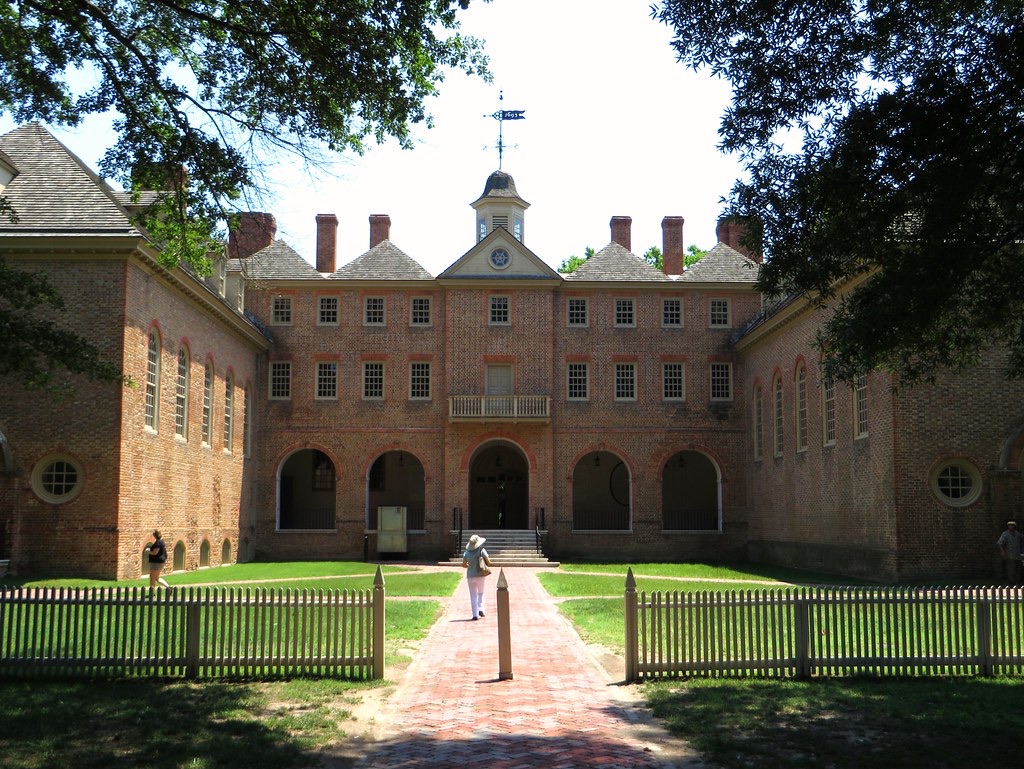
After Fort Christanna closed, Charles Griffin moved to Williamsburg to teach the Indian students at the college. In 1723 a separate brick building, the Brafferton, was built for the school next to the main college building, and it still stands on the William & Mary campus.[8][2]
Boys from many nations attended over the years. Among Virginia’s peoples, the Pamunkey, Nansemond, Chickahominy, Cheroenhaka Nottoway, Rappahannock, Upper Mattaponi and Nottoway sent sons to be educated there.[2] Some students went home and became interpreters or leaders; others died young far from their families, and many returned to their own ways of life. Colonial writers admitted that the results were disappointing. Some Native leaders were willing to let their children learn English ways while making clear that they themselves would not give up their own customs.
The money for the school came from England, and when the American Revolution cut off the rents from the Brafferton estate, the school closed.[2]
What colonial writers admitted
The Reverend Hugh Jones, a mathematics professor at the college, published The Present State of Virginia in 1724. He blamed the poor results of a century of missionary effort partly on the colonists themselves: church leaders in England, he wrote, knew too little about the origins, character and government of the Native peoples they hoped to convert, so money and labor had been spent in vain. The same book records that Native leaders at Fort Christanna were willing to leave children in the schoolmaster’s care while asking to be excused from changing their own customs, and expected the children to choose for themselves, once grown, whether to live as English or as Indians.[11]
Indian schools after the Civil War
Virginia’s constitution of 1870 created the state’s first public school system, but it was segregated. Alongside schools for white and Black children, separate Indian schools grew up, some on reservations, like the Pamunkey and Mattaponi schools, and others near tribal communities, such as the Sharon and Samaria schools, the Tsena Commocko Indian School, the Bear Mountain Indian School in Amherst County and the Nansemond Indian School. Research by the Library of Virginia has identified at least fourteen Indian schools in the state over time.[2]
These schools usually went only to the seventh or eighth grade. Native students who wanted to go further generally had to leave Virginia. From 1946 the state paid train fares for them to attend schools such as the Haskell Institute in Kansas, the Chilocco Indian Agricultural School and Bacone Junior College in Oklahoma, and the Cherokee Boarding School in North Carolina, as well as Oak Hill Academy in Grayson County. The separate system ended after the U.S. Supreme Court’s 1954 decision in Brown v. Board of Education.[2]
Hampton Institute and its Indian program
Virginia was also home to a federal Indian education program. Hampton Normal and Agricultural Institute, founded after the Civil War by Samuel Chapman Armstrong to educate formerly enslaved African Americans, began admitting Native American students in 1878. In April 1878 a group of Native prisoners of the Red River War arrived from Fort Sill, brought by Captain Richard Henry Pratt, and on November 5, 1878, a first party of students from Dakota Territory followed.[12] The program lasted until 1923 and influenced many federal boarding schools in the West and Indian schools in the Northeast. Some of Virginia’s own tribal citizens also attended Hampton.[2]
Timeline
| Year | Event |
|---|---|
| 1561 | Paquiquineo (Don Luis) leaves the Chesapeake with Spanish explorers |
| 1570-1571 | Jesuit mission of Ajacán founded and destroyed |
| 1613-1614 | Pocahontas captured, instructed and baptized; marries John Rolfe |
| 1619 | Virginia Company approves a university with an Indian college at Henrico |
| 1622 | March 22 attack; George Thorpe killed; college never built |
| 1624 | College charter revoked (June 16) |
| 1693 | College of William & Mary chartered |
| 1714-1717 | Indian school at Fort Christanna |
| 1723 | Brafferton building completed in Williamsburg |
| 1770s | Brafferton school closes during the Revolution |
| 1870 | Segregated public schools; separate Indian schools follow |
| 1878-1923 | Native American students at Hampton Institute |
| 1946-1954 | State pays for Native students to study outside Virginia |
| 1954 | Brown v. Board of Education begins the end of segregated schools |
Frequently asked questions
What was the first school for Native Americans in Virginia? A college for Native boys was planned at Henricus by 1619 but never built. The first school that actually operated was at Fort Christanna, from 1714 to 1717.
What was the Brafferton? The Indian school of the College of William & Mary, funded by the estate of Robert Boyle through rents from an English estate called the Brafferton. Its 1723 building still stands on campus.
Who was Don Luis? Paquiquineo, a Virginia Indian who lived in Spain and New Spain in the 1560s and guided Spanish Jesuits back to the Chesapeake in 1570, then left them and led the attack that ended the mission in 1571.
When did separate Indian schools in Virginia end? After the Supreme Court’s Brown v. Board of Education decision of 1954.
References
- [1] Encyclopedia Virginia, Nottoway Indian Tribe of Virginia – last checked 11/20/2026
- [2] Library of Virginia, Uncommonwealth blog, Indigenous Education in Virginia (April 17, 2024) – last checked 11/20/2026
- [3] Encyclopedia Virginia, Don Luís de Velasco / Paquiquineo (fl. 1561–1571) – last checked 11/20/2026
- [4] Encyclopedia Virginia, Juan Baptista de Segura (1529–1571) – last checked 11/20/2026
- [5] Encyclopedia Virginia, Pocahontas (d. 1617) – last checked 11/20/2026
- [6] Encyclopedia Virginia, George Thorpe (bap. 1576–1622) – last checked 11/20/2026
- [7] Encyclopedia Virginia, Alexander Spotswood (1676–1740) – last checked 11/20/2026
- [8] Library of Virginia, Document Bank of Virginia, Letter from Lt. Gov. Alexander Spotswood About Educating Indians, 1711 – last checked 11/20/2026
- [11] Project Gutenberg, Hugh Jones, The Present State of Virginia (1724; 1865 reprint) – last checked 11/20/2026
- [12] Hampton University, HU History – last checked 11/20/2026