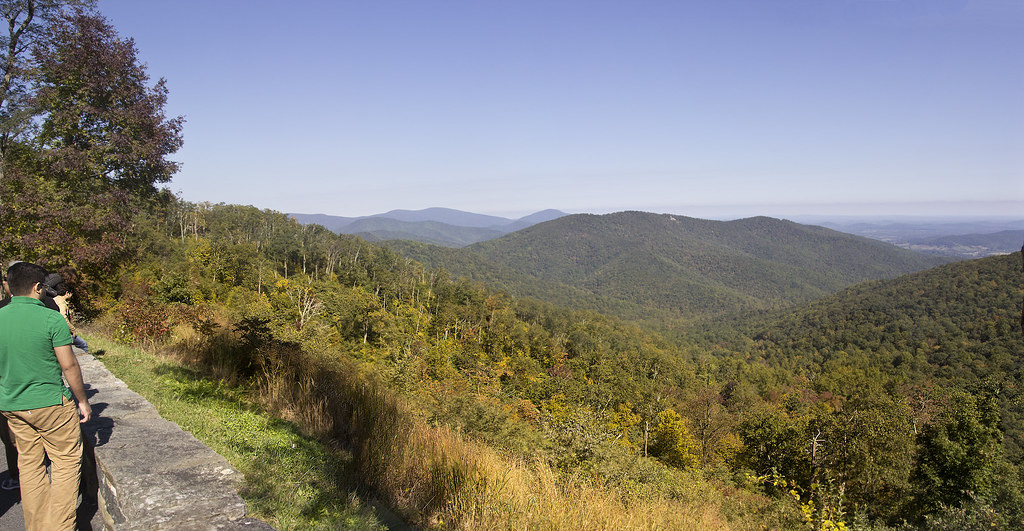
The Blue Ridge got its name from the bluish haze that hangs over its forested slopes, a natural haze produced by the trees themselves. For much of the late 20th century, that blue was buried under a gray-white murk of pollution, mostly sulfate particles drifting from coal-burning power plants upwind. Rain falling on the mountains was acidic enough to harm streams and fish. Since the 1990s Virginia’s air has improved dramatically, thanks largely to federal law, but ground-level ozone around Washington and nitrogen pollution in the mountains remain problems.
Quick answer: Air quality in Virginia is regulated under the federal Clean Air Act, which sets national standards for six “criteria” pollutants: ground-level ozone, particulate matter, carbon monoxide, lead, sulfur dioxide and nitrogen dioxide. The only part of Virginia that fails the current (2015) ozone standard is Northern Virginia, part of the Washington, DC-MD-VA nonattainment area, classified “moderate.” Virginia has two Class I areas, the James River Face Wilderness and Shenandoah National Park,, with the highest protection for visibility. Acid rain has been reduced mainly by the Acid Rain Program of the 1990 Clean Air Act Amendments, the first national cap-and-trade program, which capped power plant sulfur dioxide at 8.95 million tons by 2010, about half the 1980 level.[1][2][3][4]
Contents
- The Clean Air Act and the six pollutants
- Ground-level ozone and Northern Virginia
- Haze over the Blue Ridge
- Acid rain
- Cap and trade: how sulfur dioxide was cut
- The other ozone: protecting the stratosphere
- Air pollution today
- Timeline
- Frequently asked questions
- References
The Clean Air Act and the six pollutants
Congress passed the first Clean Air Act in 1963 and greatly strengthened it in 1970, the year the U.S. Environmental Protection Agency was created. Major amendments followed in 1977 and 1990. Under the act, the EPA sets National Ambient Air Quality Standards for six common pollutants that harm health and the environment. Each standard has a numerical limit and a way of averaging the measurements; for ozone, the current standard, set in 2015, is 0.070 parts per million averaged over eight hours.[1]
States carry out the law through state implementation plans. In Virginia, the State Air Pollution Control Board and the Department of Environmental Quality issue permits for factories and power plants, run a statewide network of air monitors and write the plans that show how areas that fail a standard will come into compliance.
Ground-level ozone and Northern Virginia
Ozone near the ground is not emitted directly. It forms when nitrogen oxides, mostly from vehicles and power plants, react with volatile organic compounds, from gasoline vapors, solvents and other sources, in strong sunlight. That is why ozone peaks on hot, still summer afternoons. Ozone irritates and damages the lungs, worsens asthma and harms crops and trees.[5]
The Washington metropolitan area has struggled with ozone for decades because of its traffic and its summer weather. Under the 2015 ozone standard, the EPA designated the Washington, DC-MD-VA area as nonattainment, now classified “moderate.” The Virginia portion includes nine counties and cities with about 2.2 million residents.[2] The rest of Virginia meets the current ozone standard.
Being labeled nonattainment has real consequences: new factories must use the cleanest technology and offset their emissions, and transportation plans must show that new highways will not push the region further over the limit.
Haze over the Blue Ridge
Haze is made of tiny particles that scatter light, mostly sulfates from sulfur dioxide, nitrates from nitrogen oxides, and organic particles. On the worst days in the 1980s and 1990s, visitors at Skyline Drive overlooks could barely see the next ridge.
Shenandoah National Park is one of only 49 Class I air areas managed by the National Park Service, the category that receives the highest level of protection under the Clean Air Act. Park staff, working with the NPS Air Resources Division, run a monitoring station near Big Meadows that measures visibility, acid deposition and ozone. The park reports that ozone, sulfur and visibility are all improving, while nitrogen deposition is neither improving nor getting worse.[6] The James River Face Wilderness in the Jefferson National Forest, south of the James River near Glasgow, is Virginia’s other Class I area.[3]
In 1999 the EPA adopted the Regional Haze Rule, which requires states to set goals and long-term strategies to return Class I areas to natural visibility conditions, revised every ten years.[7] Because much of the haze at Shenandoah comes from outside Virginia, the plan depends on cuts in emissions across the eastern United States.
Acid rain
Acid rain, or more broadly acid deposition, includes rain, snow, fog and even dry dust that contain sulfuric or nitric acid. It forms when sulfur dioxide and nitrogen oxides from burning fossil fuels react with water, oxygen and other chemicals in the atmosphere and are carried by the wind, sometimes hundreds of miles.[8]
Virginia’s mountains were especially vulnerable. Many streams in the Blue Ridge drain hard, sandy and granitic rocks that have little natural ability to neutralize acid, so acid rain lowered their pH and released aluminum from the soil. In the most acidic streams, sensitive fish and insects such as brook trout and mayflies struggle to survive. The damage was worse farther north, in the Adirondacks and New England, which sit downwind of the Ohio Valley’s power plants, but Virginia’s high-elevation streams were among the most affected in the South.
Cap and trade: how sulfur dioxide was cut
Title IV of the 1990 Clean Air Act Amendments created the Acid Rain Program. Its goal was to cut annual sulfur dioxide emissions by 10 million tons below 1980 levels. Instead of telling each plant what equipment to install, the EPA set a national cap and gave power plants allowances, each worth one ton of sulfur dioxide. Plants that cut emissions below their allowances could sell or bank the extras; plants that polluted more had to buy them.[4]
Phase I began in 1995 with 263 units at 110 mostly coal-burning plants in 21 eastern and midwestern states; Phase II, from 2000, covered more than 2,000 units. The final cap, reached in 2010, was 8.95 million tons, about half of what the power sector emitted in 1980. The program also required a two-million-ton cut in nitrogen oxides.[4] It was the first national cap-and-trade program, and it reduced emissions faster and more cheaply than most predictions. Later rules on power plant pollution that crosses state lines, and the closure of many coal plants, cut emissions much further.[9]
Recovery of damaged streams is slower than the drop in emissions. Soils that lost calcium and magnesium over decades of acid rain take a long time to rebuild, so some mountain streams in Virginia are still too acidic for their original fish communities.
The other ozone: protecting the stratosphere
High in the stratosphere, ozone is helpful: it blocks ultraviolet radiation that damages living cells. In the 1980s scientists confirmed that chlorofluorocarbons (CFCs) and related chemicals used in refrigerators, air conditioners and aerosol cans were destroying stratospheric ozone, creating the “ozone hole” over Antarctica.
The response was one of the most successful environmental agreements in history. The United States signed the Montreal Protocol in 1987; it has been ratified by 197 countries, the first treaty in United Nations history to achieve universal ratification, and it is gradually eliminating production of ozone-depleting substances.[10] Virginia law also prohibits certain materials containing fully halogenated chlorofluorocarbons.[11]
Air pollution today
Virginia’s air is far cleaner than it was in 1990. Many coal-fired power plants have closed or switched to natural gas, cars are much cleaner, and power plant sulfur dioxide emissions have fallen far below the 1990s levels.[9] The main remaining problems are summer ozone in Northern Virginia, fine particles on some days, nitrogen deposition in the mountains, and greenhouse gases, which are covered in our page on climate change. For related topics, see Waste Management in Virginia and Energy in Virginia.
Timeline
| Year | Event |
|---|---|
| 1963 | First federal Clean Air Act |
| 1970 | Clean Air Act strengthened; EPA created |
| 1987 | Montreal Protocol signed |
| 1990 | Clean Air Act Amendments create the Acid Rain Program |
| 1995 | Phase I of sulfur dioxide cap-and-trade begins |
| 1999 | Regional Haze Rule adopted |
| 2010 | Final sulfur dioxide cap of 8.95 million tons reached |
| 2015 | Eight-hour ozone standard tightened to 0.070 ppm |
Frequently asked questions
Does Virginia have bad air quality? Most of Virginia meets federal air standards. Northern Virginia, as part of the Washington area, does not meet the 2015 ozone standard.[2]
Why is the Blue Ridge hazy? Part of the haze is natural, from compounds released by trees, but much of it has been pollution, mainly sulfate particles from power plants. Visibility at Shenandoah National Park has been improving.[6]
Does acid rain still fall in Virginia? Yes, but much less acid than in the 1980s, after sulfur dioxide emissions were cut under the Acid Rain Program and later rules.[4][9]
What are Virginia’s Class I air quality areas? Two: the James River Face Wilderness and Shenandoah National Park.[3]
References
- U.S. Environmental Protection Agency, “NAAQS Table.” https://www.epa.gov/criteria-air-pollutants/naaqs-table
- U.S. Environmental Protection Agency, Green Book, “8-Hour Ozone (2015) Designated Area/State Information.” https://www3.epa.gov/airquality/greenbook/jbtc.html
- U.S. Environmental Protection Agency, “List of Areas Protected by the Regional Haze Program.” https://www.epa.gov/visibility/list-areas-protected-regional-haze-program
- U.S. Environmental Protection Agency, “Acid Rain Program.” https://www.epa.gov/acidrain/acid-rain-program
- U.S. Environmental Protection Agency, “Ground-level Ozone Basics.” https://www.epa.gov/ground-level-ozone-pollution/ground-level-ozone-basics
- National Park Service, Shenandoah National Park, “Air Quality.” https://www.nps.gov/shen/learn/nature/airquality.htm
- U.S. Environmental Protection Agency, “Regional Haze Program.” https://www.epa.gov/visibility/regional-haze-program
- U.S. Environmental Protection Agency, “What is Acid Rain?” https://www.epa.gov/acidrain/what-acid-rain
- U.S. Environmental Protection Agency, “Power Sector Programs – Progress Report.” https://www.epa.gov/power-sector/progress-report
- U.S. Environmental Protection Agency, “International Actions – The Montreal Protocol on Substances that Deplete the Ozone Layer.” https://www.epa.gov/ozone-layer-protection/international-actions-montreal-protocol-substances-deplete-ozone-layer
- Code of Virginia § 10.1-1424.1, Material containing fully halogenated chloro-fluorocarbons prohibited. https://law.lis.virginia.gov/vacode/title10.1/chapter14/section10.1-1424.1/