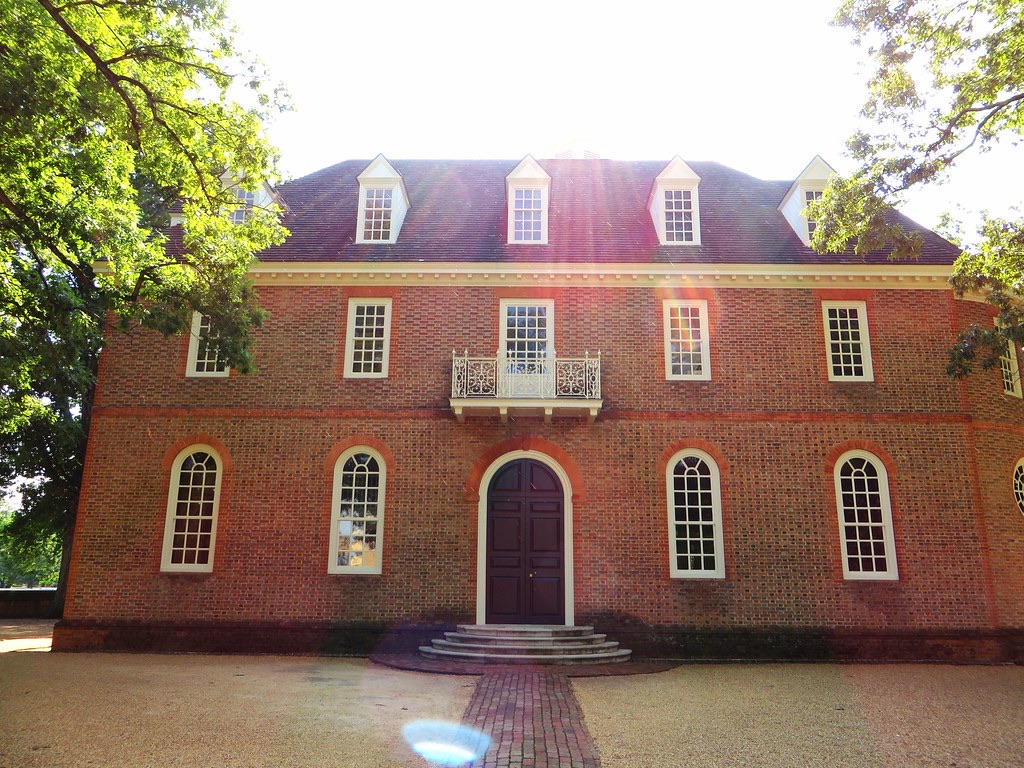
Richmond has been the seat of Virginia’s government since 1780, but it is the third English capital on the map and far from the first seat of power in the region. Before the colonists came, the Powhatan paramount chief ruled coastal Virginia from towns on the York and Pamunkey rivers. After 1607 the colony governed itself from Jamestown, then from Williamsburg, and finally from Richmond. War pushed the legislature out of Richmond more than once, giving a handful of other towns a brief claim to the title.
Quick answer: Virginia’s colonial and state capitals were Jamestown (1607-1699), Williamsburg (1699-1780) and Richmond (1780 to today). In June 1781 the General Assembly fled British cavalry and met briefly in Charlottesville and then in Staunton. During the Civil War, Unionists ran a rival “Restored Government” from Wheeling and later Alexandria, while in April 1865 the Confederate state governor fled through Lynchburg and Danville to Chatham. Before 1607, Powhatan governed from Werowocomoco and, after 1609, from Orapax.[1][2][3]
Contents
- Capital or capitol?
- Powhatan’s capitals
- Jamestown, 1607-1699
- Williamsburg, 1699-1780
- The move to Richmond in 1780
- Charlottesville and Staunton, 1781
- Richmond in the Civil War
- Danville, Lynchburg and Chatham, April 1865
- Why the capital never moved west
- Timeline
- Frequently asked questions
Capital or capitol?
The two words are easy to mix up. A capital is the city that serves as the seat of government. A capitol is the building in which the legislature meets. Jamestown had a series of statehouses, some of them private buildings borrowed or bought for public use; Williamsburg built the colony’s first purpose-made Capitol, an H-shaped brick building finished in 1704; Richmond’s Capitol, designed by Thomas Jefferson, has housed the General Assembly since October 1788.[3]
Powhatan’s capitals
When English ships entered the Chesapeake in 1607, the land along the rivers belonged to Tsenacomoco, an alliance of dozens of Algonquian-speaking communities led by the paramount chief Powhatan (his personal name was Wahunsenacawh).[2] His seat was Werowocomoco, on the north shore of what is now the York River in Gloucester County. Archeology shows people used the site for thousands of years and that a town with homes and fields grew there from about 1200 AD. It was there that Powhatan received John Smith and other English leaders, and where Pocahontas spent her childhood. Archeologists confirmed the location in 2002, and the National Park Service now cares for it together with tribal nations.[1]
Werowocomoco was not Powhatan’s first home. He came to power at a town called Powhatan near the falls of the river the English renamed the James, close to modern Richmond, and expanded his authority eastward before settling at Werowocomoco. In 1609, as tension with the colonists grew, he moved his people west to Orapax, closer to the swampy headwaters of the Chickahominy.[1] Later centers of the chiefdom lay along the Pamunkey River, where Powhatan’s brother and successor Opechancanough lived. The chiefdom’s power broke after the wars of 1622 and 1644, and no later chief held the same paramount authority.[2]
The two seats of power were close to each other. Werowocomoco and Jamestown were only a short trip apart by water, which helps explain how quickly diplomacy, trade and conflict developed between them.
Jamestown, 1607-1699
The Virginia Company’s colonists made Jamestown their seat of government in 1607, and the first General Assembly met in the church there in the summer of 1619, more than a year before the Pilgrims reached Plymouth.[3] Jamestown remained the capital for 92 years, but it never became much of a town. Government met in the church, in a row of houses built by Governor William Berkeley, in a tavern, and in a series of statehouses.[3]
Fire decided its fate. During Bacon’s Rebellion in September 1676, Nathaniel Bacon’s followers burned the town, including the church and the statehouse. A rebuilt statehouse was in use by about 1685, but in 1698 another fire, said to have been started by a prisoner in the nearby jail, destroyed the prison and the statehouse.[4] The next year the government left.
Williamsburg, 1699-1780
In 1699 the General Assembly moved the capital to Middle Plantation, on higher and healthier ground in the middle of the peninsula between the James and York rivers, and renamed it Williamsburg in honor of King William III.[3] Governor Francis Nicholson laid out a planned town: the legislature’s act called for “a new and well-ordered city,” and the Capitol was placed at one end of the main street with the College of William & Mary at the other. Within about two decades the town had a Capitol, a governor’s palace, a jail, a courthouse, a magazine and a theater. Williamsburg received a royal charter as a city in 1722, making it the first chartered city in Virginia.[5]
Until the first Capitol was ready, legislators met in the Wren Building of the college. The Capitol burned in 1747, and the Assembly met elsewhere until a second Capitol on the same plan opened in 1753. In that second building, in June 1776, Virginians declared independence from Britain and adopted their first state constitution.[3]
Williamsburg’s weakness was its location. It sat inland from both rivers, away from deep water, and the burgesses argued several times during the colonial period about moving the seat of government to a port.[6] The Revolution finally settled the question.
The move to Richmond in 1780
In 1779, at Governor Thomas Jefferson’s urging, legislators approved an act shifting the seat of government to Richmond. The act described Williamsburg as exposed to attack by the enemy. Richmond was then a small town of roughly 600 people, but it lay on a navigable river at the fall line, it was more convenient for the growing population west of Tidewater, and it was out of reach of British warships that had already burned Norfolk.[7]
In April 1780 the government’s records, books and furniture went up the James by boat, and the legislators met in Richmond in May. No public buildings existed yet. The House of Delegates is believed to have used a tobacco warehouse taken from a loyalist, and the legislature later rented two commercial buildings at 14th and Cary streets.[7][3] Six squares on Shockoe Hill were set aside for public buildings, and Jefferson’s classical Capitol opened there in 1788.[3]
Williamsburg paid a price. After 1780 its city government declined with the town; the Commonwealth deeded the old Capitol and the Palace to the city in 1782, and the Palace burned that same year.[5] That long economic slumber is one reason so many colonial buildings survived to be restored in the twentieth century.
Charlottesville and Staunton, 1781
Distance alone did not make Richmond safe. In January 1781 a British force of close to 2,000 soldiers under Benedict Arnold entered the city, destroyed powder mills, cannons and gunpowder, burned public buildings and destroyed some records, while about 200 militiamen failed to stop them.[7]
That spring the legislators retreated to Charlottesville. Lieutenant General Cornwallis learned of the move and sent Lieutenant Colonel Banastre Tarleton’s cavalry to capture Jefferson and the legislators. Jack Jouett of the militia rode about 40 miles through the night of June 3-4 to warn them. Jefferson escaped from Monticello and went on to his Poplar Forest plantation near Lynchburg; seven members of the Assembly were captured.[8]
Jefferson’s term had ended on June 2, and in the confusion no successor had been chosen, so for almost a week Virginia had no functioning governor. The legislators crossed the Blue Ridge and met in Augusta Parish Church in Staunton (today Trinity Episcopal Church) from June 7 to June 23, 1781.[8][9] There, on June 12, they elected General Thomas Nelson governor. A Windsor chair used in that session is still displayed in the church, and a marker in the churchyard lists the members who met there.[9] The Assembly returned to Richmond in October 1781.[3]
Charlottesville and Staunton therefore served, for a few weeks, as emergency seats of the state government.
Richmond in the Civil War
Richmond’s role grew in 1861. After Virginia left the Union, the city became the capital of the Confederate States as well as of the state, and it remained the Confederacy’s seat of government until April 1865.[10] In the eyes of the Confederacy, Richmond was at once a city, a state capital and a national capital.
Unionists saw things differently. Delegates from the northwestern counties met at Wheeling in June 1861 and organized the Restored Government of Virginia, which the federal government recognized as the lawful government of the state. When West Virginia became a separate state in 1863, the Restored Government moved to Alexandria, and after the war it moved to Richmond. For the full story of that split, see the Virginia–West Virginia border.
Danville, Lynchburg and Chatham, April 1865
On Sunday, April 2, 1865, Jefferson Davis received word from General Robert E. Lee that the Petersburg lines had fallen and Richmond would have to be abandoned.[11] Davis and his cabinet left by train on the Richmond and Danville Railroad and stayed in Danville for eight days, using the home of tobacco industrialist William T. Sutherlin; it was there that Davis learned of Lee’s surrender at Appomattox.[10] The Sutherlin Mansion, built about 1859, now houses the city’s art and history museum and is often called the last capitol of the Confederacy.[10]
Danville was a Confederate seat, not a Virginia one. The state’s own government had a stranger journey. Governor William “Extra Billy” Smith left Richmond on horseback for Lynchburg, found no safety there, and rode on to Danville, arriving on April 10 just as word of the surrender came in. He set up headquarters in town, issued a proclamation, and then withdrew to the nearby village of Competition, now Chatham, the seat of Pittsylvania County. The Pittsylvania Historical Society argues that his stay made Chatham the state capital “for a few hours” on April 15, 1865. Smith surrendered in Richmond on June 13 and handed over state property to the Unionist governor, Francis Pierpont.[11]
Since then Richmond’s status has never been in doubt. Apart from the brief wartime interludes, Richmond has served as the seat of Virginia government without a break, and the legislature still meets in Jefferson’s building.[3][7]
Why the capital never moved west
Moving the capital from Williamsburg to Richmond followed the population as it spread inland. After 1780 the settled area kept moving west across the Blue Ridge and the Alleghenies, yet the capital stayed at the fall line. Before the Civil War, western Virginians complained that eastern planters controlled the legislature, one of the grievances that fed the creation of West Virginia.
The issue has not disappeared. Southwest Virginia, the corner of the state farthest from Richmond, lies hundreds of miles from the Capitol by road. North Carolina offers one model for bridging that kind of distance: it keeps a Governor’s Western Residence on a mountain above Asheville, a house given to the state in 1964 that has hosted governors and civic groups ever since.[12] Virginia has no equivalent, and its governors and legislators continue to work almost entirely from Richmond.
Timeline
| Year | Event |
|---|---|
| c. 1200 | Town develops at Werowocomoco on the York River |
| 1607 | English colonists found Jamestown; Powhatan rules from Werowocomoco |
| 1609 | Powhatan moves inland to Orapax |
| 1619 | First General Assembly meets in the Jamestown church |
| 1676 | Bacon’s Rebellion burns Jamestown and its statehouse |
| 1698 | Fire destroys the last Jamestown statehouse |
| 1699 | Capital moves to Middle Plantation, renamed Williamsburg |
| 1704 | First Williamsburg Capitol completed |
| 1722 | Williamsburg receives a city charter |
| 1747-1753 | Capitol burns and is rebuilt |
| 1779 | Assembly votes to move the capital to Richmond |
| 1780 | Government moves to Richmond |
| January 1781 | Benedict Arnold’s raid on Richmond |
| June 1781 | Assembly meets in Charlottesville, then in Staunton |
| 1788 | Jefferson’s Capitol opens in Richmond |
| 1861 | Richmond becomes the Confederate capital; Restored Government organized at Wheeling |
| 1863 | Restored Government moves to Alexandria |
| April 1865 | Davis in Danville; Governor Smith flees through Lynchburg and Danville to Chatham |
Frequently asked questions
What was the first capital of Virginia? For the English colony, Jamestown, from 1607 to 1699. Before that, Powhatan’s paramount chiefdom was governed from Werowocomoco on the York River.[1][3]
Why did Virginia move its capital from Williamsburg to Richmond? Williamsburg was exposed to British attack and hard to reach for the growing western population. Richmond sat on a navigable river, farther inland, and was more central.[7]
Was Charlottesville ever the capital of Virginia? Only briefly. The General Assembly met there in late May and early June 1781 before fleeing Tarleton’s cavalry to Staunton.[8]
Was Danville the capital of Virginia? No. Danville was the last seat of the Confederate government in April 1865, but Virginia’s own government never moved there officially.[10]
When was the Virginia State Capitol built? The General Assembly moved into Thomas Jefferson’s Capitol in Richmond in October 1788.[3]
See also: Jamestown: why there?, Virginia colony government, Virginia cities and towns.
References
- National Park Service, Captain John Smith Chesapeake National Historic Trail, “Werowocomoco.” https://www.nps.gov/cajo/planyourvisit/werowocomoco.htm
- National Park Service, “Powhatan.” https://www.nps.gov/people/powhatan.htm
- Virginia General Assembly, “Three Capital Cities.” https://vga.virginia.gov/visit/about-capitol/three-capital-cities/
- National Park Service, Historic Jamestowne, “A Short History of Jamestown.” https://www.nps.gov/jame/learn/historyculture/a-short-history-of-jamestown.htm
- City of Williamsburg, “History of City Government.” https://www.williamsburgva.gov/490/History-of-City-Government
- Alonzo T. Dill and Brent Tarter, “The ‘hellish Scheme’ to Move the Capital,” Virginia Cavalcade 30, no. 1 (Summer 1980), Library of Virginia. http://www.lva.virginia.gov/public/guides/cavalcade/volumes/v21_30/sum80.htm
- Library of Virginia, Document Bank of Virginia, “Act to Remove the Seat of Government to Richmond, 1779.” https://edu.lva.virginia.gov/dbva/items/show/319
- U.S. National Archives, Pieces of History, “Thomas Jefferson: Governor of Virginia, Part II” (May 16, 2013). https://prologue.blogs.archives.gov/2013/05/16/thomas-jefferson-governor-of-virginia-part-ii/
- Trinity Episcopal Church, Staunton, “History.” https://trinitystaunton.org/about-us/history/
- Danville Museum of Fine Arts and History, “History.” https://www.danvillemuseum.org/history
- Pittsylvania Historical Society, “Chatham: Virginia’s Capital for A Day,” The Pittsylvania Packet (Winter 1999). https://www.victorianvilla.com/sims-mitchell/local/articles/phsp/051/
- Our State, “NC Governor’s Mansion in Asheville.” https://www.ourstate.com/governors-mansion-west/