Every Virginian is either a migrant or descended from one. The first people walked in thousands of years before any written record; the English sailed in from the east; Africans were brought by force; Germans and Scots-Irish came down from Pennsylvania; and in the last 80 years newcomers from other states and from Latin America, Asia and Africa have remade the population again. This page follows those waves in order and shows what the census data say about where today’s residents were born.
Quick answer: Virginia was peopled in several waves: Native Americans whose ancestors reached the continent at least 15,000 years ago, English colonists from 1607, enslaved Africans from 1619, German and Scots-Irish settlers moving south from Pennsylvania in the 1700s, and, since World War II, large numbers of people from other states and other countries. In 2025 about 1.24 million Virginians, or 13.9 percent of residents, were born abroad, up from 12.2 percent in 2015.[1]
Contents
- The first arrivals
- The English come from the sea
- Servants, convicts and the enslaved
- A frontier settled from the north
- Spotswood’s buffer against the French
- Through the gaps: Roanoke and Cumberland
- The center of the nation moves west
- A century of leaving, 1850-1940
- Newcomers after World War II
- Immigration today
- Who decides who becomes a citizen
- Timeline
- Frequently asked questions
The first arrivals
The oldest migration into Virginia left no documents, only stone tools and campsites. The most widely accepted explanation is that the ancestors of Native Americans crossed from northeast Asia during the last Ice Age, when lower sea levels exposed a broad plain between Siberia and Alaska that scientists call Beringia. The National Park Service, which manages the Bering Land Bridge National Preserve, describes this landscape as the route by which people first entered the Americas.[2] Over many generations their descendants spread across the continent and reached the Atlantic coast.
Archaeologists continue to debate the exact timing and whether some groups followed the Pacific coastline by boat instead of an inland corridor. A minority have argued for contact across the North Atlantic as well, but that idea remains unproven. Whatever the route, people were living in what is now Virginia for well over 10,000 years before Europeans arrived, and their cultures changed many times over that span. Our guides to Native peoples of Virginia and Native American trails and travel cover that long history.
One way to put the colonial period in proportion: 1606 was the final year in which everyone living in Virginia had been born in North America. Everything since then, roughly four centuries, is a short chapter in a much longer story of human settlement.
The English come from the sea
European settlement reversed the direction of movement. The Virginia Company’s colonists crossed the Atlantic and landed at Jamestown in May 1607, and for the next century the colony grew outward from the tidal rivers.[3] Ships could reach plantation wharves along the James, York, Rappahannock and Potomac, so tobacco could be loaded close to where it was grown. That advantage ended at the fall line, where rapids blocked ocean-going vessels.
Because overland hauling by wagon cost far more than water transport, settlers were slow to move inland. Farmers above the falls paid much of their earnings simply to get crops to ports such as Alexandria or, further afield, Baltimore and Philadelphia. For roughly two centuries most of the colonial population stayed within reach of the coast, and the Piedmont filled in gradually, river valley by river valley.
Servants, convicts and the enslaved
Most early migrants did not arrive free. Historian Christopher Tomlins, reviewing the research on colonial labor in 2001, estimated that between 470,000 and 515,000 Europeans migrated to the mainland colonies through 1780. About 54,500 of them were convicts or prisoners shipped against their will, mostly in the 1700s. Of the voluntary migrants, Tomlins calculated that close to half bound themselves to a term of indentured service; in the 1600s the share was even higher, around 60 to 65 percent.[4] Virginia’s tobacco economy was one of the main destinations for these servants.
The same study put the number of enslaved Africans brought into the mainland colonies at between 285,000 and 310,000, most of them after 1680.[4] The first recorded Africans in English Virginia arrived at Point Comfort in 1619. Over the following decades the colony’s laws turned servitude for a term into slavery for life, inherited through the mother, and by 1790 about two in five Virginians were enslaved. Our page on slavery in Virginia tells that history in detail.
A frontier settled from the north
East of the Blue Ridge, settlement moved westward from the coast. West of it, the pattern was different. The Shenandoah Valley and the other long valleys of the Valley and Ridge were mostly settled by people who came down from Pennsylvania, not across the mountains from Tidewater.
Many of these settlers were immigrants who had landed at Philadelphia: Germans from the Rhineland and Palatinate, and Presbyterian Scots-Irish from Ulster. Good land near Philadelphia was already expensive, so they followed the valleys southwest along an old Native American path that became known as the Great Wagon Road. They brought their own churches with them. The Scots-Irish founded Presbyterian congregations, while the Germans built Lutheran, Reformed, Brethren (Dunker) and Mennonite churches, a pattern still visible in the Shenandoah Valley.
The Blue Ridge is often described as a wall that held back settlers from the east, but it was only part of the explanation. In the 1720s and 1730s much of the Piedmont was still thinly occupied, and a planter’s son could claim new land without crossing the mountains at all. When English families from the east finally did cross into the lower Valley, they found Germans and Scots-Irish already there. The eastern edge of Frederick County, settled largely by Anglican planters from Tidewater, later became Clarke County, and the two counties kept noticeably different characters.
Spotswood’s buffer against the French
Colonial officials had strategic reasons to welcome non-English settlers on the frontier. Lieutenant Governor Alexander Spotswood, who ran the colony from 1710 to 1722, worried that France would claim the lands west of the mountains by linking its posts in Canada with those on the Mississippi. The maps of his time placed the Great Lakes too far south, making the French seem closer than they really were.
In 1714 Spotswood settled a group of German miners and their families on the Rapidan River, at a fort called Germanna in what is now Orange County. More German families followed in 1717.[5] The idea, repeated later in the Valley, was to place communities of settlers between the established plantations and any threat from the west, where they could farm, guard the passes and give early warning of an attack. Spotswood himself led an expedition across the Blue Ridge in 1716.
His fears were not baseless. During the French and Indian War in the 1750s, French-allied warriors raided frontier farms from the Winchester area south to the New River, and Virginia built a chain of frontier forts to protect them. Had France held the Ohio Valley, the language of the American interior might well have been French.
Through the gaps: Roanoke and Cumberland
Not every settler who came down the Great Wagon Road stayed in Virginia. Near present-day Roanoke the road turned east through the gap cut by the Roanoke River, and many families followed it into the upper Piedmont west of Lynchburg or continued south into North Carolina.
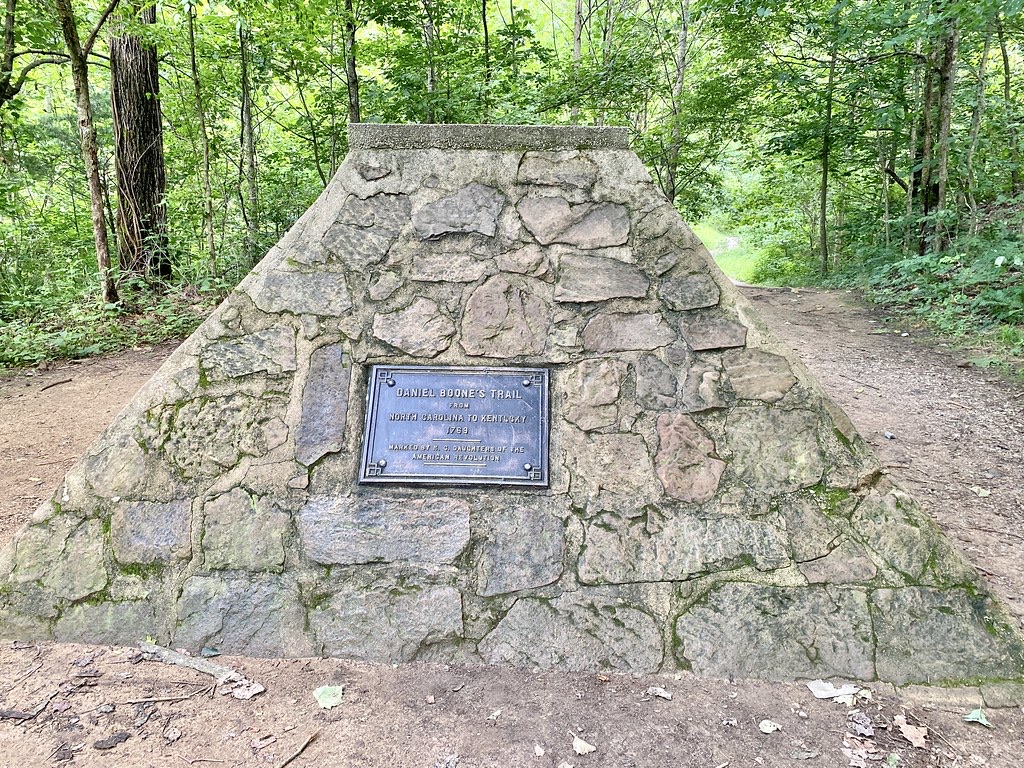
The Moravians who founded Bethabara in 1753 and later Salem, today’s Old Salem in Winston-Salem, came this way from Pennsylvania.[6] So did the family of young Daniel Boone, who settled on the Yadkin River. Boone later explored westward and in 1775 marked a route through Cumberland Gap into Kentucky, the trail that became the Wilderness Road.[7] Tens of thousands of settlers followed it into Kentucky, which was part of Virginia until 1792. The modern descendant of this corridor is Interstate 81.
The center of the nation moves west
The Census Bureau calculates a “mean center of population” for every census: the point where a flat map of the country would balance if every resident had the same weight. For four censuses in a row, 1810 through 1850, that point lay inside Virginia. In 1810 it was in Loudoun County, northwest of Washington; by 1850 it had drifted to a spot southeast of Parkersburg, in the part of the state that became West Virginia in 1863. By 1860 it had crossed into Ohio.[8]
The steady westward drift reflected the opening of new farmland beyond the Appalachians, and it carried political weight with it. As the population center moved west, new states entered the Union and Virginia’s share of the House of Representatives shrank. Our page on Virginia’s population history follows that decline.
A century of leaving, 1850-1940
From the middle of the 1800s until World War II, Virginia looked like most of the South: it gained few newcomers and lost many residents. A history of state migration patterns compiled at the University of Washington notes that, before 1940, people born in Virginia made up most of the population, and the state grew mainly because births outnumbered deaths while more people moved out than moved in.[9]
Two large outflows stand out. White and Black farm families left worn-out land in the Piedmont and Southside for cheaper land further west. Then, from about 1910, the Great Migration carried millions of African Americans from the South to cities in the North and Midwest, seeking work and escape from segregation and violence.[10] Many Black Virginians moved to Baltimore, Philadelphia, New York and Washington, D.C. Our page on race and Jim Crow in Virginia explains the laws that pushed many of them to go.
Newcomers after World War II
World War II turned the tide. Military bases and shipyards in Hampton Roads expanded, and the growing federal workforce in Washington spilled across the Potomac into new suburbs in Arlington and Fairfax. According to the University of Washington project, Virginia passed 3 million people by 1950, 5 million in the mid-1970s, 7 million by 2000 and 8 million a decade later, with migration supplying much of that growth.[9]
The newcomers came from new places. Neighboring states still sent many people, but the Northeast became a major source; in the 2000 census New York ranked second only to Virginia itself as the birthplace of Virginia residents, with Pennsylvania, New Jersey and Ohio also high on the list. Since about 2000, people born outside Virginia have outnumbered those born in the state.[9] Most of that growth has gone to the “urban crescent” from Northern Virginia through Richmond to Hampton Roads, as described on our urban population growth page.
Immigration today
Foreign immigration was modest in Virginia for most of the twentieth century. It has since become one of the main engines of growth. The Census Bureau estimates cited by USAFacts show about 1.24 million foreign-born Virginians in 2025, roughly one resident in seven, up from about 1 million in 2015.[1] Virginia’s share, 13.9 percent, is slightly below the national figure.
Immigrants are concentrated heavily in Northern Virginia. In the Washington metropolitan area about one resident in four (25.2 percent) was born abroad in 2025, while in the Kingsport metro area of far Southwest Virginia the figure was about 2 percent.[1] The University of Washington study counted more than 105,000 people born in El Salvador living in Virginia in 2022, about 250,000 from other Latin American countries, nearly 400,000 from Asia and about 150,000 from Africa.[9] Communities with roots in Korea, Vietnam, India, the Philippines, Ethiopia and Central America have reshaped neighborhoods in Fairfax, Prince William, Loudoun and Arlington counties and in the cities of Hampton Roads.
International arrivals have also kept Virginia growing when Americans were moving away. Old Dominion University’s 2021 State of the Commonwealth report found that between 2010 and 2020 more people left Virginia for other states than arrived from them, but net migration from abroad more than made up the difference. Natural increase (births minus deaths) stayed positive as well.[11]
Some immigrant stories are only now being documented. A 2019 exhibit at the University of Virginia, for example, traced the history of nurses from the Philippines who came to work in Virginia hospitals, many recruited during nursing shortages.[12]
Who decides who becomes a citizen
In the colonial era and the early republic, naturalization was handled by courts, and many state and local courts could grant citizenship. Congress set the rules, but procedures and records varied widely. In 1906 the federal government created a national naturalization service and standardized the forms, and over the following decades the process moved almost entirely into federal hands.[13] Naturalization records held by the National Archives are now one of the main sources for tracing immigrant ancestors.
Timeline
| Year | Event |
|---|---|
| 15,000+ years ago | Ancestors of Native Americans reach the Americas from Asia |
| 1607 | English colonists land at Jamestown |
| 1619 | First recorded Africans arrive at Point Comfort |
| 1714 | German colonists settle at Germanna on the Rapidan River |
| 1730s-1750s | Germans and Scots-Irish move south from Pennsylvania into the Valley |
| 1753 | Moravians from Pennsylvania found Bethabara in North Carolina |
| 1775 | Boone marks the Wilderness Road through Cumberland Gap |
| 1810-1850 | U.S. center of population lies in Virginia |
| c. 1910-1970 | Great Migration of Black Southerners to Northern cities |
| 1950 | Virginia passes 3 million residents |
| 2000s | Virginians born elsewhere outnumber those born in the state |
| 2025 | About 1.24 million foreign-born residents, 13.9 percent of the population |
Frequently asked questions
Where did most early Virginia settlers come from? Most free colonists in the 1600s came from England, many as indentured servants. In the 1700s Germans and Scots-Irish arrived in large numbers, mostly by way of Pennsylvania, and enslaved Africans made up a large share of all arrivals.
Why was the Shenandoah Valley settled from the north? Immigrants landing at Philadelphia found land there expensive and moved southwest along the Great Wagon Road. Meanwhile, Tidewater planters still had unclaimed land in the Piedmont and little reason to cross the Blue Ridge.
How many immigrants live in Virginia? About 1.24 million in 2025, or 13.9 percent of the population, according to Census Bureau data compiled by USAFacts.
Where do immigrants in Virginia live? Most live in Northern Virginia, where about a quarter of the Washington-area population was born abroad. Richmond and Hampton Roads have smaller but growing immigrant communities.
Is Virginia gaining or losing people through migration? In 2010-2020 Virginia lost more residents to other states than it gained from them, but immigration from abroad more than offset that loss.
References
- USAFacts, “How many immigrants are in Virginia?” (U.S. Census Bureau data, updated November 2026). https://usafacts.org/answers/how-many-immigrants-are-in-the-us/state/virginia/
- National Park Service, Bering Land Bridge National Preserve, “History & Culture.” https://www.nps.gov/bela/learn/historyculture/index.htm
- National Park Service, Historic Jamestowne, “A Short History of Jamestown.” https://www.nps.gov/jame/learn/historyculture/a-short-history-of-jamestown.htm
- Christopher Tomlins, “Reconsidering Indentured Servitude: European Migration and the Early American Labor Force, 1600-1775,” Labor History 42, no. 1 (2001). https://library.fes.de/libalt/journals/swetsfulltext/11116561.pdf
- Historic Germanna, “The People. Their Places. Their Stories.” https://germanna.org/
- Old Salem Museums & Gardens. https://www.oldsalem.org/
- National Park Service, Cumberland Gap National Historical Park, “History & Culture.” https://www.nps.gov/cuga/learn/historyculture/index.htm
- U.S. Census Bureau, “Centers of Population.” https://www.census.gov/geographies/reference-files/time-series/geo/centers-population.html
- James Gregory, “Virginia Migration History 1850-2022,” America’s Great Migrations Project, University of Washington. https://depts.washington.edu/moving1/Virginia.shtml
- National Archives, “The Great Migration (1910-1970).” https://www.archives.gov/research/african-americans/migrations/great-migration
- Old Dominion University, 2021 State of the Commonwealth Report, December 2021, pp. 45-46. https://ceapodu.com/wp-content/uploads/2021/12/2021SOC-FINAL-121621-.pdf
- UVA Today, “New Exhibit Uncovers the History of Filipino Nurses in Virginia,” July 2, 2019. https://news.virginia.edu/content/new-exhibit-uncovers-history-filipino-nurses-virginia
- National Archives, “Naturalization Records.” https://www.archives.gov/research/naturalization