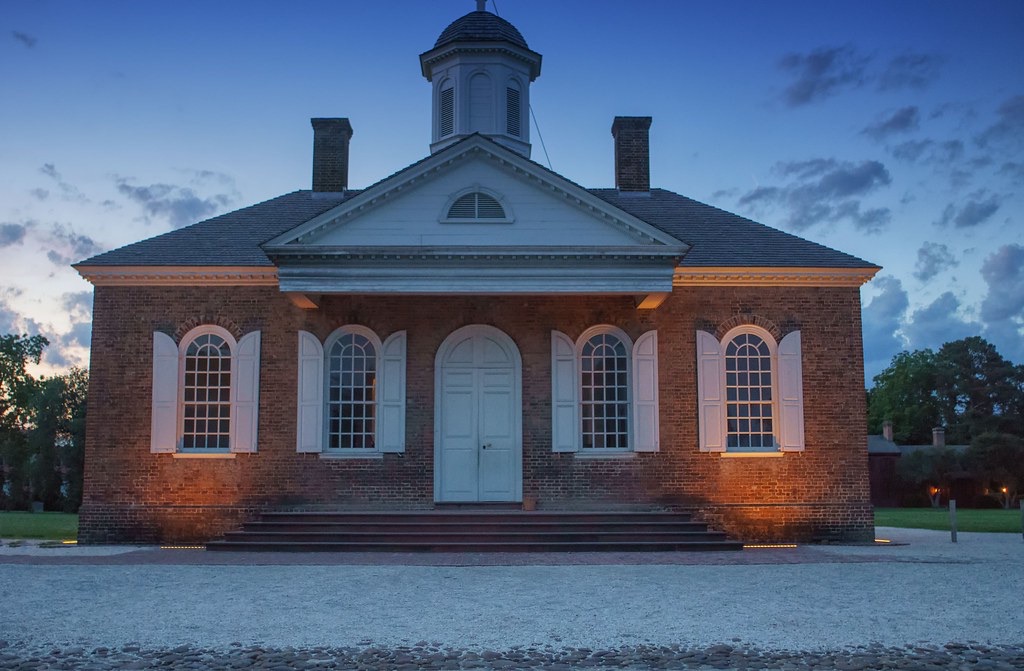
The first Virginians to vote for a legislature did so in 1619, when settlers chose burgesses for the first General Assembly at Jamestown. For more than two centuries afterward, voting meant something very different from today: a small group of landowning white men stood up at the county courthouse and announced their choice aloud, often after the candidates had treated them to food and drink. Most local officials were not elected at all. This page traces how voting changed, from property rules to the modern system of registrars, precincts, absentee ballots and same-day registration. For the ways Virginians were kept from voting, see disfranchisement in Virginia; for women’s long fight for the ballot, see women’s suffrage in Virginia.
Quick answer: In colonial and early state Virginia, only white men who owned a set amount of land could vote, and they voted aloud. The Constitution of 1830 opened the vote to white male taxpayers, and the Constitution of 1851 to all adult white men; voting by written ballot became required in 1864. Today any U.S. citizen aged 18 who lives in Virginia and is registered may vote. Elections are run by local electoral boards and registrars under the State Board and Department of Elections. Any registered voter may vote absentee, and voters may register in person up to and including Election Day.[1][2][3][4]
Contents
- Colonial elections
- Property requirements, 1736-1851
- Who was elected, and who was appointed
- From voice votes to the secret ballot
- How elections are run today
- Precincts and split districts
- Registering and casting a ballot
- Virginia’s election calendar and turnout
- Timeline
- Frequently asked questions
Colonial elections
The General Assembly first met in the church at Jamestown in 1619, with the governor, the council and burgesses chosen to represent the settlements.[5] Through the colonial period, the voters of each county elected two burgesses, a practice the 1776 constitution kept regardless of a county’s population.[1] Elections were held only when the governor called them, so the same House of Burgesses could sit for years.
Only men could vote or hold office, and the right was tied to property. There was no ballot: until 1864 voters announced their choices aloud, so everyone present, including the candidates, knew how each man voted.[1] Candidates were expected to be generous hosts on election day, a custom that lasted long after independence.
Property requirements, 1736-1851
Under a law of 1736, which Virginia’s 1776 constitution kept in force, a voter had to be an adult white man who owned or held a long lease on at least 100 acres of land, or 50 acres and a house, or who owned a lot in Williamsburg or Norfolk.[1] The Revolution did not change who could vote. The leaders of 1776 believed that only men with a lasting stake in the land were independent enough to vote freely.
As settlement spread west and towns grew, more and more white men were left out: sons of landowners, tenants, craftsmen and merchants in towns. The Constitution of 1830 relaxed the rule and let white men who paid taxes vote, which enlarged the electorate moderately. Only the Constitution of 1851 established universal white manhood suffrage, with no property or tax test.[1]
| Period | Who could vote |
|---|---|
| 1619-1736 | Free men, increasingly limited to landholders by colonial laws |
| 1736-1830 | White men with 100 acres, 50 acres and a house, or a town lot |
| 1830-1851 | White men meeting a property test or paying taxes |
| 1851-1867 | All adult white men |
| 1867-1902 | All adult men, Black and white |
| 1902-1966 | Men (and women from 1920) who paid the poll tax and passed registration rules |
| 1971-today | Citizens aged 21 (18 from 1972) who are registered |
Sources: Library of Virginia; Constitution of Virginia.[1][2]
Who was elected, and who was appointed
Voters chose surprisingly few officials before 1851. In colonial times they elected only burgesses. The governor appointed the justices of the county courts, who ran local government, and the sheriff. Members of the Anglican parish vestries, who levied church taxes and cared for the poor, were elected only when a parish was created and then filled their own vacancies. Delegates to the Continental Congress were chosen by conventions and the General Assembly, not by voters.
After 1776 the General Assembly elected the governor, the Council of State and judges, and the unelected county courts continued as before. The 1851 constitution was the turning point: voters now elected the governor, the new lieutenant governor, the attorney general, judges and county officials. The 1869 constitution created elected boards of supervisors to govern counties.[1] Even today, Virginia’s judges are chosen by the General Assembly rather than by voters.[2]
From voice votes to the secret ballot
Virginia was one of the last states to give up voting aloud. Voice voting ended only with the Constitution of 1864, which for the first time required voting by ballot, and the 1869 constitution guaranteed it.[1] Voting aloud exposed tenants, workers and debtors to pressure from the men they depended on, which is one reason reformers wanted written ballots.
How elections are run today
Virginia has a locally administered, state-supervised system:
- State Board of Elections: makes rules and, through the Department of Elections, supervises and coordinates the work of local electoral boards and registrars to keep practices uniform and elections legal and fair.[6]
- Department of Elections: the state agency that runs voter registration systems, certifies candidates and publishes results.[4]
- Local electoral boards: each county and city has a three-member electoral board, appointed by the chief circuit judge, that appoints election officers and certifies local results.[11]
- General registrars: each locality’s registrar maintains the voter rolls and assigns voters to precincts.
On Election Day no one may loiter, hand out campaign material or try to influence voters within 40 feet of a polling place entrance while the polls are open.[7]
Precincts and split districts
Each voter is assigned to a precinct, a small area with defined boundaries and one polling place. Because a single address can fall inside a congressional district, a state Senate district, a House of Delegates district, a magisterial district, a school board district and sometimes a town, the ballot at each precinct must list the right set of races. When district lines cut through a precinct, registrars must create “split” precincts and hand out different ballots to voters at the same polling place. Mistakes in matching addresses to districts can cause voters to get the wrong ballot, which is why precinct boundaries are redrawn after every round of redistricting.
Registering and casting a ballot
To vote in Virginia, a person must be a U.S. citizen, at least 18, a resident of Virginia and of the precinct, and registered.[2] Someone who will be 18 by the next general election may register in advance and vote in primaries before then.[2]
Ways to register and vote have widened since 2020:
- Registration can be done in person or by mail.[8]
- Same-day registration: any qualified person may register in person up to and including Election Day, at the registrar’s office or at the polling place for his or her precinct.[3]
- Absentee voting: any registered voter may vote absentee, by mail or in person before Election Day, without giving a reason.[9]
Virginia’s election calendar and turnout
Unlike most states, Virginia elects its governor and legislature in odd-numbered years. The governor, lieutenant governor and attorney general are elected every four years (2021, 2025, 2029), all 100 delegates in every odd-numbered year, and all 40 senators every fourth year.[10][2] Federal elections take place in even-numbered years.
The calendar produces large swings in turnout. Presidential years bring the most voters, governor’s races fewer, and “off-off” years, when only the House of Delegates and local offices are on the ballot, the fewest. Party primaries can be decided by a few hundred voters.
Timeline
| Year | Event |
|---|---|
| 1619 | First General Assembly meets at Jamestown |
| 1736 | Property requirement fixed by law |
| 1776 | First constitution keeps the 1736 rule |
| 1830 | White male taxpayers may vote |
| 1851 | Universal white manhood suffrage; voters elect governor and judges |
| 1864 | Voting by ballot required |
| 1867 | Black men vote for the first time |
| 1902 | Poll tax and registration rules |
| 1920 | Women vote under the 19th Amendment |
| 1972 | Voting age lowered to 18 in the state constitution |
| 2020s | No-excuse absentee voting and Election Day registration |
Frequently asked questions
Who could vote in colonial Virginia? Only free adult men who met property rules; from 1736, white men with at least 100 acres, or 50 acres and a house, or a town lot.[1] See also who could vote in colonial Virginia.
When did Virginia stop requiring property to vote? With the Constitution of 1851, which gave the vote to all adult white men.[1]
Can you register to vote on Election Day in Virginia? Yes. You may register in person at the registrar’s office or at your precinct’s polling place on Election Day.[3]
Do I need an excuse to vote absentee in Virginia? No. Any registered voter may vote absentee.[9]
Why does Virginia vote in odd years? Its constitution and election laws set state elections for odd-numbered years: the governor every fourth year from 1997, the House every two years.[10]
References
- Library of Virginia, “Virginia’s Constitutions: Discover.” https://lva.virginia.gov/constitutions/discover
- Constitution of Virginia (full text). https://law.lis.virginia.gov/constitution/
- Code of Virginia § 24.2-420.1, Extended time for persons to register in person. https://law.lis.virginia.gov/vacode/title24.2/chapter4/section24.2-420.1/
- Virginia Department of Elections, official website. https://www.elections.virginia.gov/
- Virginia House of Delegates, House History, “State Capitol Locations.” https://history.house.virginia.gov/capitols
- Code of Virginia § 24.2-103, Powers and duties in general (State Board of Elections). https://law.lis.virginia.gov/vacode/title24.2/chapter1/section24.2-103/
- Code of Virginia § 24.2-604, Polling places; prohibited activities. https://law.lis.virginia.gov/vacode/title24.2/chapter6/section24.2-604/
- Code of Virginia § 24.2-416.1, Voter registration by mail. https://law.lis.virginia.gov/vacode/title24.2/chapter4/section24.2-416.1/
- Code of Virginia § 24.2-700, Persons entitled to vote by absentee ballot. https://law.lis.virginia.gov/vacode/title24.2/chapter7/section24.2-700/
- Code of Virginia § 24.2-210, Election and term of Governor, Lieutenant Governor, and Attorney General. https://law.lis.virginia.gov/vacode/title24.2/chapter2/section24.2-210/
- Code of Virginia § 24.2-106, Appointment and terms of local electoral boards. https://law.lis.virginia.gov/vacode/title24.2/chapter1/section24.2-106/