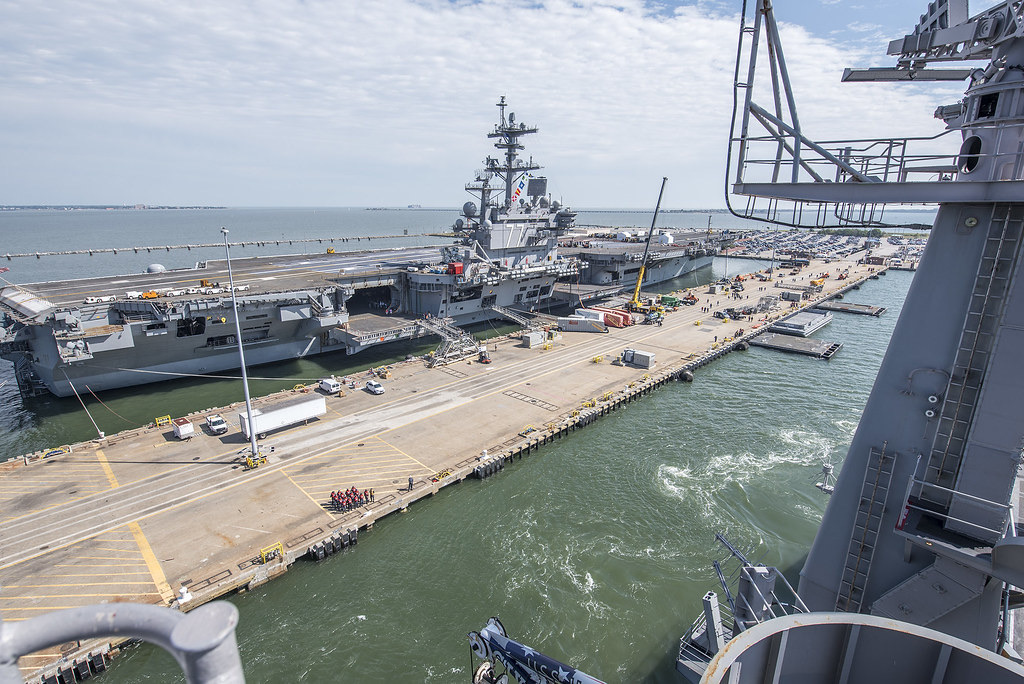
Virginia is one of the most nuclear states in the country, though most people only think of the two power stations. Beyond North Anna and Surry, the state hosts the Navy’s largest concentration of nuclear-powered ships, the only shipyard that builds nuclear aircraft carriers, and a cluster of nuclear fuel and engineering companies around Lynchburg. At the same time, Virginia sits on the largest unmined uranium deposit in the nation and has refused to allow it to be mined for more than four decades.
Quick answer: Virginia has four commercial nuclear reactors at two Dominion Energy stations: Surry 1 and 2 on the James River (in service 1972 and 1973, about 1,638 megawatts combined) and North Anna 1 and 2 on Lake Anna in Louisa County (1978 and 1980, about 1,863 megawatts). In 2025 they produced about 28% of the electricity generated in Virginia, and nuclear is the state’s largest source of energy production. All their fuel comes from outside Virginia; uranium mining has been under a state moratorium since 1982.[1][2][3]
Contents
- The two power stations
- How the reactors work
- Baseload power and cost
- The Navy’s nuclear fleet
- Lynchburg: a nuclear industry town
- Military and research reactors
- Uranium at Coles Hill
- Safety and waste
- What comes next
- Timeline
- Frequently asked questions
The two power stations
| Station | Location | Units in commercial service | Summer capacity |
|---|---|---|---|
| Surry | Gravel Neck, Surry County, on the James River | Unit 1: Dec. 1972; Unit 2: May 1973 | about 1,638 MW |
| North Anna | Lake Anna, Louisa County | Unit 1: June 1978; Unit 2: Dec. 1980 | about 1,863 MW |
Source: U.S. Energy Information Administration.[1]
Surry Power Station sits on an 840-acre peninsula on the south bank of the James, across the river from Jamestown and beside the state’s Hog Island Wildlife Management Area. Dominion says the plant can power about 420,000 homes.[1][4]
North Anna Power Station needed cooling water in the Piedmont, so the utility dammed the North Anna River to create Lake Anna, with a separate set of cooling lagoons called the Waste Heat Treatment Facility.[5] Each of its two units produces about 945 megawatts, enough for roughly 475,000 homes in total.[5] Dominion holds a federal license to add a third reactor at North Anna but has not built it.[6]
Both sites were chosen for the same reasons: plenty of cooling water, and distance from big cities in case of an accident. Neither has the tall, curved cooling towers many people associate with nuclear plants; warmed water goes back to the James River at Surry and into the cooling lagoons at Lake Anna.
How the reactors work
All four are pressurized water reactors. In the reactor vessel, uranium-235 atoms split in a chain reaction, releasing heat. Water under high pressure carries that heat away without boiling, then passes through steam generators, where it boils water in a separate loop. That steam spins conventional turbines and generators, then is condensed with cooling water drawn from the river or lake.[1]
The fuel itself is uranium oxide pressed into ceramic pellets, stacked in metal rods and bundled into fuel assemblies. Commercial reactors use uranium enriched to about 5% U-235.
Baseload power and cost
Nuclear reactors are most efficient when they run flat out, day and night, so they provide “baseload” power, the minimum the grid needs at all hours. Other plants, especially gas turbines, ramp up and down to follow the morning and evening peaks. That is why nuclear produces a bigger share of Virginia’s electricity than its share of generating capacity: in 2010, for example, nuclear was about 15% of the state’s capacity but about 36% of its generation.[1] By 2025, with more gas and solar on the grid, the nuclear share of generation was about 28%.[2]
Once built, nuclear plants are cheap to run, because fuel is a small part of their cost and they emit no carbon dioxide. The problem is building them. In the 1950s promoters claimed nuclear power might become “too cheap to meter,” but construction costs soared in the 1970s, interest rates climbed, and after the Three Mile Island accident in 1979 utilities stopped ordering new reactors for decades. Smaller designs are the industry’s answer (see small modular reactors and fusion in Virginia).
The Navy’s nuclear fleet
The largest group of nuclear reactors in Virginia does not stand on land. Naval Station Norfolk is home port to nuclear-powered aircraft carriers and submarines, and the number of reactors in Hampton Roads changes as ships come and go (see military bases in Virginia).
Across the harbor, Newport News Shipbuilding, a division of Huntington Ingalls Industries, is the only shipyard in the nation that builds nuclear-powered carriers, and one of just two that build nuclear submarines. It is currently building the Gerald R. Ford class of carriers.[7] The yard also refuels carriers at mid-life and removes the reactors when ships are retired, a long and delicate job that brings old carriers back to Hampton Roads at the end of their service.
Lynchburg: a nuclear industry town
The Lynchburg area has been a nuclear center since the 1950s, when Babcock & Wilcox chose a site in Campbell County, along the James River at Mount Athos, for a plant making nuclear components and fuel. The region’s skilled foundry and factory workforce was a draw.
Two companies descend from that start:
- BWX Technologies (BWXT), headquartered at its Innovation Campus on Mount Athos Road in Lynchburg, makes the reactor cores and fuel assemblies for the Navy’s submarines and aircraft carriers, and is one of only two private sites in the United States licensed to handle highly enriched uranium for that purpose.[8] BWXT has also branched into advanced fuels and microreactors. In 2022 the Defense Department chose it to build Project Pele, a transportable gas-cooled microreactor producing 1 to 5 megawatts, designed to fit in standard shipping containers and run on TRISO fuel, for testing at Idaho National Laboratory.[9]
- Framatome, the French nuclear company, has its North American headquarters in Lynchburg, where it designs, installs and services components for nuclear power plants and supports refueling outages at North Anna and Surry. In 2023 it announced a $49.4 million investment in its Lynchburg-area sites and 515 new jobs, on top of about 1,300 people already working there.[10]
The cluster survived a lean era. Without new power plant orders, commercial nuclear work shrank in the 2000s, and a fuel fabrication line making assemblies for power plants closed in 2011. Navy work kept the region going, and the renewed interest in nuclear power since the 2020s has brought expansion.
Military and research reactors
Virginia’s nuclear history includes several smaller reactors. In 1957 the Army built a small nuclear generator, known as SM-1, to power facilities at Fort Belvoir in Fairfax County; it also served to train military reactor crews.[11] The University of Virginia and Virginia Tech once ran small research and teaching reactors, but none operates in the state today. In 2025 a group of universities, companies and state agencies began planning a new research and education reactor for Virginia.[12]
Nuclear materials are also everyday tools. Hospitals use radioactive isotopes and X-ray machines for imaging and cancer treatment, and road builders rely on nuclear gauges to check how dense soil, pavement and concrete are. These uses are regulated under state radiation programs and involve tiny amounts of material compared with a reactor.
Uranium at Coles Hill
The largest unmined uranium deposit in the United States lies at Coles Hill in Pittsylvania County, near Chatham. It was discovered in 1978, and exploration drilling followed in the early 1980s. In 1982 the General Assembly passed a law that allowed exploration but imposed a moratorium on mining until a regulatory program was set up by statute. Uranium prices then collapsed and the leases were dropped. When prices rose again in the 2000s, interest in Coles Hill revived, and in 2007 the company Virginia Uranium began pressing to open the deposit, setting off years of studies, legislative fights and court challenges. The moratorium remains in place.[3]
Opponents, especially downstream communities such as Virginia Beach, which draws drinking water from Lake Gaston, feared contamination from mill tailings in a humid climate with hurricanes. Supporters pointed to jobs in Southside and the value of a domestic uranium supply.
Safety and waste
Nuclear plants are designed with multiple barriers and backup cooling, because a reactor keeps producing heat after it shuts down. The accidents at Three Mile Island (1979), Chernobyl (1986) and Fukushima (2011) shaped public opinion everywhere; at Fukushima, a tsunami knocked out backup power and three reactor cores melted.
The other unresolved issue is spent fuel. The United States has no permanent repository for high-level waste, so used fuel is kept at the plants, first in cooling pools and then in steel and concrete dry casks on site at both North Anna and Surry.
What comes next
Dominion says relicensing extends Surry’s operation to 2053,[4] and North Anna is also seeking a longer life, making both stations central to Virginia’s clean-energy plans. The 2020 Virginia Clean Economy Act treats nuclear as carbon-free generation that can keep running past 2045 (see electricity in Virginia). The next step under discussion is small modular reactors, possibly at North Anna, near Lynchburg or in Southwest Virginia, and the Navy is studying shore-based nuclear power at four Virginia installations: Marine Corps Base Quantico, Naval Weapons Station Yorktown, Naval Support Activity South Potomac at Dahlgren, and Naval Air Station Oceana.[11]
Timeline
| Year | Event |
|---|---|
| 1950s | Babcock & Wilcox opens nuclear operations near Lynchburg |
| 1957 | Army SM-1 reactor begins operating at Fort Belvoir |
| 1972–1973 | Surry Units 1 and 2 enter commercial service |
| 1978 | Coles Hill uranium deposit discovered |
| 1978–1980 | North Anna Units 1 and 2 enter commercial service |
| 1982 | Virginia imposes a moratorium on uranium mining |
| 2007 | Virginia Uranium formed to pursue Coles Hill mining |
| 2022 | BWXT selected to build the Project Pele microreactor |
| 2023 | Framatome announces 515 new Lynchburg-area jobs |
| 2024 | Navy names four Virginia bases for shore-based nuclear study |
Frequently asked questions
How many nuclear power plants are in Virginia? Two power stations, North Anna and Surry, with two reactors each, all owned and run by Dominion Energy.[1]
How much of Virginia’s electricity is nuclear? About 28% of in-state generation in 2025.[2]
Where does the uranium come from? From outside Virginia. The state’s own deposit at Coles Hill cannot be mined because of a moratorium in place since 1982.[3]
Why is Lynchburg called a nuclear hub? BWXT, which builds reactor cores for Navy ships, and Framatome, which services nuclear plants, both have major operations there.[8][10]
Where is spent nuclear fuel stored in Virginia? At the North Anna and Surry sites, in cooling pools and dry storage casks, because there is no national repository.
See also: energy in Virginia, small modular reactors and fusion in Virginia, military bases in Virginia.
References
- U.S. Energy Information Administration, “Virginia Nuclear Profile.” https://www.eia.gov/nuclear/state/virginia/
- U.S. Energy Information Administration, “Virginia: State Profile and Energy Estimates – Analysis.” https://www.eia.gov/state/analysis.php?sid=VA
- Virginia Energy, Geology and Mineral Resources, “Uranium.” https://energy.virginia.gov/geology/Uranium.shtml
- Dominion Energy, “Surry Power Station.” https://www.dominionenergy.com/projects-and-facilities/nuclear-facilities/surry-power-station
- Dominion Energy, “North Anna Power Station.” https://www.dominionenergy.com/projects-and-facilities/nuclear-facilities/north-anna-power-station
- Dwayne Yancey, “The unnamed Virginia coal plant the Dept. of Energy flagged as a possible nuclear reactor site,” Cardinal News, April 20, 2023. https://cardinalnews.org/2023/04/20/the-unnamed-virginia-coal-plant-the-dept-of-energy-flagged-as-a-possible-nuclear-reactor-site/
- Huntington Ingalls Industries, “Newport News Shipbuilding.” https://hii.com/what-we-do/divisions/newport-news-shipbuilding/
- BWX Technologies, “Locations.” https://www.bwxt.com/about/locations
- World Nuclear News, “BWX Technologies selected to build Project Pele microreactor,” June 9, 2022. https://www.world-nuclear-news.org/Articles/BWX-Technologies-selected-to-build-Project-Pele-mi
- Cardinal News, “Framatome to invest $49.4 million in Lynchburg-area facilities, add 515 jobs,” December 14, 2023. https://cardinalnews.org/2023/12/14/framatome-to-invest-49-4-million-in-lynchburg-area-facilities-add-515-jobs/
- Virginia Energy, “U.S. Department of Navy Considers Four Virginia Sites for Nuclear Energy Expansion,” press release, October 11, 2024. https://www.energy.virginia.gov/public/documents/newsroom/2024/PR_NavyNuclearAnnouncementVirginia%201.pdf
- Cardinal News, “Virginia group plans nuclear test reactor to boost research efforts,” June 20, 2025. https://cardinalnews.org/2025/06/20/virginia-group-plans-nuclear-test-reactor-to-boost-research-efforts/