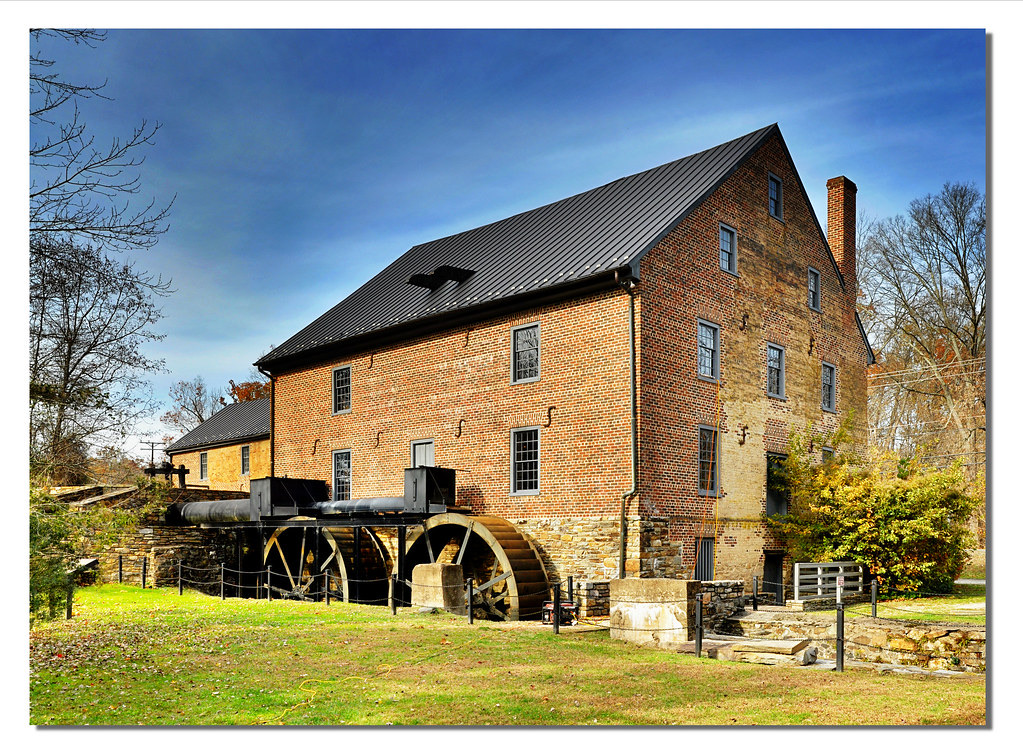
For most of Virginia’s history, energy meant something you could see and touch: a paddle in the water, an ox in a field, a stack of split oak by the hearth, a sail filling with wind or a wheel turned by a millrace. Each source had limits, and those limits shaped where people farmed, where towns grew and where factories could be built. Electricity broke most of those limits in a single generation, which is why the older energy landscape is easy to forget, even though its traces are everywhere in place names, millponds and restored mills.
Quick answer: Before 1900, Virginians relied on muscle (human and animal), firewood, wind and falling water. The first windmill in English North America was built at Flowerdew Hundred on the James River around 1621. Water mills spread along streams and clustered on the Fall Line, while low, flat Tidewater used windmills and a few tide mills; the last surviving one, at Poplar Grove in Mathews County, ran until 1912. Coal was first mined near Richmond in 1748, early locomotives burned wood, and Richmond opened the first successful large electric streetcar system in 1888.[1][2][3][4]
Contents
- Muscle power
- Firewood: heat, cooking and early industry
- Wind: ships and windmills
- Falling water and the mill economy
- Poplar Grove, the last tide mill
- Moving people and goods
- Coal, steam and gas lights
- Electricity changes the map
- Where to see early energy today
- Timeline
- Frequently asked questions
Muscle power
For thousands of years, the only engine in Virginia was the human body. Native peoples hunted, fished, cleared garden plots and built villages by hand, and they carried meat, hides, tools and children on their backs. There were no horses or oxen in the region before Europeans arrived, and no wheeled carts. On the water, people burned and scraped tree trunks into dugout canoes and paddled them along rivers and across open stretches of the Chesapeake Bay. A loaded dugout was heavy and slow, so every trip was a real investment of effort.
The English colony did not change this at first. Tobacco, the cash crop that kept Jamestown alive, needed huge amounts of hand labor: clearing forest, raising seedlings, transplanting, weeding, topping, cutting and curing. That work was done by indentured servants, small farmers and, increasingly, enslaved Africans. In a very direct sense, the colonial economy ran on forced human energy, and the demand for that labor drove the growth of slavery in Virginia.
Horses, mules and oxen arrived with the colonists and gradually took over plowing and hauling. Feeding them reshaped the countryside: farms needed pasture, hay fields and grain for animals as well as crops for people, a pattern still visible in the mix of fields and pastures across rural Virginia (see agriculture in Virginia).
Firewood: heat, cooking and early industry
Wind and water can push and turn, but they cannot warm a house. For heat and cooking, both Native Virginians and colonists burned wood. Before metal tools, felling trees was hard work, so Native households relied heavily on dead branches and fallen timber gathered from the forest floor. With iron axes, the English could cut and split as much wood as they needed, and the colony’s dense forests seemed inexhaustible. Brick chimneys and big kitchen hearths became standard features of colonial houses.
Wood was also the first industrial fuel. The glassmakers who worked at Jamestown in its first years fired their furnace with it, and the colonial ironworks of the 1700s burned enormous amounts of charcoal made from local forests. When steam engines arrived, their boilers could burn wood as well. Even today, fireplaces, wood stoves and campfires keep this oldest fuel in use, and about 1% of Virginia households still heat mainly with wood.[5]
Wind: ships and windmills
The English reached Virginia under sail. Wind carried the Susan Constant, Godspeed and Discovery across the Atlantic in 1607, and for the next two centuries sailing ships linked the colony to England, Africa and the Caribbean. Inside the Bay, sails moved cargo up the broad tidal rivers as far as the Fall Line, the rapids where navigation ends. When the wind died or a creek narrowed, crews lowered the sails and rowed, as John Smith’s men did on their 1608 exploring voyages.
Wind also ground grain. Governor George Yeardley paid to build a windmill at Flowerdew Hundred, on the south side of the James River in today’s Prince George County, around 1621. It is the first documented windmill in English North America; a reproduction was later built on Windmill Point to mark the spot.[1][6] Windmills made the most sense where streams were too sluggish to drive a wheel, in flat Tidewater and on the Eastern Shore. Port towns such as Norfolk and Yorktown used them to grind flour for bakers and for ships taking on bread before long voyages. A windmill had to sit right beside the millstones it turned, so millers built them on bluffs and open shores where the breeze was steady.
The same coastal winds are the reason modern offshore wind turbines now stand in the Atlantic off Virginia Beach; that story continues on our page about wind energy in Virginia.
Falling water and the mill economy
Falling water was the workhorse energy of colonial and early national Virginia. A dam or a dug pond stored water; a ditch called a millrace carried it to the mill; and the drop of the water turned a wheel. Through gears, shafts and belts, the wheel drove millstones that ground corn and wheat, saws that cut logs into boards, or bellows that blasted air into an iron furnace. Millers could open or close the race to start or stop the wheel as needed.
The English tried waterpower almost at once. Within about a dozen years of Jamestown’s founding, colonists began an ironworks at Falling Creek, where a creek tumbles off the Fall Line south of present-day Richmond. The works was destroyed in the 1622 attack, but the site name records why it was chosen.
As settlement moved inland, the steeper streams of the Piedmont and mountains offered far more power. By the mid-1700s, gristmills and sawmills stood on creeks across the colony. Some were small plantation mills serving a single owner; larger merchant mills ground grain for whole neighborhoods, and roads converged on them, turning the mill into a social and business center. Thousands of “mill” names on modern maps, and old millponds such as Chandler’s Mill Pond in Westmoreland County, first dammed around 1670, are leftovers of that era.[7]
Waterpower also decided where cities and factories grew. Richmond, Petersburg, Fredericksburg and Lynchburg all rose at or near falls, where canals and races fed flour mills, ironworks and tobacco factories. After the Civil War, textile mills followed the same logic, using river power at places like Danville and Fries on the New River. More on the engineering and the later shift to hydroelectric turbines is on our page about hydropower in Virginia.
Poplar Grove, the last tide mill
In the lowest parts of the Coastal Plain, there was not enough drop in the streams to turn a waterwheel. Besides windmills, a handful of waterfront owners found another answer: the tide.
A tide mill works by trapping seawater. The miller builds a dam with gates across a tidal creek. As the tide rises, water flows in through the gates and fills the millpond; at high tide the gates close. When the tide outside has fallen far enough, the miller releases the stored water through the wheel, and the drop between pond and creek turns the millstones. The key point, as tide mill historians stress, is that the stored water can only be put to work after the outside level has dropped on the ebb.[8] Milling hours therefore shifted with the moon, and a miller had to work whenever the water allowed, day or night.
Tide mills once operated around the Chesapeake, including sites on the Elizabeth River, in Hampton and in Gloucester County. Only one survives in Virginia: the Poplar Grove mill on the East River, an arm of Mobjack Bay in Mathews County. The Virginia Department of Historic Resources describes it as the state’s only surviving tide mill, built to replace a colonial mill burned during the Civil War. It operated until 1912 and has since been restored, standing across its lagoon from the Poplar Grove house, whose oldest part probably dates to the later 1700s.[2] The tidal range at the site is small, only a couple of feet, which shows how little “head” a tide miller had to work with.
Moving people and goods
For travel and freight, Virginia’s energy sources lined up in a clear sequence: feet and paddles, then sails, then horses and wagons, then steam. Rafts, bateaux and canal boats extended water transport up the rivers, but on land the horse and wagon ruled until the 1830s. A single horse could pull a light wagon; a team of six or eight could move heavy loads, especially on stone-surfaced turnpikes. Beyond that, a new kind of engine was needed (see turnpikes in Virginia and canals of Virginia).
That engine was the steam locomotive. Virginia’s first railroads ran in the 1830s, and their engines burned wood. Contractors cut and stacked cordwood along the tracks, and firemen fed it into the boilers. Coal packs more heat into each pound, yet wood cost little and grew everywhere, so most Virginia railroads kept burning it until after the Civil War (see railroads of Virginia).
Coal, steam and gas lights
Coal mining in Virginia began in 1748 in the Richmond area, in a small basin of coal-bearing rock southwest of the city.[3] For a century it remained a modest local industry. The big change came in the 1880s, when railroads finally reached the Appalachian Plateau. The famous Pocahontas seam in Tazewell County, 13 feet thick, was first mined in 1882, and Pocahontas coal later fueled ships of the U.S. Navy.[10] Coal mining transformed isolated valleys from subsistence farming into company towns built around the mine. Coal then fed steam locomotives, factory boilers and, soon, power plants, and the Norfolk and Western famously kept running coal-burning steam engines into the late 1950s. Today’s coal industry is described on our page about coal in Virginia.
Coal also lit cities before electricity did. Gas works heated coal in closed ovens to drive off a flammable mixture of gases, which was piped under the streets to light lamps and homes. Richmond began making coal gas in 1851 and soon moved to a larger gas works in the Fulton neighborhood. Natural gas pipelines replaced manufactured gas in the 20th century (see natural gas pipelines in Virginia).
Electricity changes the map
Electricity solved the biggest problem with mechanical power: it could travel. A waterwheel had to stand beside the stream, and a windmill had to stand beside the millstones, but electric current could be sent over wires to a factory, a streetcar line or a house miles away.
Richmond showed what was possible. In February 1888 the electric street railway designed by Frank J. Sprague for the Richmond Union Passenger Railway began service. The engineering history program of the IEEE recognizes it as the lasting prototype for electric streetcar systems around the world.[4] Around the same time, entrepreneurs began building dams with turbines and generators instead of waterwheels, including on the Rappahannock at Fredericksburg, where Embrey Dam was built in the early 1900s.
Factories converted gradually, since owners first had to pay off their old belt-and-shaft mills. But once motors could be placed anywhere, plants no longer had to sit on a river or a rail siding. Rural electrification in the mid-20th century carried power to farms and small towns, and furniture and textile plants spread to places such as Galax and Pulaski County. Our electricity in Virginia page explains how the grid works today.
Where to see early energy today
- Poplar Grove tide mill, Mathews County: Virginia’s only surviving tide mill (privately owned; view respectfully).[2]
- Flowerdew Hundred, Prince George County: site of the first windmill in English North America.[6]
- Colvin Run Mill, Fairfax County: a restored 19th-century water-powered gristmill run as a county historic site.[9]
- Mabry Mill, Blue Ridge Parkway: a water-powered mill complex beside the Parkway in Floyd County.
- Aldie Mill, Loudoun County: a brick gristmill beside the old Little River Turnpike, now a regional historic park.[11]
Timeline
| Year | Event |
|---|---|
| 1607 | Wind-powered ships bring English colonists to Jamestown |
| c. 1619–1622 | Ironworks at Falling Creek on the Fall Line |
| c. 1621 | First windmill in English North America at Flowerdew Hundred |
| c. 1670 | Chandler’s Mill Pond dammed in Westmoreland County |
| 1748 | First coal production in Virginia, Richmond area |
| 1830s | First railroads, with wood-burning locomotives |
| 1851 | Richmond begins manufacturing coal gas for lighting |
| 1882 | Pocahontas coal seam first mined in Tazewell County |
| 1888 | Richmond’s electric street railway begins service |
| 1912 | Poplar Grove tide mill stops grinding |
Frequently asked questions
Where was the first windmill in Virginia? At Flowerdew Hundred on the James River, built around 1621 for Governor George Yeardley. It is the first documented windmill in English North America.[1][6]
Is there still a tide mill in Virginia? Yes, one: the Poplar Grove mill on the East River in Mathews County, which operated until 1912 and has been restored.[2]
Why did colonial towns grow at the Fall Line? It was the head of navigation for ships and the first place where rivers dropped enough to power mills, so trade and industry met there.
When did Virginia start mining coal? In 1748, near Richmond. Large-scale mining in the southwest began after railroads arrived in the 1880s.[3]
What was the first electric streetcar system? Richmond’s Union Passenger Railway, designed by Frank J. Sprague, opened in 1888 and became the model for electric street railways.[4]
See also: energy in Virginia, hydropower in Virginia, wind energy in Virginia.
References
- National Park Service, “Flowerdew Hundred Plantation.” https://www.nps.gov/articles/flowerdew.htm
- Virginia Department of Historic Resources, “057-0008 Poplar Grove Mill and House.” https://www.dhr.virginia.gov/historic-registers/057-0008/
- Virginia Energy, Geology and Mineral Resources, “Coal.” https://energy.virginia.gov/geology/coal.shtml
- Engineering and Technology History Wiki (IEEE), “Milestones: Richmond Union Passenger Railway, 1888.” https://ethw.org/Milestones:Richmond_Union_Passenger_Railway,_1888
- U.S. Energy Information Administration, “Virginia: State Profile and Energy Estimates – Analysis.” https://www.eia.gov/state/analysis.php?sid=VA
- Virginia Department of Historic Resources, “074-0006 Flowerdew Hundred.” https://www.dhr.virginia.gov/historic-registers/074-0006/
- Virginia Department of Wildlife Resources, “Chandler’s Mill Pond.” https://dwr.virginia.gov/waterbody/chandlers-mill-pond/
- Tide Mill Institute, “What’s a Tide Mill?” https://www.tidemillinstitute.org/definition-of-a-tide-mill/
- Fairfax County Park Authority, “Colvin Run Mill Historic Site.” https://www.fairfaxcounty.gov/parks/colvin-run-mill
- Virginia Energy, “Pocahontas Exhibition Mine.” https://energy.virginia.gov/public/Pocahontas-Exhibition-Mine.shtml
- NOVA Parks, “Aldie Mill Historic Park.” https://www.novaparks.com/parks/aldie-mill-historic-park