Some of the most familiar living things in Virginia did not evolve here. Honeybees, apple trees, wheat, starlings, house sparrows, dandelions and Japanese honeysuckle all arrived with people from other continents. Most newcomers either need human care or fit quietly into the landscape. A few, though, spread out of control, push aside native plants and animals, and cost farmers, foresters and taxpayers dearly. Those are invasive species, and Virginia is fighting dozens of them on land and in the water.
Quick answer: A native species is one that lived in Virginia before European colonization; a non-native species was brought by people, on purpose or by accident; an invasive species is a non-native that spreads and causes ecological or economic harm. Major invaders in Virginia include feral hogs, nutria (a large South American rodent destroying Tidewater marshes), the spongy moth (formerly called the gypsy moth), the spotted lanternfly (first found in Virginia in 2018), the hemlock woolly adelgid (which killed about 95 percent of Shenandoah National Park’s hemlocks by 2003) and blue catfish in the Chesapeake Bay’s rivers. State agencies combine early detection, quarantines, trapping and public reporting to slow them down.[1][2][5][6][7][8]
Contents
- Native, non-native and invasive
- How invaders arrive
- Why invaders do so much harm
- Feral hogs
- Nutria in Tidewater marshes
- The spongy moth
- The spotted lanternfly
- Hemlock woolly adelgid and other forest pests
- Blue catfish and other aquatic invaders
- Invasive plants
- Virginia’s own exports
- What you can do
- Frequently asked questions
Native, non-native and invasive
“Native” usually means a species that lived in Virginia before Europeans arrived, with the founding of Jamestown in 1607 often used as the dividing line. That is a convenient convention rather than a law of nature: Native Americans brought dogs with them thousands of years ago, and many plant and animal ranges shift over time on their own. Coyotes and nine-banded armadillos, for example, have spread into Virginia by themselves in recent decades (see Squirrels, Beavers and Armadillos in Virginia and Bears, Cougars, Coyotes and Wolves in Virginia).
“Non-native” (also called exotic or alien) means a species brought by people, intentionally or accidentally, from outside its natural range. Many are harmless or useful: corn, soybeans and daffodils rarely spread beyond where they are planted. “Invasive” is reserved for the non-natives that do spread and cause harm to native species, ecosystems, the economy or human health.
How invaders arrive
Colonists deliberately brought cattle, horses, sheep, pigs, honeybees, wheat, barley, apples and many garden plants. Other species stowed away in ship ballast, packing material, soil around nursery plants and, more recently, on trucks, trains and shipping containers. Faster travel in the 1800s and 1900s sharply increased the number of arrivals. Some invaders were released on purpose for sport, fur or food and then escaped control; others, such as Asian ornamental shrubs, were sold by nurseries for decades before anyone noticed them spreading into the woods.
Why invaders do so much harm
Species that evolve together keep one another in check through predators, parasites, diseases and competition. An invader often arrives without any of those enemies and can multiply unchecked. Native animals may not recognize it as food; many native insects cannot eat the leaves of Asian ornamentals, so a yard full of them supports far fewer caterpillars, and therefore far fewer birds, than one planted with native species. Once an invader is widespread, eradication becomes almost impossible, which is why early detection is the key to control.
Feral hogs
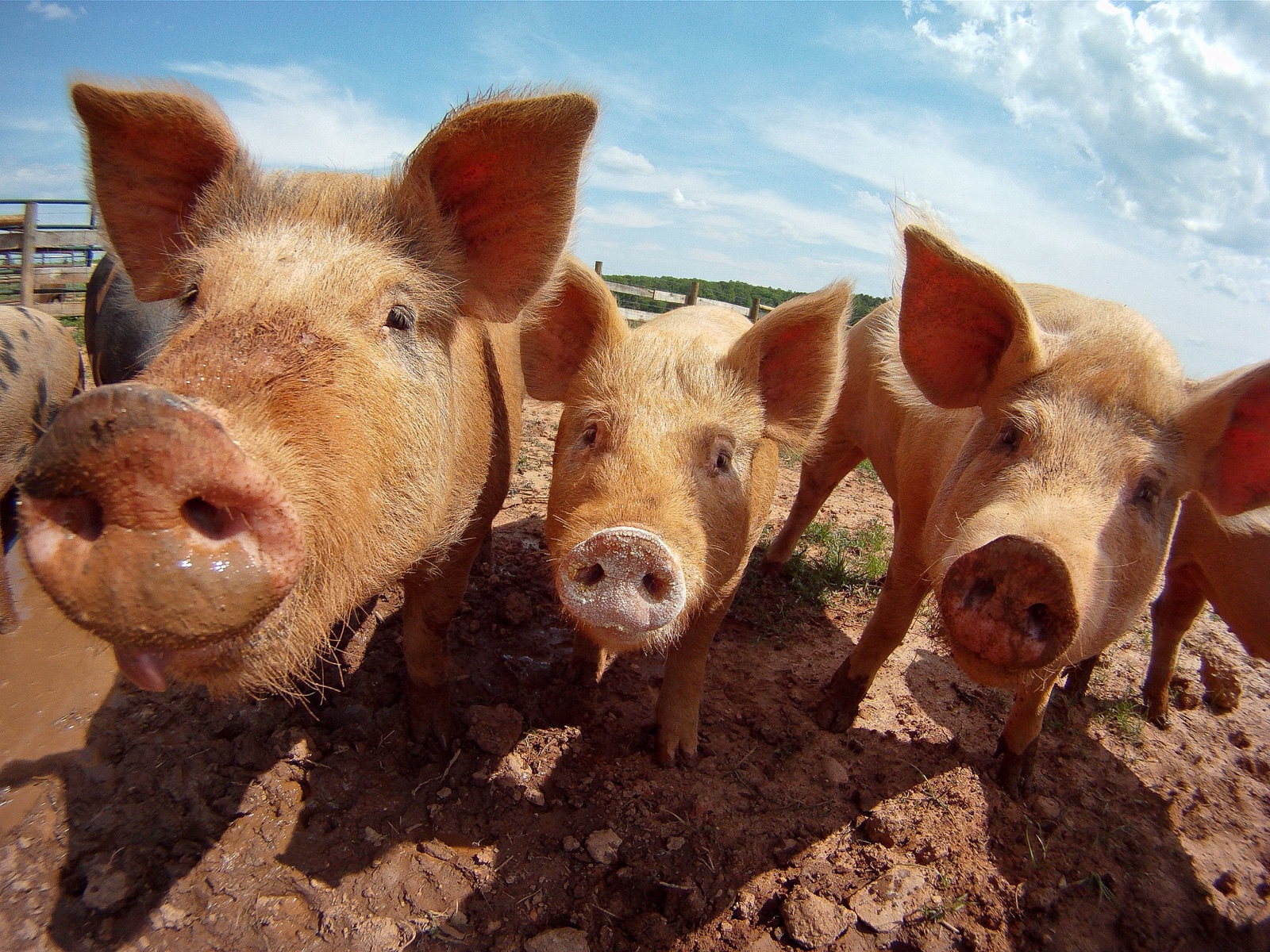
Pigs did not exist in North America until Spanish explorers brought them in the 1500s. In Virginia, DWR defines feral hogs as “any swine that are wild or for which no proof of ownership can be made.” Color and ancestry do not matter: a few loose domestic pigs can turn into a thriving wild population within a few generations.[1]
DWR describes Virginia as being on the front lines of the northward spread of feral hogs in the East. The animals root up wetlands, fields and forest floors, compete with native wildlife for acorns and other food, eat ground-nesting birds and reptiles, damage crops and fences, and carry diseases such as swine brucellosis and pseudorabies that threaten the commercial pork industry. A population can triple in 14 to 16 months, and 70 percent must be removed each year just to keep it stable.[1] Hogs do not migrate on their own, so new populations that suddenly appear are almost always loose domestic hogs or animals released illegally for hunting. DWR, working with state and federal partners, tries to eliminate small populations before they become established and asks the public to report loose hogs.[1]
Nutria in Tidewater marshes
Nutria are large, semi-aquatic South American rodents, bigger than muskrats but smaller than beavers, weighing from under 12 to over 20 pounds, with webbed hind feet and big orange front teeth. Fur farmers introduced them to Louisiana and other states beginning in the late 1800s, and when the farms failed many escaped or were released.[2]
Nutria are a disaster for marshes because they eat not just the leaves of marsh plants but also dig out roots and rhizomes. With the roots gone, the soil washes away, and the marsh becomes a mud flat and then open water.[2][3] They also breed fast, maturing in four to six months and producing up to three litters a year.[2]
Maryland’s experience shows what is at stake. On one 10,000-acre tract in Dorchester County, nutria grew from about 150 in 1968 to more than 35,000 by the early 2000s, and a 2004 report blamed them as a major cause of the loss of 2,905 acres of marsh at Blackwater National Wildlife Refuge over about 50 years. The Chesapeake Bay Nutria Eradication Project, launched in 2002 with trapping, detector dogs and radio-collared “Judas” nutria that lead trappers to others, trapped the last confirmed Dorchester County nutria in 2015.[4]
Virginia is now applying those lessons. Nutria crossed into southeastern Virginia from North Carolina and took about 50 years to spread north of the James River; the Chickahominy is the northernmost river system they have reached. Most sightings are east of Interstate 95 and south of the James, with some in lakes and rivers of the central Piedmont near the North Carolina line.[2] On the Upper Chickahominy, DWR biologists patrol with a nutria detection dog named Finn, log any signs in a national database and set traps.[3] DWR asks anyone who sees a nutria to report it, with a photo if possible.[2]
The spongy moth
The spongy moth (Lymantria dispar), known for more than a century as the gypsy moth, was accidentally introduced to the United States in 1869. The Entomological Society of America changed its common name on March 2, 2022.[5] Its caterpillars strip the leaves from oaks and many other trees; healthy trees can usually survive a year or two of defoliation, but repeated attacks kill weakened trees.
The Virginia Department of Agriculture and Consumer Services (VDACS) runs three programs: suppression, in which participating localities and the U.S. Forest Service treat heavily infested forests, often by aircraft; Slow the Spread, a multistate effort that surveys the advancing edge of the infestation to catch new colonies while they are small; and a quarantine that requires businesses and travelers to make sure items moved out of infested areas, from logs to campers and outdoor furniture, carry no egg masses.[5]
The spotted lanternfly
The spotted lanternfly (Lycorma delicatula) is a colorful planthopper from China that feeds on the sap of grapevines, fruit trees, maples and many other plants. Its favorite host is the tree-of-heaven, another Chinese invader that is common in Virginia. The insect was first found in Virginia in 2018 and has since been found in more than half of Virginia’s counties and independent cities.[6]
Lanternflies are weak fliers. They spread mainly by hitchhiking, laying egg masses on vehicles, rail cars and outdoor materials that are then moved long distances.[6] Virginia set up a quarantine to slow that movement, but as the insect kept turning up in new places, the emphasis shifted to public action. VDACS now asks residents to check vehicles and outdoor items before leaving infested areas, kill any lanternflies they find, manage infestations on their property and report the pest where it is still new; in many counties where it is widespread, reports are no longer needed.[6]
Hemlock woolly adelgid and other forest pests
Some of the worst invaders are tiny insects that kill trees. The hemlock woolly adelgid, a sap-sucking insect from Asia, shows up as small white cottony tufts at the base of hemlock needles. In Shenandoah National Park, heavy infestations combined with drought from 1993 to 2003 killed roughly 95 percent of the park’s eastern hemlocks.[7] Hemlocks grow in cool, shady coves and along streams, where they shelter rare plants and birds and keep water cold for trout, and no other tree can fill their role. The park now protects surviving trees with systemic insecticide treatments and is testing predatory beetles as a long-term biological control.[7]
The emerald ash borer, a metallic green beetle from Asia whose larvae tunnel under the bark, is doing the same to Virginia’s ash trees, and the chestnut blight of the early 1900s, caused by an imported fungus, wiped out the American chestnut, once a dominant tree of Virginia’s mountains (see American Chestnut in Virginia).
Blue catfish and other aquatic invaders
Invaders in the water are hard to see but can reshape entire food webs. Blue catfish are native in Virginia only to the upper Tennessee River basin in the far southwest. Introduced for sport fishing, they are now established in the James and other Bay tributaries, as well as in rivers draining to North Carolina’s Albemarle Sound and in many reservoirs.[8] They grow huge: the world and Virginia record, caught at Buggs Island Lake in 2011, weighed 143 pounds.[8] Big blue catfish eat mostly other fish, and scientists worry about their impact on native species and on blue crabs.
Other aquatic invaders include flathead catfish, northern snakeheads, zebra mussels, Chinese mystery snails, mute swans and invasive marsh plants such as common reed (Phragmites) and purple loosestrife.
Invasive plants
On land, invasive plants may be the most widespread problem. Japanese stiltgrass now carpets stream valleys and forest floors across nearly all of Virginia; kudzu, Japanese honeysuckle, English ivy, multiflora rose, tree-of-heaven, autumn olive and Callery pear (including the once-popular Bradford pear) overrun old fields, forest edges and roadsides. English ivy and multiflora rose crowd out native flowers and shrubs.[4] Some nurseries still sell invasive ornamentals such as nandina and butterfly-bush, which is why native plant groups encourage gardeners to choose native alternatives.
The Virginia Department of Conservation and Recreation keeps the state’s official invasive plant species list, ranking species by the level of threat they pose; the list is educational rather than regulatory. VDACS separately designates noxious weeds, which can be regulated and phased out of commercial sale.
Virginia’s own exports
Invasion runs both ways. Atlantic blue crabs, native from New England to the Gulf of Mexico, have become invasive in the Mediterranean Sea, where they damage clam and mussel harvests. Smooth cordgrass, the backbone of Virginia’s salt marshes, is treated as an invasive weed in parts of the Pacific Northwest. A species that is an asset in one place can be a pest in another.
What you can do
- Don’t move firewood, and check vehicles, campers and outdoor gear for egg masses and hitchhiking insects before leaving infested areas.[5][6]
- Report invaders such as spotted lanternflies, nutria and feral hogs to the state agencies that track them.[1][2][6]
- Never release pets, bait or aquarium plants and animals into the wild.
- Plant natives instead of invasive ornamentals, and remove invasive plants from your own yard.
- Clean boots, boats and trailers between waterways to avoid spreading aquatic invaders.
Frequently asked questions
What is the difference between a non-native and an invasive species? A non-native species was brought by people from elsewhere; it becomes invasive only if it spreads and causes ecological or economic harm.
Are there feral hogs in Virginia? Yes. DWR says Virginia is on the front lines of their northward spread, and it works to eliminate new populations before they become established.[1]
Where are nutria found in Virginia? Mostly in southeastern Virginia east of I-95 and south of the James River, with the Chickahominy River the northernmost system they have reached.[2]
Why was the gypsy moth renamed? The Entomological Society of America changed the common name to spongy moth on March 2, 2022.[5]
When did the spotted lanternfly arrive in Virginia? It was first found in Virginia in 2018 and now occurs in more than half of the state’s counties and independent cities.[6]
References
- Virginia Department of Wildlife Resources, “Problems with Feral Hogs.” https://dwr.virginia.gov/wildlife/feral-hogs/
- Virginia Department of Wildlife Resources, “Nutria” (species fact file). https://dwr.virginia.gov/wildlife/information/nutria/
- Ron Messina, “Menace of the Marsh,” Virginia Department of Wildlife Resources. https://dwr.virginia.gov/blog/menace-of-the-marsh/
- “Solving a Problem Like Nutria,” Chesapeake Quarterly (Maryland Sea Grant), vol. 20, no. 2. https://chesapeakequarterly.net/V20N2/main1
- Virginia Department of Agriculture and Consumer Services, “Gypsy Moth, Now Spongy Moth.” https://www.vdacs.virginia.gov/plant-industry-services-spongy-moth.shtml
- Virginia Department of Agriculture and Consumer Services, “Spotted Lanternfly (Lycorma delicatula).” https://www.vdacs.virginia.gov/plant-industry-services-spotted-lanternfly.shtml
- National Park Service, Shenandoah National Park, “Eastern Hemlock.” https://www.nps.gov/shen/learn/nature/eastern_hemlock.htm
- Virginia Department of Wildlife Resources, “Blue Catfish” (species fact file). https://dwr.virginia.gov/wildlife/information/blue-catfish/