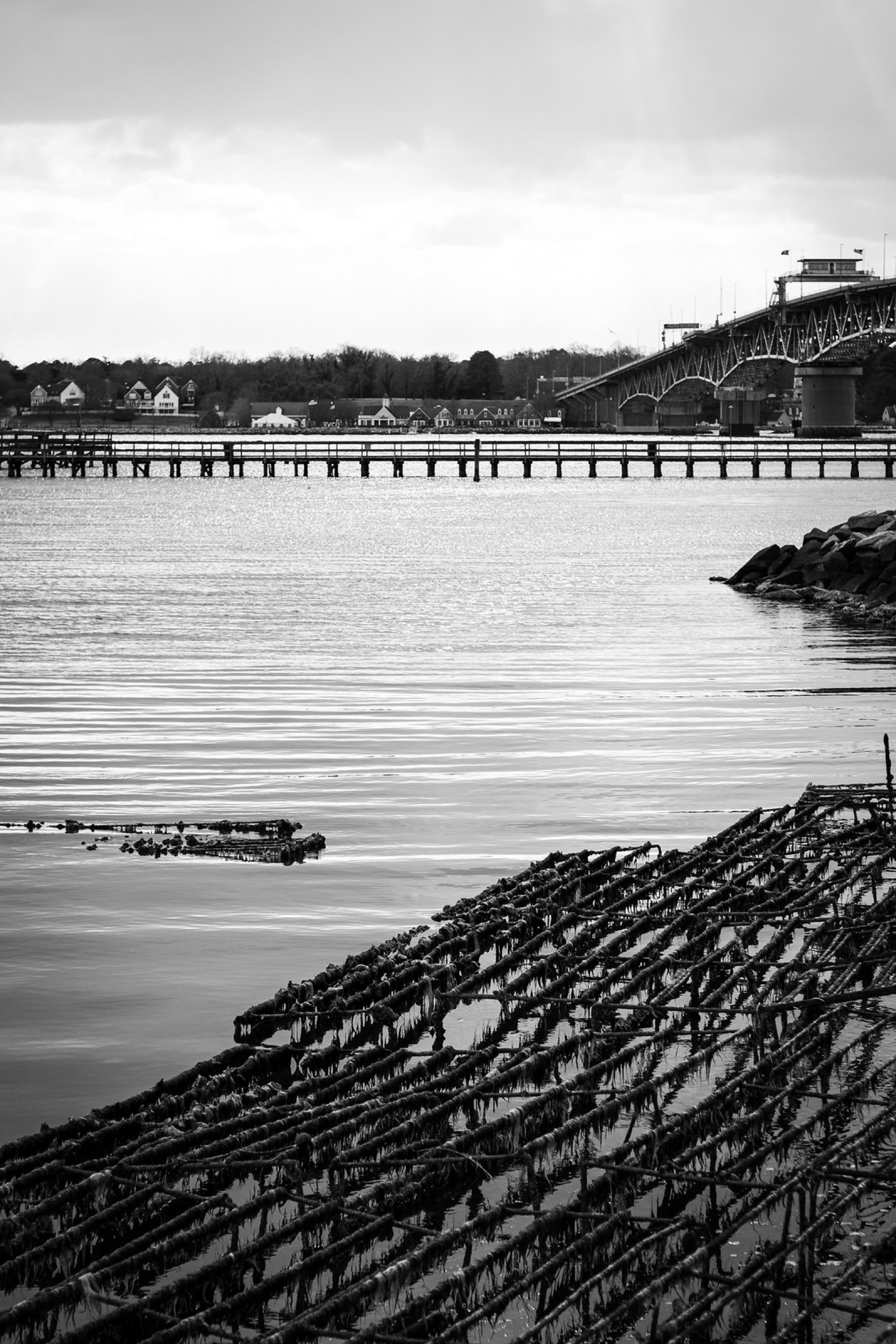
Oysters built the lower Chesapeake Bay as much as any river did. Their reefs once rose from the bottom so high that early colonists treated them as hazards to navigation, and for three centuries the oyster fed Virginians, filled packing houses and paid for schooners, steamers and an armed state navy. Then overharvesting, disease and pollution reduced the Bay’s wild oysters to a tiny fraction of their former numbers. This page covers wild oysters, their history and their recovery; oyster farming has its own page, aquaculture in Virginia.
Quick answer: Virginia’s oyster is the eastern oyster (Crassostrea virginica), also called the Virginia oyster. It lives up to about 20 years, cements itself to hard bottom and builds reefs as young oysters settle on older shells. Chesapeake harvests peaked at about 20 million bushels a year in the 1880s, then collapsed under overharvesting; the diseases Dermo (found in 1949) and MSX (found about a decade later) finished much of what was left. Today the Bay’s oysters are estimated at 1 to 2% of historic levels, but restored reefs, managed public grounds and farming have brought harvests back to their highest level in about 25 years.[1][2][3]
Contents
- How an oyster lives
- Reefs that filtered the Bay
- Before the colonists
- From abundance to mining
- Oyster wars and the oyster navy
- The Baylor Survey and private leases
- The Potomac and the Compact of 1958
- MSX, Dermo and Hurricane Agnes
- Restoring reefs
- Are oysters water filters?
- Eating oysters safely
- Timeline
- Frequently asked questions
How an oyster lives
An eastern oyster has two rough, whitish to tan shells, usually 3 to 5 inches long but sometimes up to 8. The bottom shell is cupped and the top one flat. Oysters spawn in early summer when the water warms: adults release eggs and sperm into the water, and a single female can produce 100 million eggs or more a year. Most oysters start life as males and many later become females.[2][1]
Within a day, fertilized eggs become swimming larvae that drift with the plankton for two to three weeks. In the final larval stage, the pediveliger, a young oyster uses a small foot to search for a hard surface, then glues its left shell down with a natural cement. From then on the juvenile, called spat, never moves again. Oysters do best in brackish to salty water of about 10 to 28 parts per thousand and can die if salinity stays below 5 for long periods, which is why they grow in the lower Bay and the mouths of tidal rivers but not upstream.[2][3]
Spat that land on mud or shifting sand die, so the best place to settle is on other oyster shells. Over generations, oysters pile up into reefs, also called bars, beds or rocks, that rise upward and outward from the bottom. Their nooks shelter small fish, crabs, worms and hundreds of other creatures. Many animals eat oysters at different stages: sea nettles and anemones take larvae, flatworms and mud crabs eat new spat, blue crabs and fish attack young oysters, and shorebirds pick at oysters exposed at low tide.[3]
Because they cannot move, oysters are at the mercy of their water. A heavy load of mud can smother a reef, and long floods of fresh water can kill oysters that cannot escape.
Reefs that filtered the Bay
Oysters feed by pumping water across their gills and trapping plankton and other particles. Under the right conditions one oyster can filter more than 50 gallons in a day. In the late 1800s the Bay’s oysters could filter a volume of water equal to the whole Chesapeake in three or four days; today’s much smaller population would need nearly a year.[3]
Before the colonists
Long before Jamestown, the Native peoples of the Tidewater ate oysters from the shallow reefs of the Bay and its salty rivers, and heaps of their discarded shells, called middens, are still found along Tidewater shorelines. Their gathering, by hand and with simple tools, left the reefs standing; the reefs that 17th-century English sailors found so dangerous had survived thousands of years of Native harvesting. See native peoples of Virginia.[3]
From abundance to mining
In the 1600s, English settlers described huge reefs rising from the Bay’s bottom that threatened their ships. Colonists first gathered oysters with hand tongs, long-handled rakes worked from small boats. By the 1800s, sail-powered dredges dragged across the reefs, ripping up oysters and shell together.[3]
Harvests soared. In the 1850s watermen took more than 1.5 million bushels a year from the Bay; three decades later the catch was about 20 million bushels, and around 1900 the Chesapeake oyster fishery was one of the most important in the country. But watermen sold shell along with meat. Shell was burned for lime, ground into chicken grit or spread on roads instead of being returned to the reefs, and dredges and tongs gradually flattened the three-dimensional reefs into thin layers of shell spread over the bottom, easily buried by silt.[3]
Oyster grounds belonged to the state, not to any one person, so no waterman had a reason to leave oysters behind: whatever he left, someone else would take. It was a textbook example of the “tragedy of the commons.”
Oyster wars and the oyster navy
After the Civil War, thousands of men without other work went oystering, and fighting broke out over boundaries and beds. Virginia and Maryland each formed an oyster police navy. Virginia’s “Board of the Chesapeake” sent out two police schooners, the Tangier and the Pocomoke. Watermen from outside the state, and from Maryland, raided Virginia beds, and Virginians raided Maryland’s.[4]
The water boundary across the Bay and in Tangier and Pocomoke sounds, where the best beds lay, was finally settled in 1877 by binding arbitration, the “Black and Jenkins Award.” In 1897 the oyster navy was placed under the state Fish Commission, by then with four vessels; that agency later became today’s Virginia Marine Resources Commission.[4] See the Virginia–Maryland border.
The Baylor Survey and private leases
In the 1890s Virginia chose a different path from Maryland. Rather than cap the harvest, it tried to grow more oysters by letting private planters lease bare bottom, spread shell and transplant young “seed” oysters. To protect the public’s share, the state first had to decide which bottoms were natural oyster grounds.
That job fell to the Baylor Survey. Over two years in the mid-1890s, surveyors mapped the naturally productive beds, rocks and shoals in Virginia’s tidal waters. Those areas were reserved for public harvest and cannot be leased; the “Baylor grounds” still appear on Virginia’s oyster maps today. Everything outside them could be leased for planting.[4]
The rule was written into the Virginia Constitution and survives as Article XI, Section 3, which says the natural oyster beds, rocks and shoals may not be leased, rented or sold and are held in trust for the people, while letting the General Assembly define them by survey.[5]
At first, county inspectors and surveyors handled leases and were paid from fees and fines. In 1920 the state took over, creating 19 oyster districts with a full-time inspector in each.[4]
The Potomac and the Compact of 1958
The tidal Potomac belongs to Maryland, but the Compact of 1785 gave Virginians equal rights to fish it. In the 1950s the two states agreed to replace the outdated parts of the old agreement with the Potomac River Compact of 1958, which created the Potomac River Fisheries Commission. The commission licenses oystering, clamming, crabbing and fishing in the tidal river below Washington and must treat the citizens of both states equally.[4][6]
MSX, Dermo and Hurricane Agnes
Two parasites changed everything. Dermo (Perkinsus marinus) was found in the Bay in 1949; it usually strikes oysters in their second year, slowing growth and killing them. MSX (Haplosporidium nelsoni) was found about ten years later and kills oysters of any age. Both spread from May to October and thrive in warm, salty water, so oysters in Virginia’s part of the Bay face constant disease pressure. In high-disease areas, 80% or more of a year’s oysters may die by age three.[3]
The timing was brutal. In 1957 Virginia’s oyster industry was healthy, leased acreage was at an all-time high, and the state produced about 30% of the nation’s oysters. Within two years MSX had devastated beds in the lower Bay and Hampton Roads, and 1962 production was the lowest in 44 years. The state began dredging old buried shell to replenish public beds in 1963, and production was climbing again by 1970. Then, in June 1972, Tropical Storm Agnes poured fresh water down the rivers and killed many of the beds that MSX had spared.[4]
There is good news: research shows that wild oysters in high-disease Virginia waters are developing resistance, and breeders are building on that resistance.[3]
Restoring reefs
Restoration now works on several fronts at once: careful management of wild harvests, sanctuaries closed to harvest, rebuilding reefs with shell, stone or concrete, and farming. Under the 2014 Chesapeake Bay Watershed Agreement, Maryland and Virginia, the only Bay states where oysters can live, set a goal of restoring oyster reefs in ten tributaries by 2025. By 2024 reefs had been restored in nine of the ten, and in 2025 the partners committed to maintaining them, protecting more reefs and supporting farming and sustainable harvests.[3][7] NOAA calls the Chesapeake effort the largest oyster restoration project in the world.[1]
On public grounds, the Marine Resources Commission plants shell so young oysters have somewhere to settle and opens areas to harvest in rotation. Combined with the growth of oyster farming, the results show up at the dock: in the 2022–23 season Virginia watermen landed about 700,000 bushels, the most in 25 years.[8]
Volunteers help too. Waterfront homeowners raise oysters in cages off their piers through oyster gardening programs, and restaurants and shuckers recycle shell for new reefs.[3]
Are oysters water filters?
Oysters are often called tiny water treatment plants, and they do remove algae, sediment and nitrogen. The Chesapeake Bay Foundation argues that restored reefs also store carbon and soften storm waves, worth an estimated $40,000 per acre each year.[8] Oysters cannot do the job alone, though. Nutrients and sediment from land fuel algae blooms and low-oxygen zones that harm oyster larvae and smother shellfish, so the Bay’s recovery still depends mainly on cutting pollution at its source.[3] See impaired waters in Virginia.
Eating oysters safely
Oysters filter whatever is in the water, including bacteria and viruses. The Virginia Department of Health’s Division of Shellfish Safety tests growing waters and closes them to harvest when they are polluted, often after heavy rains wash runoff into rivers. It oversees more than 90 shellfish growing areas.[9]
The system was tested in 2026. On October 9, 2026, the department closed the Little Wicomico River in Northumberland County to oyster and clam harvesting after a Salmonella outbreak in Pennsylvania was linked to shellfish from the river. A grower recalled oysters harvested between September 18 and October 8, the CDC and the FDA issued alerts, and after more samples tested positive, the closure was extended past its first 30 days.[9][10]
The old advice to eat oysters only in months with an “R” made sense before refrigeration: oysters spoiled quickly in summer heat, and wild oysters are thin and watery right after spawning. Farmed triploid oysters, which do not spawn, have made summer oysters common. Raw shellfish can still carry bacteria such as Salmonella and Vibrio, so health officials urge care, especially for people with weak immune systems.[2][9]
Timeline
| Year | Event |
|---|---|
| 1600s | Colonists report huge reefs that threaten navigation |
| 1785 | Compact of 1785 gives Virginians equal fishing rights on the Potomac |
| After 1865 | Virginia and Maryland form oyster police navies |
| 1877 | Black and Jenkins Award fixes the Bay boundary |
| 1880s | Bay harvest reaches about 20 million bushels a year |
| 1890s | Baylor Survey maps public oyster grounds |
| 1920 | State takes over oyster leasing from counties |
| 1949 | Dermo discovered in the Bay |
| 1958 | Potomac River Compact creates the Potomac River Fisheries Commission |
| 1959 | MSX strikes the lower Bay |
| 1972 | Tropical Storm Agnes kills many surviving beds |
| 2014 | Watershed agreement sets ten-tributary reef goal |
| 2022–23 | Virginia harvest highest in 25 years |
| 2026 | Little Wicomico River closed after Salmonella outbreak |
Frequently asked questions
What kind of oyster grows in Virginia? The eastern oyster, Crassostrea virginica, also called the Virginia or American oyster.[1]
Why did Chesapeake oysters decline? Overharvesting that destroyed the reefs, the diseases MSX and Dermo, pollution and loss of habitat.[3]
What are the Baylor grounds? Natural oyster beds mapped in the 1890s that the Virginia Constitution keeps open to public harvest and forbids leasing.[4][5]
Is it safe to eat Virginia oysters in summer? Oysters from open, state-monitored growing areas are tested, but warm water raises the risk of bacterial illness from raw shellfish.[9]
See also: aquaculture in Virginia, blue crabs in Virginia, the Chesapeake Bay in Virginia, wetlands and underwater grasses in Virginia, habitats and species of Virginia.
References
- NOAA Fisheries, “Eastern Oyster.” https://www.fisheries.noaa.gov/species/eastern-oyster
- Chesapeake Bay Program, Field Guide, “Eastern Oyster (Crassostrea virginica).” https://www.chesapeakebay.net/discover/field-guide/entry/eastern_oyster
- Chesapeake Bay Program, “Oysters.” https://www.chesapeakebay.net/issues/issue/oysters
- Virginia Marine Resources Commission, “Historical Highlights of the Virginia Marine Resources Commission.” https://mrc.virginia.gov/vmrchist.shtm
- Constitution of Virginia, Article XI, Section 3, “Natural oyster beds.” https://law.lis.virginia.gov/constitution/article11/section3/
- Potomac River Fisheries Commission, “The Commission.” https://prfc.us/commission/commission.html
- Chesapeake Bay Watershed Agreement (2014, as amended). https://d18lev1ok5leia.cloudfront.net/chesapeakebay/Chesapeake-Bay-Watershed-Agreement-Amended.pdf
- Katherine Hafner, “‘Hope on the Half Shell:’ Report says oysters can fight climate change in the Chesapeake Bay,” WHRO, February 15, 2024. https://whro.org/news/45016-chesapeake-bay-foundation-oyster-report
- Virginia Department of Health, “Salmonella Outbreak Associated With Oysters,” 2026. https://www.vdh.virginia.gov/news/salmonella-outbreak-oysters/
- Virginia Department of Health, “Virginia Department of Health Closes Little Wicomico River to Shellfish Harvesting,” October 9, 2026. https://www.vdh.virginia.gov/news/public-relations-contacts/2026-regional-news-releases/virginia-department-of-health-closes-little-wicomico-river-to-shellfish-harvesting/
- Virginia Department of Health, Division of Shellfish Safety and Waterborne Hazards. https://www.vdh.virginia.gov/shellfish/