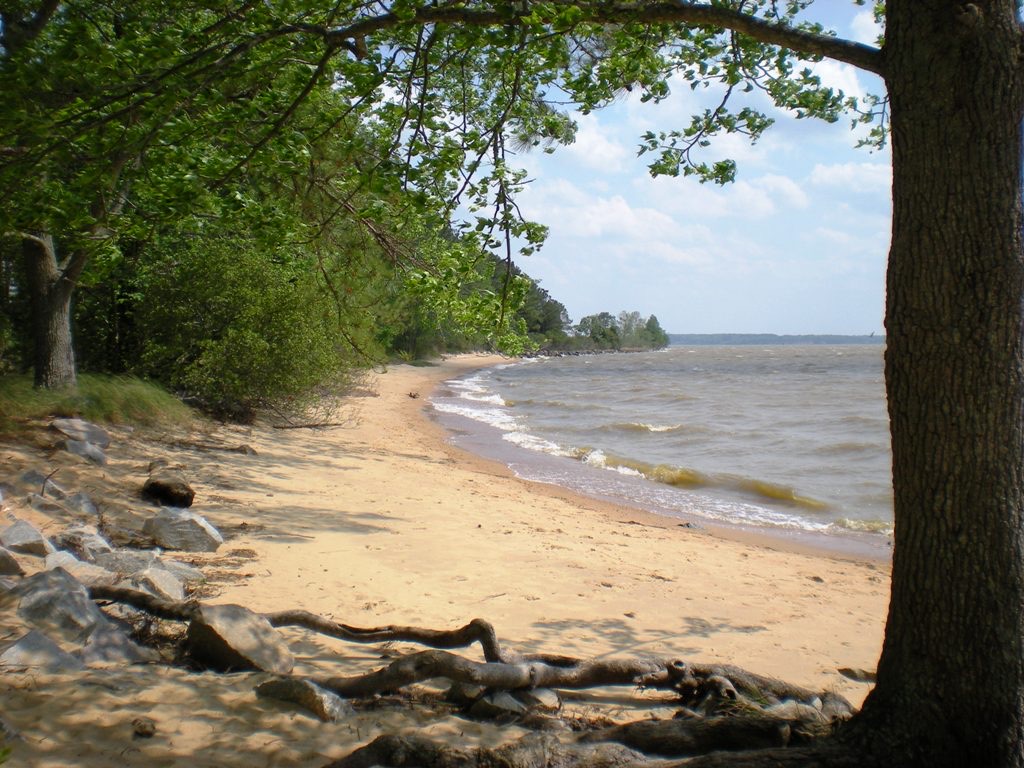
The English who landed at Jamestown in 1607 described a land of tall oaks, abundant deer and turkeys, rivers crowded with fish and flocks of birds that darkened the sky. They assumed they were looking at an untouched wilderness. In fact the landscape had been changing for thousands of years, through a dramatic shift in climate after the last ice age and through the deliberate management of the Native peoples who had lived there for millennia. This page traces Virginia’s plants and animals from the ice age to the colonial era, including the dogs and cats that people brought with them, and how farming, firewood cutting and roads later remade the habitat.
Quick answer: During the last glacial maximum about 18,000 years ago Virginia was not covered by ice, but it was much colder, sea level was far lower and the forests were dominated by pine and spruce, with fir, birch and oak in smaller amounts.[1][2] As the climate warmed, the ocean flooded the Susquehanna valley to form the Chesapeake Bay, and oak-hickory and other hardwood forests spread.[3] Native Americans burned woods regularly to keep them open for hunting. Arriving in the middle of a severe multi-year drought, the English met a native breed of dog, abundant deer and turkeys, mountain lions and passenger pigeons.[4]
Contents
- Virginia during the ice age
- Warming, rising seas and a new forest
- The first Virginians and fire
- What the English saw in 1607
- Why trees grow where they do
- From forest to farms and suburbs
- Native dogs of Virginia
- Dogs, trade and the Fredericksburg Dog Mart
- The first cats
- Wild animals in early accounts
- Winners and losers since contact
- Timeline
- Frequently asked questions
Virginia during the ice age
At the peak of the last glaciation, around 18,000 years ago, the great Laurentide ice sheet reached into northern Pennsylvania but never crossed into Virginia. The state was nonetheless a very different place. So much water was locked in ice that sea level stood roughly 200 meters (more than 600 feet) lower than today, and the Atlantic shoreline lay near the edge of the continental shelf, dozens of miles east of the modern beaches.[3][5]
Winters were long and bitter, and cold, dry winds blew south off the ice. Permafrost patches reached as far as Georgia, and freezing and thawing of sandy ground on the Coastal Plain left shallow thermokarst lakes, dunes and the oval depressions known as Carolina bays.[6]
Pollen grains preserved in the mud of old ponds and bogs record the plants of that time. Across the Southeast, full-glacial pollen samples consist mainly of pine and spruce, with lesser amounts of fir, birch and oak.[2] In the Blue Ridge near Shenandoah National Park, a U.S. Geological Survey study found that the vegetation swung back and forth between boreal and warm-temperate forest over the past 45,000 years as the climate cooled and warmed.[1] Scientists still debate how open those forests were. Some picture a dense spruce forest like modern Canada; others an open parkland of pine and spruce with grassy clearings, especially on the sandy Coastal Plain, where evidence of wind-blown sand suggests patchy cover. Hardwoods such as oak, hickory, chestnut and maple probably survived in sheltered valleys and farther south.
Above the tree line on the highest ridges there may have been shrubs, grasses and wildflowers, but true Arctic tundra seems to have been limited.
Warming, rising seas and a new forest
When the ice sheets began melting rapidly, sea level rose and drowned the continental shelf. The Susquehanna River had carved a valley all the way across what is now the bay; by about 10,000 years ago its main channel was flooded into a narrow estuary, and by 6,000 to 7,000 years ago the rise slowed enough for the Chesapeake Bay to take on its familiar branching shape of drowned river valleys.[5] Stumps of drowned forests still lie buried under the mud of tributary creeks.[5] Native people living on the coast watched their hunting grounds turn into bay and marsh over many generations.
Warmer, wetter conditions favored broadleaf trees. Over thousands of years oaks, hickories, chestnuts, tulip poplars and maples spread across the Piedmont and mountains, and the Eastern Deciduous Forest became Virginia’s dominant forest type. On the sandy Coastal Plain, where rain drains quickly below the roots, drought-tolerant pines held a competitive edge. Spruce and fir retreated upslope, and today they survive only on the coolest summits, such as Mount Rogers and Whitetop. As the climate continues to warm, those relict stands are at risk of disappearing.
The first Virginians and fire
People reached Virginia during or soon after the ice age, when mastodons, bison and elk still grazed open landscapes. Hunters with spears benefited from scattered trees that made game easier to approach.
As forests closed in, Native Americans reshaped them with fire. Regular burning cleared underbrush, kept the woods open for travel and hunting, and created the edges between forest and meadow where deer, elk, turkeys and berry plants thrive. Early colonists and explorers described woods so open that a person could ride a horse through them, and parts of the Shenandoah Valley were grassland rather than forest when Europeans first saw them. Before European settlement, light ground fires probably passed through a given patch of Virginia forest every decade or so, scorching bark but leaving most large trees standing; west of the Allegheny Front, fires were rarer but more intense. For more on fire’s role, see Virginia ecosystems and plant communities.
What the English saw in 1607
The three ships that sailed between Cape Henry and Cape Charles in 1607 carried colonists into a warmer and wetter Virginia than the one the first people had known, and a much smaller one: rising seas had pushed the coastline far to the west.
They also arrived at an unlucky moment. Growth rings from ancient bald cypress trees in the swamps of the Blackwater and Nottoway rivers show that 1606 to 1612 was the driest seven-year period in a 770-year record. Researchers linked the drought to crop failures, tension with the Powhatan over food and the deadly “Starving Time” of 1609–10.[4][7] Oyster shells found in a Jamestown well later confirmed that the James River near the fort was unusually salty in those years, as expected when fresh water stops flowing.[8]
The colonists valued the forest for game, fuel and lumber. They also burned hardwoods to make potash for soap and glass. Deer and wild turkeys were the animals hunted most often.
Why trees grow where they do
Soil, water and slope decide which trees grow where. Virginia receives around 40 inches of precipitation a year, enough to support many creek valleys and swamps where water-loving species dominate. Bald cypress is the classic example: its trunk flares at the base for stability in soft mud, and it sends up woody “knees” around the tree, whose purpose is still debated. Upland species such as mockernut hickory lack those adaptations; their roots suffocate if flooded for long. That is why a new reservoir, whether built by people or by beavers, kills most of the trees it covers and leaves a “ghost forest” of standing dead trunks. If the water stays long enough, wetland soils form and a different forest grows. See swamps of Virginia and Dragon Run.
From forest to farms and suburbs
Colonial farming required sunlight. Tobacco, like the Native crops of corn, beans and squash, needs full sun, and so do wheat, soybeans, tomatoes and pasture grass. Settlers cleared and burned woods to plant fields, and for more than two centuries firewood was the main fuel for homes and industry. By the time of the Civil War much of eastern and central Virginia had been cut at least once. Today’s forests are mostly second, third or later growth with a different mix of species than in 1607.
In the 20th century roads and subdivisions broke large woodlands into smaller blocks. That fragmentation matters to wildlife separately from the total acreage of forest. The wood thrush, famous for its flute-like song, nests in the interior of large forests.[9] The brown-headed cowbird lays its eggs in other birds’ nests and leaves the hosts to raise its young; it prefers open country and forest edges.[10] When a road or clearing cuts into a forest, cowbirds can reach thrush nests that used to be safely out of range, and the thrush parents may end up raising a cowbird chick instead of their own.
Native dogs of Virginia
The only domesticated animal of the Native peoples of Virginia was the dog. Dogs came to the Americas with people from northeast Asia, descended from wolves domesticated thousands of years earlier. Some of the earliest migrants, who may have moved along the Pacific coast by boat, may have traveled without them; later arrivals brought dogs that served as hunting partners and camp guards.
Archaeologists have found large numbers of dog burials in Virginia. At Weyanoke Old Town near present-day Hopewell, excavations produced the remains of many carefully buried dogs, an unusually large collection that sheds light on the place of dogs in Virginia Algonquian culture.[11] The English described the native dogs as fox-like and noted that they howled rather than barked. They were medium-sized animals, smaller than the mastiffs and greyhounds the colonists brought.
DNA confirms the English accounts. Researchers who sampled 22 dog bones excavated at Jamestown, from animals that lived between 1609 and 1617, found that at least six carried clearly Native American maternal ancestry. Bones bearing butchery marks show that colonists ate both native and English dogs during and around the Starving Time.[12] The Powhatan, by contrast, used their dogs for hunting and as sentinels.
Almost all dogs in the Americas today descend from breeds brought by Europeans; the native lineages largely vanished. One surviving type, the Carolina Dog, found living semi-wild in the Southeast, is thought to preserve much of that ancient ancestry; the United Kennel Club recognizes it as a breed.[13]
Dogs, trade and the Fredericksburg Dog Mart
Dogs became trade goods. To impress Powhatan, the English presented him with a white greyhound, a striking prestige gift. Colonial leaders soon grew wary of improving Native hunting dogs and restricted the trade in English breeds.
Trade later resumed in an organized way. In 1698 a yearly market day was set aside near the falls of the Rappahannock so that the Manahoac, and later the Pamunkey and Mattaponi, could trade furs and food with English settlers for hunting dogs. That custom is the root of the Fredericksburg Dog Mart.[14][15] The event was revived in the 20th century, appeared in a Pathé newsreel in 1928 and in Time magazine in 1937, drew an estimated 15,000 people in 1949 (including a delegation of 100 Pamunkey), and now takes place each fall at the Izaak Walton League grounds in Spotsylvania County. It bills itself as the oldest dog event in America.[14][15]
The first cats
House cats had no place in the Americas before Europeans. Spanish sailors kept cats aboard ship to protect food stores from rats and mice. The oldest archaeological evidence of domestic cats in what is now the United States comes from at least two cats found in the wreck of a Spanish galleon that sank off Florida in 1559; analysis suggests they were well-fed ship’s mousers.[16] Cats almost certainly came to Jamestown with the first colonists, but survivors of the Starving Time recorded eating horses, dogs, cats and even rats and mice.[16]
Wild animals in early accounts
Early explorers wrote detailed and sometimes fanciful descriptions of Virginia’s wildlife. John Lederer, a German physician who led expeditions from the falls of the James and Pamunkey toward the Blue Ridge in 1669–70, described watching a large wild cat ride a doe until it fell, then turn on his party after a Native companion shot it with an arrow. He noted that the cat’s fur was valued as a remedy for aches and that Native people ate its meat.[17] Some maps of the era warned of “tygers” and other beasts south of the James.
Mountain lions, wolves, elk and bison all lived in Virginia when the English arrived; all were eventually eliminated from the state, although elk have since been reintroduced. Wildlife officials have not confirmed a wild mountain lion population in Virginia despite frequent reports; the only native wild cat today is the bobcat. See bears, cougars, coyotes and wolves in Virginia, elk in Virginia and bison in Virginia.
Winners and losers since contact
Some species are more common now than in 1607. White-tailed deer thrive in the patchwork of fields, woodlots and suburbs, and raccoons were abundant then and remain so. See white-tailed deer and hunting in Virginia.
The most dramatic loss is the passenger pigeon. Early colonists saw flocks so vast they took hours to pass overhead. Market hunting and the clearing of the nut-bearing forests drove the species to extinction; the last known bird, a female named Martha, died at the Cincinnati Zoo in 1914, and her preserved body is held by the Smithsonian.[18] No living person has seen one. See birds and wild turkeys in Virginia.
Timeline
| Date | Event |
|---|---|
| About 18,000 years ago | Last glacial maximum; sea level about 200 m lower; pine and spruce forests[2][3] |
| About 10,000 years ago | Flooded Susquehanna valley becomes a narrow estuary[5] |
| 6,000–7,000 years ago | Sea level rise slows; Chesapeake Bay takes its modern shape[5] |
| 1559 | Earliest known domestic cats in the future United States (Florida shipwreck)[16] |
| 1606–1612 | Driest seven years in a 770-year tree-ring record[4] |
| 1607 | English colonists settle at Jamestown |
| 1609–1610 | Starving Time; colonists eat dogs and cats[12] |
| 1669–1670 | John Lederer’s expeditions toward the Blue Ridge[17] |
| 1698 | Annual dog trading day established near Fredericksburg[14] |
| 1914 | Martha, the last passenger pigeon, dies[18] |
Frequently asked questions
Were there glaciers in Virginia? No. The ice sheets stopped in Pennsylvania, but Virginia’s climate, coastline and forests were transformed by the cold.[3]
What trees covered Virginia during the ice age? Mostly pine and spruce, with some fir, birch and oak, and hardwoods in sheltered places.[1][2]
Did Native Americans in Virginia have dogs? Yes. Their dogs were medium-sized, fox-like and known for howling instead of barking, and DNA from Jamestown confirms native dogs lived there.[12]
Were there mountain lions in colonial Virginia? Yes. Early explorers such as John Lederer described them. No breeding population has been confirmed in modern Virginia.[17]
Why did the Jamestown colonists starve? Many causes contributed, but tree rings show the colony began during the worst drought in centuries.[4]
See also: Habitats and species of Virginia, the American chestnut, Jamestown: why there?, native peoples of Virginia, the Chesapeake Bay in Virginia.
References
- U.S. Geological Survey, Open-File Report 2004-1351, pollen records from the Blue Ridge in and near Shenandoah National Park. https://pubs.usgs.gov/of/2004/1351/report.pdf
- Bonan and Hayden, “Using a forest stand simulation model to examine the ecological and climatic significance of the late-Quaternary pine–spruce pollen zone in eastern Virginia, USA,” Quaternary Research. https://www.cambridge.org/core/journals/quaternary-research/article/abs/using-a-forest-stand-simulation-model-to-examine-the-ecological-and-climatic-significance-of-the-latequaternary-pinespruce-pollen-zone-in-eastern-virginia-usa/BFB24531F186E14D286CBEB5B0F3E4FC
- U.S. Geological Survey, “The Chesapeake Bay Bolide Impact: A New View of Coastal Plain Evolution,” Fact Sheet 049-98. https://pubs.usgs.gov/fs/fs49-98/
- “Extreme Droughts Played Major Role In Tragedies At Jamestown, ‘Lost Colony’,” ScienceDaily, April 1998. https://sciencedaily.com/releases/1998/04/980428075409.htm
- U.S. Geological Survey, “The Chesapeake Bay: Geologic Product of Rising Sea Level,” Fact Sheet 102-98. https://pubs.usgs.gov/fs/fs102-98/
- NASA Earth Observatory, “Ice Age Carolinas.” https://earthobservatory.nasa.gov/images/147904/ice-age-carolinas
- The Ancient Bald Cypress Consortium (University of Arkansas), “The Lost Colony.” https://cypress.uark.edu/?p=665
- William & Mary News, “VIMS oyster study confirms early Jamestown drought,” 2010. https://www.wm.edu/news/stories/2010/vims-oyster-study-confirms-early-jamestown-drought.php
- National Audubon Society, Guide to North American Birds, “Wood Thrush.” https://www.audubon.org/field-guide/bird/wood-thrush
- National Audubon Society, Guide to North American Birds, “Brown-headed Cowbird.” https://www.audubon.org/field-guide/bird/brown-headed-cowbird
- Jeffrey P. Buck, “The Archaeology and Ethnohistory of the Dog in Virginia Algonquian Culture as Seen from Weyanoke Old Town,” Algonquian Papers 31 (2000). https://ojs.library.carleton.ca/index.php/ALGQP/article/view/1091
- “Jamestown colonists killed and ate the dogs of Indigenous Americans,” Live Science, April 8, 2022. https://www.livescience.com/jamestown-colonists-ate-indigenous-dogs
- United Kennel Club, “Carolina Dog.” https://www.ukcdogs.com/carolina-dog/
- Library of Virginia, The UnCommonwealth blog, “Every Dog Will Have His Day,” August 24, 2016. https://uncommonwealth.lva.virginia.gov/blog/2016/08/24/every-dog-will-have-his-day/
- Fredericksburg Dog Mart, “History.” https://fredericksburgdogmart.com/history/
- “Pet Cat Found on 16th-Century Shipwreck Is Earliest Evidence of Them in the US,” IFLScience, May 1, 2025. https://www.iflscience.com/pet-cat-found-on-16th-century-shipwreck-is-earliest-evidence-of-them-in-the-us-79021
- John Lederer, The Discoveries of John Lederer (London, 1672), Internet Archive. https://archive.org/details/discoveriesofjoh00leder
- “Martha (pigeon),” Wikipedia. https://en.wikipedia.org/wiki/Martha_(pigeon)