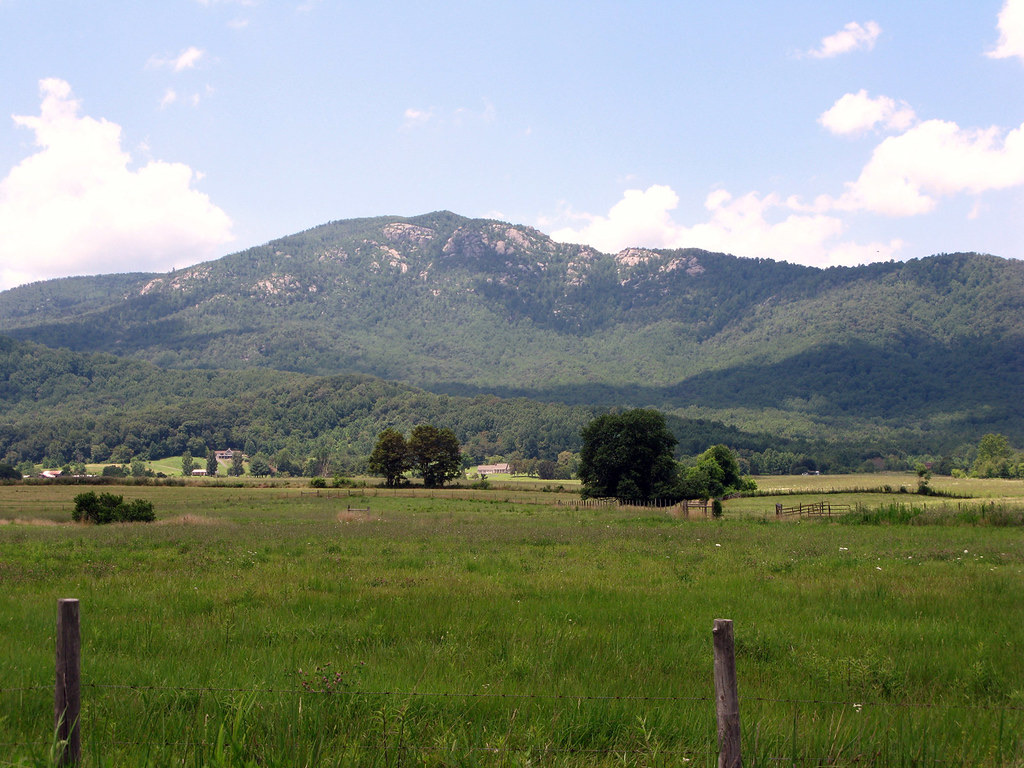
A century ago, a hiker on the Blue Ridge would have walked under a forest where roughly one tree in four was an American chestnut. Within a few decades almost every one of those giants was dead, killed by a fungus that arrived from Asia. The loss changed Virginia’s mountains more than any other natural event of the 20th century. Yet the species is not extinct: its roots keep sending up sprouts, a few trees still bear nuts, and growers in Nelson County and elsewhere are planting orchards of blight-resistant chestnuts.
Quick answer: The American chestnut (Castanea dentata) once made up about a quarter of the canopy in the Blue Ridge.[1] Chestnut blight, caused by the fungus Cryphonectria parasitica, was discovered at the Bronx Zoo in New York in 1904, probably brought in on imported Asian chestnut trees, and spread through Virginia in the following decades.[2] It killed an estimated four billion trees across the eastern United States.[3] The fungus girdles trunks but not roots, so the species survives as short-lived sprouts. Breeders have produced hybrids that are mostly American chestnut, and a Nelson County farm harvested 15,000 pounds of nuts from such trees in 2019.[4]
Contents
- A keystone of the eastern forest
- How to recognize a chestnut
- How chestnuts grew and reproduced
- Food, wood and tannin
- The blight arrives
- How the fungus kills
- Root rot in the lowlands
- Living sprouts and ghost forests
- What replaced the chestnut
- Bringing the chestnut back
- Chestnut farming in Virginia today
- Lessons for future invasions
- Timeline
- Frequently asked questions
A keystone of the eastern forest
The American chestnut ranged from Maine to Georgia and west into the Ohio Valley, with its heart in the Appalachians. In the Blue Ridge it accounted for about a quarter of the tree canopy.[1] Ecologists call such a dominant species a “keystone” or foundation species, because so many other plants and animals depend on it. Each fall chestnuts dropped a reliable crop of nuts that fed black bears, deer, wild turkeys, squirrels, elk and the now-extinct passenger pigeon.
After the last ice age, chestnuts that had survived in the South gradually spread north as the climate warmed. Their preferred habitat was the well-drained, acidic soil of mountain slopes and ridges, where they grew alongside northern red oak, chestnut oak, white oak and hickories. On dry sites they shared the canopy with pitch pine; on moister ground with tulip poplar, beech and sugar maple. Whether the species once grew commonly all the way to the Atlantic coast is still debated; a historical study of pre-blight records suggests it was more limited on the Coastal Plain.[5]
Virginia also has a smaller relative, the Allegheny chinquapin (Castanea pumila), a shrub or small tree that bears a single nut in each spiny bur.
How to recognize a chestnut
American chestnut leaves are long and narrow, with large, curved, hooked teeth along the edges. Each spiny bur usually holds up to three nuts. The trees flower in early summer, long after the danger of frost: long, cream-colored catkins carry the male flowers, with the female flowers near their base. A tree cannot fertilize itself, so pollen has to travel by wind from another chestnut nearby. That is one reason isolated survivors today rarely produce good nuts.
The common chestnut in yards and old orchards is usually a Chinese chestnut (Castanea mollissima), a shorter, spreading tree that tolerates the blight. As a rule of thumb, a healthy chestnut growing in full sun in a lawn is probably Asian; a spindly sapling in the shade of the woods is probably a native sprout.
How chestnuts grew and reproduced
Chestnuts could wait. A seedling in the shade of the forest might grow slowly for years until a storm or a falling tree opened a gap; then it shot up toward the light, often outpacing oaks and maples. In full sun it began to bear nuts.
The species also reproduced by sprouting. When a trunk was cut or damaged, buds near the base sent up vigorous new shoots that could grow several feet in a single season. That habit served chestnuts well in a landscape shaped by fire and logging. Native Americans burned woods regularly, and although young chestnuts have thin bark that fire can kill, the quick resprouting kept them in the forest. When loggers clear-cut the mountains in the late 1800s, chestnut sprouts grew back faster than most competitors, and in some second-growth stands chestnut became the dominant tree.
Food, wood and tannin
People prized the chestnut as much as wildlife did. Families gathered nuts each fall for roasting and stuffing, and mountain farmers sold them for cash in a season when other farm work was light. Hogs were turned loose in the woods to fatten on them.
The wood was lightweight, straight-grained, easy to split and highly resistant to decay, so it was used for log homes, fence rails, poles and posts.[1][2] The bark and wood were also rich in tannins, used to tan leather. Because chestnut wood resists rot so well, gray skeletons of trees killed by the blight could be found on mountain slopes for decades afterward.
The blight arrives
The fungus that causes chestnut blight, now named Cryphonectria parasitica (earlier Endothia parasitica and Diaporthe parasitica), is native to East Asia, where local chestnuts have evolved defenses against it.[3] A forester at the New York Zoological Park, the Bronx Zoo, noticed scattered infected American chestnuts in the summer of 1904.[2] William A. Murrill, a mycologist at the New York Botanical Garden, studied and described the fungus in the years that followed.[2]
No one knows exactly how it arrived, but nurseries had been importing Asian chestnut trees for orchards for decades. In 1882, for example, a New Jersey nurseryman brought in 1,000 grafted Japanese chestnut trees, and Japanese and Chinese trees were sold widely by mail order. Any of those shipments could have carried the fungus.[2] Plant explorer Frank Meyer later confirmed that the fungus was present in both China and Japan, where trees often showed few symptoms.[2]
Carried by wind, rain, birds, insects and people, the spores spread outward from New York at a rate of many miles a year. The blight reached Virginia in the following decades and swept through the Blue Ridge into North Carolina. By around World War II the chestnut had been virtually wiped out as a canopy tree across eastern North America.[3] An estimated four billion trees died.[3][4]
How the fungus kills
The blight fungus enters through a wound or crack in the bark, then grows in the living inner bark and cambium. It releases oxalic acid that kills the surrounding cells, forming a sunken or swollen orange canker. American chestnuts try to wall off infections with callus tissue, a defense that works against native diseases, but the Asian fungus spreads too fast. Once a canker circles the trunk, it stops water from rising to the crown and blocks food moving down to the roots, and everything above the canker dies.[3]
Chinese and Japanese chestnuts are resistant rather than immune: they become infected but usually contain the fungus before it girdles the tree.
Root rot in the lowlands
The blight was not the chestnut’s first enemy. Phytophthora cinnamomi, a water mold that causes ink disease or root rot, reached the Southeast in the 1800s and killed chestnuts in moist lowland soils. Unlike the blight, Phytophthora destroys the roots and kills the whole tree. Some scientists think it explains why chestnuts had largely vanished from the Piedmont and Coastal Plain before the blight arrived.[5]
Living sprouts and ghost forests
The blight fungus does not live in the soil, so roots below the canker usually survive. They send up new sprouts, which grow for a few years until the bark develops cracks, often around the age when the tree would start flowering. Then the fungus gets in, the sprout dies back, and the root tries again.[3] Millions of these small chestnuts still grow in Virginia’s woods, which is why the American chestnut is not classified as endangered. Deer browsing kills many sprouts, and the ones that bear a few nuts pass on the same vulnerability.
Clearing land for pasture kills chestnut roots entirely, so native sprouts are rarely found in open fields. American chestnuts planted far from the blight, in the Pacific Northwest and other western areas, have grown to large size, but no American chestnut anywhere is safe if the fungus reaches it.
After the die-off, salvage crews cut many dead chestnuts for lumber, poles and firewood in the 1920s and 1930s. Old chestnut rails and barn beams can still be found in rural Virginia, and “wormy chestnut” boards remain prized by woodworkers.
What replaced the chestnut
The loss of the chestnut opened space for other trees: chestnut oak, red oak and red maple filled many gaps. Those replacements face their own troubles, including spongy moth (formerly gypsy moth) defoliation of oaks, hemlock woolly adelgid killing eastern hemlocks, and oak decline.
The change is still unfolding. A survey in the 1920s found chestnut and oak sharing the canopy in White Oak Canyon in what is now Shenandoah National Park. When ecologist Richard Karban resurveyed the canyon in 1977, the forest looked much as before, with oaks in the canopy. But by his most recent survey, with his daughter Claire, birch and maples had become far more abundant, while chestnut sprouts persisted mainly where red oaks dominated.[6][7] The researchers concluded that the full effects of losing a foundation species may take many decades to appear.[6]
Bringing the chestnut back
Scientists have pursued several ways to restore the species:
- Hybrid breeding: Crossing American trees with blight-resistant Chinese chestnuts, then crossing the offspring back to American trees over several generations, produced trees that are about 15/16 American, with the goal of keeping the native form while adding resistance.[1] Results have been mixed, as many backcross trees still succumb to the blight.
- Genetic engineering: Researchers at the State University of New York developed a transgenic American chestnut carrying a wheat gene that helps neutralize the fungus’s oxalic acid. As of 2023 it was under federal regulatory review, and some Native nations raised questions about who would control and benefit from the trees.[8]
- Conservation of native genes: Volunteers locate surviving wild trees that still flower, pollinate them by hand and grow the nuts in seed orchards. Because the southern part of the range holds the most genetic diversity, conserving southern populations, including Virginia’s, is a priority.
Restoration plantings have also been made on former mine lands and in national forests in western Virginia.[1]
Chestnut farming in Virginia today
Chestnuts are also returning as a crop. David and Kim Bryant, who had worked in software, planted an orchard near Shipman in Nelson County, choosing the Dunstan variety, about 95 percent American and 5 percent Chinese. They planted 1,600 trees on 23 acres of hillside. The 2019 harvest yielded about 15,000 pounds of nuts, and they expected yields to grow as the trees matured.[4][9]
Harvest season in September and October is a race: most nuts fall within about two weeks of ripening, and deer and squirrels will take any left on the ground overnight.[9] The Bryants and other central Virginia growers formed a cooperative, Virginia Chestnuts, which sells fresh nuts at markets, to restaurants and online, and offers pick-your-own days.[4] They compete with imports: about 90 percent of chestnuts sold in American groceries come from Italy, France and China.[9] The 2022 Census of Agriculture counted 133 acres of chestnuts in Virginia, the largest share of the state’s 301 acres of tree nuts.[10] See specialty crops in Virginia.
Lessons for future invasions
The chestnut blight is a warning about imported pests and diseases. It came on nursery stock long before modern plant quarantines. Ports such as those in Hampton Roads and international airports such as Dulles are now the most likely entry points for new arrivals, but as white-nose syndrome in bats and the snakehead fish in the Potomac show, an introduced organism can appear almost anywhere. See invasive species in Virginia and bats in Virginia.
Timeline
| Date | Event |
|---|---|
| 1800s | Root rot (Phytophthora) kills chestnuts in moist lowland soils[5] |
| 1882 | 1,000 Japanese chestnut trees imported to a New Jersey nursery[2] |
| 1904 | Chestnut blight noticed at the Bronx Zoo, New York[2] |
| 1905–1906 | William Murrill describes the fungus[2] |
| 1910s–1930s | Blight sweeps through Virginia and the southern Appalachians |
| By the 1940s | Chestnut virtually gone as a canopy tree in the East[3] |
| 2019 | Nelson County orchard harvests about 15,000 pounds[4] |
| 2022 | 133 acres of chestnuts recorded in Virginia[10] |
Frequently asked questions
Is the American chestnut extinct? No. Millions of sprouts grow from surviving roots, but few reach nut-bearing size before the blight kills them back.[3]
What killed the American chestnut? Chestnut blight, an Asian fungus (Cryphonectria parasitica) first noticed in New York in 1904, plus earlier root rot in the lowlands.[2]
How many chestnut trees died? About four billion across the eastern United States.[3]
Can I buy Virginia-grown chestnuts? Yes. Virginia growers sell fresh chestnuts each fall through a cooperative and at markets.[4]
How can I tell an American chestnut from a Chinese chestnut? American chestnut leaves are long and narrow with large hooked teeth, and the trees are usually spindly sprouts in the woods; Chinese chestnuts are spreading trees with broader, often hairy-backed leaves, typically planted in the open.
See also: Habitats and species of Virginia, forestry in Virginia, Virginia ecosystems and plant communities, the Blue Ridge, bears, cougars, coyotes and wolves.
References
- American Forests, “The Fight Against Blight.” https://americanforests.org/blog/the-fight-against-blight
- Sandra L. Anagnostakis, “Chestnuts and the Introduction of Chestnut Blight,” Connecticut Agricultural Experiment Station. https://portal.ct.gov/caes/fact-sheets/plant-pathology/chestnuts-and-the-introduction-of-chestnut-blight
- “When Chestnuts Ruled Our Forests,” JSTOR Daily. https://daily.jstor.org/chestnuts-ruled-forests
- “Chestnut dreams: In Nelson County, growers bring back a local delicacy,” C-Ville Weekly, January 8, 2020. https://www.c-ville.com/chestnut-dreams-in-nelson-county-growers-bring-back-a-local-delicacy
- Emily W. B. Russell, “Pre-Blight Distribution of Castanea dentata,” Bulletin of the Torrey Botanical Club 114, no. 2 (1987). https://www.jstor.org/stable/2996129
- Richard Karban and Claire C. Karban, “Floristic changes following the chestnut blight may be delayed for decades,” PLOS One, October 2, 2024. https://journals.plos.org/plosone/article?id=10.1371/journal.pone.0306748
- “Chestnut Blight Has Significantly Altered the Composition of Shenandoah National Park,” Discover, October 4, 2024. https://www.discovermagazine.com/environment/chestnut-blight-has-significantly-altered-the-composition-of-shenandoah
- “The American chestnut tree is coming back. Who is it for?,” Grist, September 13, 2023. https://grist.org/indigenous/transgenic-american-chestnut-indigenous-rights/
- “Going Nuts Over An Old Favorite,” Piedmont Virginian, April 10, 2018. https://piedmontvirginian.com/going-nuts-over-an-old-favorite/
- “Native Chestnut Trees Returning,” NRV News, November 21, 2024. https://nrvnews.com/native-chestnut-trees-returning/