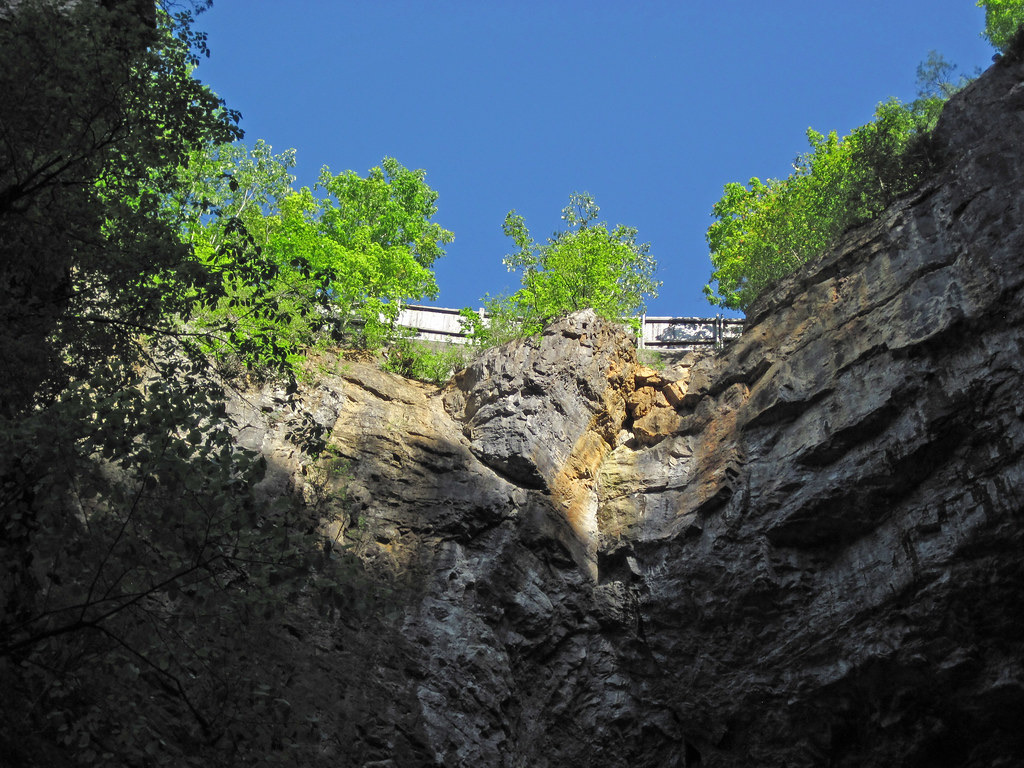
Natural Bridge, the great stone arch over Cedar Creek in Rockbridge County, was famous long before Virginia had parks of any kind. Thomas Jefferson owned it, wrote about it and called it “the most sublime of nature’s works.” Yet for almost 250 years the bridge was private property, run as a roadside attraction with a hotel and gift shop. It became a state park only in 2016, and the Commonwealth did not actually own it until 2023.
Quick answer: Thomas Jefferson acquired Natural Bridge and 157 acres from the Crown in 1774. The site stayed in private hands until 2014, when the Virginia Conservation Legacy Fund bought about 1,500 acres from owner Angelo Puglisi, who had been preparing to subdivide and auction it, using a state Clean Water Revolving Loan. The property began operating as Natural Bridge State Park in 2016, with admission and gift shop revenue repaying the loan. The Trust for Public Land took over the debt in 2022, the General Assembly appropriated $6.8 million to retire it, and the deed passed to the Commonwealth in June 2023. In October 2024 the state also acquired the neighboring Caverns at Natural Bridge.[1][2][3][4]
Contents
- The arch and the gorge
- Jefferson’s bridge
- Two centuries as a private attraction
- The auction that almost happened
- A loan instead of a sale
- A state park the state did not own
- The 2023 transfer
- The caverns
- Why Natural Bridge is not a national park
- Timeline
- Frequently asked questions
The arch and the gorge
The bridge is a natural limestone arch. Cedar Creek runs through the gorge beneath it, which is about 215 feet deep.[2] The surrounding land, about 1,500 acres of forest, meadow and creek valley, slopes toward the James River and is underlain by the karst limestone typical of the Great Valley of Virginia. See the geology of Virginia and the Valley and Ridge.
Jefferson measured the gorge himself, or relied on others’ measurements, and reported depths ranging from 205 to 270 feet, a width of about 45 feet at the bottom and 90 feet at the top. Looking down from the arch, he wrote, was painful; looking up from below was “delightful in an equal extreme,” the arch “springing as it were up to heaven.”[5]
Jefferson’s bridge
Jefferson obtained Natural Bridge and 157 acres in 1774, under a grant from the government of King George III, two years before he wrote the Declaration of Independence. He believed the bridge should be held in a kind of public trust, and in his Notes on the State of Virginia he described it as “the most sublime of nature’s works,” a sight that no traveler should miss.[1][5]
Jefferson’s book was widely read, and his praise helped make the bridge one of the best-known natural sights in the young United States. That fame did not translate into public ownership. After Jefferson the land passed through a series of private owners, and the colonial grant of 1774 turned out to be the last time any government held title to it for 249 years.[1]
Two centuries as a private attraction
For most of its history Natural Bridge was a business. Owners charged admission to walk the path beneath the arch and ran lodging, a gift shop and, nearby, a commercial cave tour. Travelers on U.S. 11, and later Interstates 81 and 64, could make a short detour to see the bridge.
The private model had limits. Revenue from tickets and souvenirs had to cover the costs of an aging hotel, water and sewer systems and the trail through the gorge, and the owner had every incentive to add development that would earn more money.
The auction that almost happened
The crisis came in 2013. That spring a Roanoke real estate and auction firm told Rockbridge County’s new administrator that the Natural Bridge property was about to be subdivided and auctioned. The owner was Angelo Puglisi, who had owned the site for many years.[3] An auction would have scattered the land among many buyers, with no guarantee of public access to the arch.
By 2014 about 1,700 privately owned acres, including the bridge itself, were slated for sale.[1] Local and state officials, conservation groups and the owner began looking for a way to keep the property together.
A loan instead of a sale
The solution was unusual. A new nonprofit, the Virginia Conservation Legacy Fund (VCLF), bought the bridge and about 1,500 surrounding acres from Puglisi in 2014. It paid with a loan from the Virginia Clean Water Revolving Loan Fund, a state program run by the Department of Environmental Quality and the Virginia Resources Authority and capitalized in part by federal Environmental Protection Agency money. The loan was justified as a way to protect the streams on the property and to prevent piecemeal development of the landmark.[1][2][3]
The Virginia Resources Authority’s director later said that, almost a decade earlier, Virginians had been at risk of losing public access to one of the state’s most recognized natural features, and that the loan fund made it possible to conserve the landmark.[1]
A state park the state did not own
In 2016 the property began operating as Natural Bridge State Park, staffed and managed by the Department of Conservation and Recreation like any other state park. The land, however, still belonged to the nonprofit. Debt payments on the loan were made by the state, mostly from money the park itself earned: entrance fees and gift shop sales.[2][3]
The arrangement had a drawback. Because the state did not own the property, it could not easily spend capital funds on the buildings and infrastructure, many of which needed repair.[3] The Lexington newspaper summed it up: for seven years Natural Bridge ran like any other state park, with the odd distinction that the state did not own it.[3]
The 2023 transfer
The path to public ownership ran through a national conservation group. In 2022 the Trust for Public Land took title to the property and assumed the remaining loan balance from the Virginia Conservation Legacy Fund as an interim owner.[1][2] In its 2022 session the General Assembly approved a $6.8 million appropriation to pay off the remaining debt, through a budget amendment sponsored by Senator Emmett Hanger and supported by other legislators from the area.[3]
The Trust for Public Land then transferred the property, about 1,530 acres, to the Department of Conservation and Recreation. Rockbridge County reported the transfer date as June 15, 2023, the anniversary of the opening of the state park system in 1936, and the deed was recorded in Lexington that month.[1][3] A conservation easement, required as a condition of using the clean water loan, permanently protects the land.[2] The Chesapeake Conservation Partnership later cited the deal as a model: a revolving loan at a low interest rate, repaid from the revenue the property itself generated.[2]
The caverns
One piece of the old attraction remained private: the Caverns at Natural Bridge, a commercial cave tour that had run continuously for about 50 years. On October 18, 2024, the state acquired the caverns and closed them for renovation. The park manager said the cave’s electrical system and some railings were unsafe and needed to be replaced with more environmentally sensitive equipment, and that the cave needed time to “heal.” The plan is for park rangers to lead tours and programs about karst and cave ecology, including how groundwater moves through limestone.[4]
As of mid-2026 the caverns remained closed while the Department of Conservation and Recreation and the Virginia Natural Heritage Karst Program assessed the site, with no reopening date announced. Once reopened, the caverns will operate as part of the state park.[6]
Why Natural Bridge is not a national park
Natural Bridge is often mistaken for a national park, and many people have argued that it should be one. But the federal government never took the site. The arch remained a private attraction while other famous American landscapes entered the National Park System, and when its future was in doubt in the 2010s, the answer came from a state loan program, a nonprofit and a national land trust rather than from Washington. See national parks in Virginia.
Timeline
| Year | Event |
|---|---|
| 1774 | Jefferson acquires Natural Bridge and 157 acres under a Crown grant |
| 1780s | Jefferson’s Notes on the State of Virginia describes the bridge |
| 2013 | Owner prepares to subdivide and auction the property |
| 2014 | Virginia Conservation Legacy Fund buys about 1,500 acres with a state clean water loan |
| 2016 | Natural Bridge State Park opens under state management |
| 2022 | Trust for Public Land takes title and the loan; General Assembly appropriates $6.8 million |
| June 2023 | Deed transferred to the Commonwealth |
| October 18, 2024 | State acquires the Caverns at Natural Bridge |
| 2026 | Caverns still closed for assessment |
Frequently asked questions
Who owns Natural Bridge? The Commonwealth of Virginia, through the Department of Conservation and Recreation, since June 2023.[3]
When did Natural Bridge become a state park? It began operating as a state park in 2016, though the state took title only in 2023.[2]
How much did Jefferson pay for Natural Bridge? Jefferson obtained the bridge and 157 acres under a 1774 grant from the Crown, the last government ownership before 2023.[1]
How tall is Natural Bridge? The gorge beneath the arch is about 215 feet deep.[2]
Are the Natural Bridge caverns open? They were closed after the state bought them in October 2024 and remained closed for assessment in 2026.[6]
See also: state parks in Virginia, parks and forests of Virginia, bridges in Virginia.
References
- “Virginia’s State Parks get anniversary gift: Deed to Natural Bridge,” Augusta Free Press, July 1, 2023. https://augustafreepress.com/news/virginias-state-parks-get-anniversary-gift-deed-to-natural-bridge/
- Chesapeake Conservation Partnership, “Natural Bridge State Park.” https://www.chesapeakeconservation.org/success-stories/natural-bridge-state-park/
- “Virginia Takes Ownership Of NBSP,” The News-Gazette (Lexington). https://www.thenews-gazette.com/article/2487,virginia-takes-ownership-of-nbsp
- “The important reasons Natural Bridge Caverns are closed: ‘The cave needs to heal’,” WTVR, June 5, 2025. https://www.wtvr.com/news/local-news/natural-bridge-caverns-closed-for-renovations-june-5-2025
- Thomas Jefferson, Notes on the State of Virginia, Query V (Documenting the American South, University of North Carolina). https://docsouth.unc.edu/southlit/jefferson/jefferson.html
- “Natural Bridge caverns remain closed during assessment,” WSET, June 2026. https://wset.com/news/local/natural-bridge-caverns-remain-closed-during-assessment-virginia-department-of-conservation-and-recreation-virginia-state-park-june-2026