Virginia has only one place that carries the formal title “National Park,” yet the National Park Service manages more than two dozen sites in the state. They range from the high ridges of Shenandoah to a Richmond rowhouse, from Civil War battlefields to a performing arts center in Fairfax County. At the same time, many of the places visitors think of as “parks” are not federal at all. Some are state parks, some belong to cities and counties, and some of the most famous landmarks in Virginia are privately owned.
Quick answer: Shenandoah is the only unit in Virginia named a National Park, but the National Park Service lists many more sites in the state, including the Blue Ridge Parkway, Assateague Island National Seashore, Colonial National Historical Park (Jamestown and Yorktown), Cumberland Gap, Appomattox Court House, Fort Monroe, four battlefield parks, the Appalachian Trail and Wolf Trap. In fiscal year 2020 the agency counted about 21.7 million visits to its Virginia parks and estimated about $2.07 billion in economic benefit from park tourism.[1] Many other well-known places, from Natural Bridge (state-owned only since 2023) to Montpelier, are not national parks.[2][3]
Contents
- What the National Park Service runs in Virginia
- Shenandoah: the one National Park
- Parkways, seashore and trails
- Battlefields and historical parks
- Monuments, homes and a stage
- Not every green space is a national park
- Private landmarks and the National Register
- Tribal lands
- Frequently asked questions
What the National Park Service runs in Virginia
The Park Service uses a confusing set of titles. A “National Park” is usually a large natural area; a “National Historical Park” protects a group of historic places; a “National Battlefield Park” or “National Military Park” protects fighting grounds; a “National Monument” can be anything from a birthplace to a fort; and “National Scenic Trails” and “National Historic Trails” are long corridors that cross many owners’ land. The agency’s state page for Virginia lists units in all of these categories, plus partnership programs that cover the whole Chesapeake Bay watershed.[1]
| Type | Units in Virginia (as listed by the Park Service) |
|---|---|
| National Park | Shenandoah |
| Parkways | Blue Ridge Parkway; George Washington Memorial Parkway (including Great Falls Park) |
| National Seashore | Assateague Island (Virginia and Maryland) |
| National Historical Parks | Appomattox Court House; Cedar Creek and Belle Grove; Colonial (Historic Jamestowne, Yorktown Battlefield, Cape Henry Memorial); Cumberland Gap; Harpers Ferry (mostly in West Virginia) |
| Battlefield and military parks | Fredericksburg and Spotsylvania; Manassas; Petersburg; Richmond |
| National Monuments | Booker T. Washington; Fort Monroe; George Washington Birthplace |
| Other sites | Arlington House, The Robert E. Lee Memorial; Maggie L. Walker National Historic Site; Prince William Forest Park; Wolf Trap National Park for the Performing Arts; Green Springs (Louisa County) |
| Trails | Appalachian National Scenic Trail; Potomac Heritage National Scenic Trail; Captain John Smith Chesapeake National Historic Trail |
The same page reports what the parks mean to the state’s economy. For the fiscal year that ended September 30, 2020, the Park Service counted 21,695,740 visits to national park units in Virginia and estimated $2,073,600,000 in economic benefit from park tourism. It also reported $103.6 million in Land and Water Conservation Fund grants appropriated for Virginia projects since 1965, money that has helped build state and local parks as well as federal ones.[1]
Shenandoah: the one National Park
Shenandoah’s origin explains a lot about how eastern national parks differ from western ones. The great western parks were carved out of land the federal government already owned. In the East nearly everything was private. In 1924 a federal committee searching for a national park site in the southern Appalachians came to the Blue Ridge of Virginia, looking for scenery within reach of the roughly 40 million people living in eastern cities, including Washington.[4] Because the Blue Ridge was already settled and privately owned, creating the park meant moving the people who lived on the ridge. The park now treats the lives of those mountain residents, the establishment of the park, the CCC and the segregation of early visitors as core parts of its history.[20]
The park was built largely by the Civilian Conservation Corps. Between May 1933 and March 1942, twelve CCC camps operated at nine locations in and around the future park, each housing about 200 young men. Enrollees earned $30 a month and kept only $5; the rest went home to their families. More than 6,500 men passed through Shenandoah’s camps, building overlooks, picnic grounds and developed areas along Skyline Drive, plus 101 miles of trails and 1,145 miles of fire trails.[5] In 1976 Congress designated 79,019 acres of the park as the Shenandoah Wilderness, the only wilderness area in Virginia managed by the Park Service rather than the Forest Service.[6] For more on the ridge itself, see the Blue Ridge.
Parkways, seashore and trails
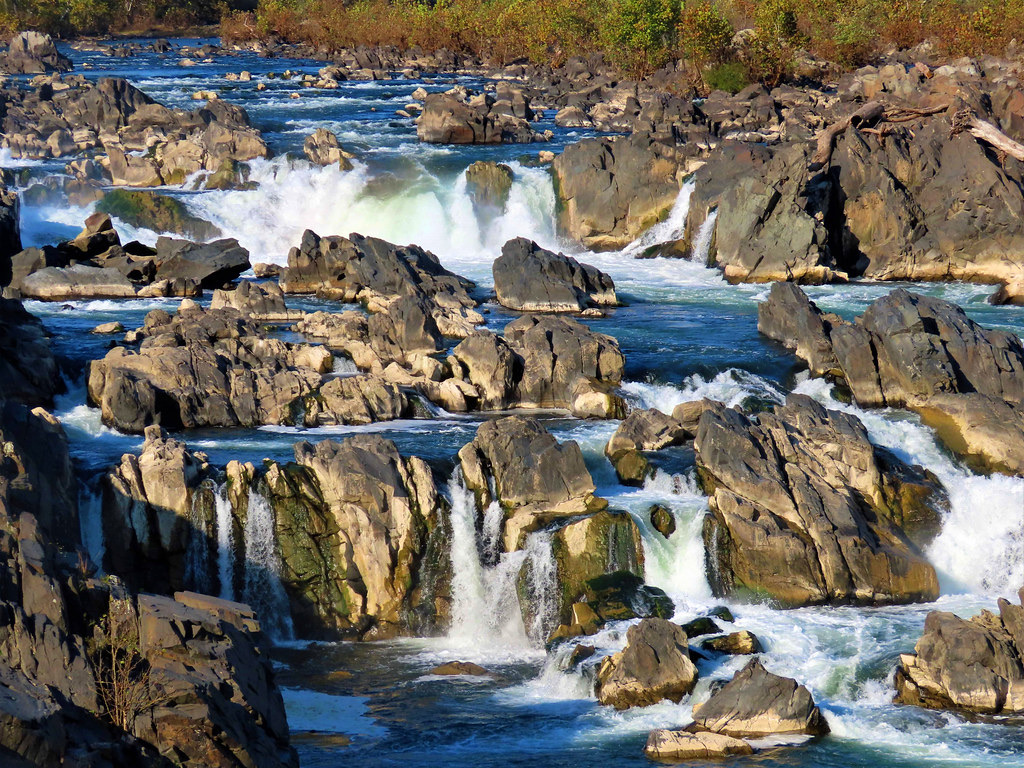
Two of Virginia’s Park Service units are roads. The Blue Ridge Parkway runs along the crest of the mountains from the southern end of Shenandoah into North Carolina, built for slow, scenic driving rather than speed.[1] The George Washington Memorial Parkway follows the Potomac through Northern Virginia and also manages Great Falls Park, where the river drops through a rocky gorge. The Park Service describes Great Falls as a place that has been a trading site, a fishing spot, a canal town, an amusement park and a nature destination over thousands of years; remnants of George Washington’s Patowmack Company canal still bypass the falls.[7]
Assateague Island National Seashore straddles the Maryland line. On the Virginia end, the beach and the Bateman Educational and Administrative Center sit inside Chincoteague National Wildlife Refuge, managed by the U.S. Fish and Wildlife Service, with the Park Service providing visitor services there.[8] The wild ponies are split by a fence at the state line: the Park Service manages the Maryland herd, while the Chincoteague Volunteer Fire Company owns the Virginia herd and swims it to Chincoteague Island for Pony Penning on the last Wednesday of July.[9]
The Appalachian Trail crosses more of Virginia than any other state, nearly a quarter of its length, running through Shenandoah, the George Washington and Jefferson National Forests and the Mount Rogers high country.[10] See trails and scenic rivers in Virginia.
Battlefields and historical parks
Most of Virginia’s Park Service sites protect history rather than wilderness. Colonial National Historical Park joins Historic Jamestowne, the first permanent English settlement (1607), with the Yorktown Battlefield, where Cornwallis surrendered on October 19, 1781.[1] Appomattox Court House preserves the village where the Army of Northern Virginia surrendered on April 9, 1865. Four battlefield parks (Manassas, Fredericksburg and Spotsylvania, Richmond and Petersburg) preserve Civil War ground, and Cedar Creek and Belle Grove protects a battlefield and a historic manor in the Shenandoah Valley.[1]
Not all protected battlefield land is federal. Private preservation groups and universities own parts of many battlefields, often with federal help. The Park Service’s American Battlefield Protection Program, for example, helped pay for the purchase of a former golf course on the Cool Spring battlefield in Clarke County, which is now owned by Shenandoah University rather than the federal government.[11] See golf in Virginia.
Cumberland Gap National Historical Park sits where Virginia, Kentucky and Tennessee meet and protects the gap used by bison, Native Americans, long hunters and settlers heading west.[1] See Cumberland Gap.
Monuments, homes and a stage
The smaller units tell individual stories. Booker T. Washington National Monument in Franklin County preserves the farm where Washington was born enslaved in 1856.[1] Maggie L. Walker National Historic Site in Richmond honors the bank president, newspaper editor and civil rights leader.[1] Fort Monroe National Monument was created by presidential proclamation in 2011, after the Army left the post; the Park Service manages about 325 acres of Old Point Comfort, including the fort and moat, while the state’s Fort Monroe Authority manages the rest.[12] See the old resort hotels at Old Point Comfort.
Prince William Forest Park protects a large forested watershed near Triangle, and Wolf Trap National Park for the Performing Arts, near Vienna in Fairfax County, is a park built around an outdoor stage.[1]
Not every green space is a national park
Visitors often assume that any big, scenic or historic place is a national park. In Virginia the opposite is usually true. Most of the state is private land, and public parks are run by many different owners:
- National forests (the George Washington and Jefferson National Forests) are run by the U.S. Forest Service, an agency of the Department of Agriculture, under different rules from the parks; logging, hunting and grazing can be allowed. Twenty-three of Virginia’s 24 wilderness areas are in these forests.[13]
- National wildlife refuges belong to the U.S. Fish and Wildlife Service and are managed first for wildlife.[14] See wilderness, wildlife refuges and nature preserves in Virginia.
- State parks are run by the Department of Conservation and Recreation. Virginia opened six on the same day in 1936 and had 44 by 2026.[15] See state parks in Virginia.
- Local parks can be enormous. Carvins Cove Natural Reserve, owned by the City of Roanoke, covers more than 12,000 acres and is described by the city as the second-largest municipal park in the United States.[16]
Private landmarks and the National Register
Some of Virginia’s best-known attractions are, or long were, private property. Natural Bridge was in private hands from Thomas Jefferson’s purchase in 1774 until the state took title in June 2023, even though it began operating as a state park in 2016.[2] See Natural Bridge State Park. Montpelier, James Madison’s home, has been run since 1998 by the private Montpelier Foundation, which transformed a privately owned estate into a site drawing more than 125,000 visitors a year.[3] Commercial caves, theme parks and resorts operate as businesses, paying their costs out of admission fees and sales.
The National Register of Historic Places, kept by the Park Service, causes more confusion. It is the official federal list of places worthy of preservation, authorized by the National Historic Preservation Act of 1966.[17] Virginia’s Department of Historic Resources maintains a database of more than 3,000 Virginia places listed on the Virginia Landmarks Register, the National Register or both.[18] Listing honors a property and can qualify its owner for tax incentives, but it does not make the property public. A listed farmhouse or plantation house may be a private home with no public access at all.
Tribal lands
Reservations are another kind of land that is neither park nor ordinary private property. The Pamunkey Indian Tribe’s reservation lies on the north bank of the Pamunkey River in King William County, and the tribe points to treaty and legal rights that date back more than 400 years. The federal government recognized the Pamunkey as a tribe in a decision effective January 28, 2016.[19] See Native peoples of Virginia.
Frequently asked questions
How many national parks are in Virginia? Only Shenandoah is called a National Park, but the National Park Service manages more than two dozen units in Virginia, including parkways, a seashore, historical parks, battlefields, monuments and trails.[1]
Is the Blue Ridge Parkway a national park? It is a unit of the National Park System, classified as a parkway, not as a National Park.[1]
Is Montpelier a national park? No. James Madison’s home is run by the private Montpelier Foundation, not by the National Park Service.[3]
Does listing on the National Register mean I can visit a place? No. The Register is a list of historic places; many listed properties are private and closed to the public.[17]
Who owns Natural Bridge? The Commonwealth of Virginia, since June 2023. It had been privately owned since 1774.[2]
See also: parks and forests of Virginia, history tourism and museums in Virginia, wildlife refuges and nature preserves in Virginia.
References
- National Park Service, “Virginia” (park list and “By the Numbers,” fiscal year 2020). https://www.nps.gov/state/va/index.htm
- “Virginia’s State Parks get anniversary gift: Deed to Natural Bridge,” Augusta Free Press, July 1, 2023. https://augustafreepress.com/news/virginias-state-parks-get-anniversary-gift-deed-to-natural-bridge/
- James Madison’s Montpelier, “About.” https://www.montpelier.org/about/
- National Park Service, Shenandoah National Park, “Skyline Drive History.” https://www.nps.gov/shen/learn/historyculture/skylinedrivehistory.htm
- National Park Service, Shenandoah National Park, “Civilian Conservation Corps.” https://www.nps.gov/shen/learn/historyculture/ccc.htm
- Wilderness Connect (University of Montana), “Shenandoah Wilderness.” https://wilderness.net/visit-wilderness/?ID=549
- National Park Service, Great Falls Park, “History and Culture.” https://www.nps.gov/grfa/learn/historyculture/index.htm
- National Park Service, Assateague Island National Seashore, “Plan Your Visit.” https://www.nps.gov/asis/planyourvisit/index.htm
- National Park Service, Assateague Island National Seashore, “Horses.” https://www.nps.gov/asis/learn/nature/horses.htm
- Appalachian Trail Conservancy, “Virginia.” https://appalachiantrail.org/explore/explore-by-state/virginia/
- Shenandoah University, “Public-private Partnership To Protect Cool Spring Battlefield.” https://su.edu/cool-spring/public-private-partnership-to-protect-cool-spring-battlefield
- Fort Monroe Authority, “History.” https://fortmonroe.org/history-education/history/
- Virginia Wilderness Committee, “Wilderness and National Scenic Areas on the GW/Jeff NF.” https://www.vawilderness.org/va-wilderness.html
- National Wildlife Refuge System Administration Act, 16 U.S.C. § 668dd (Legal Information Institute). https://www.law.cornell.edu/uscode/text/16/668dd
- Library of Virginia, “Discover Virginia State Parks with Your Public Library,” April 13, 2026. https://uncommonwealth.lva.virginia.gov/blog/2026/04/13/discover-virginia-state-parks/
- Roanoke Parks and Recreation, “Carvins Cove Natural Reserve.” https://www.playroanoke.com/parks/carvins-cove-natural-reserve/
- National Park Service, “National Register of Historic Places.” https://www.nps.gov/subjects/nationalregister/index.htm
- Virginia Department of Historic Resources, “Historic Registers.” https://www.dhr.virginia.gov/historic-registers/
- Pamunkey Indian Tribe, official website. https://pamunkey.org/
- National Park Service, Shenandoah National Park, “History and Culture.” https://www.nps.gov/shen/learn/historyculture/index.htm