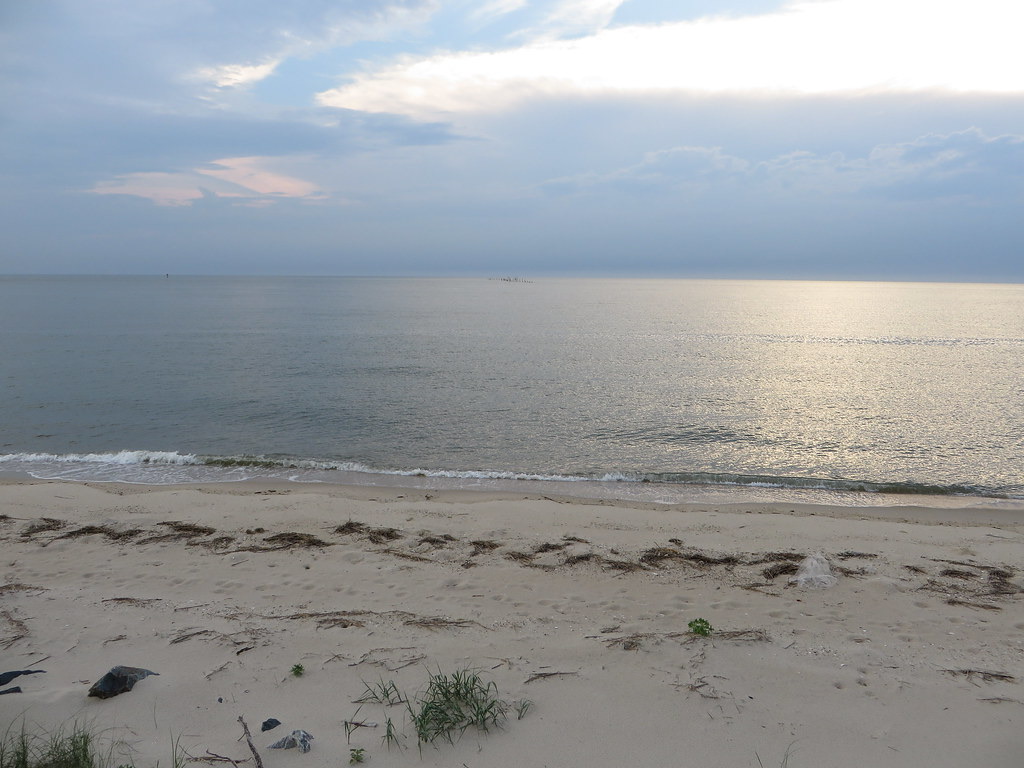
Virginia’s coast and the lower Chesapeake Bay are busy with large marine animals that most beachgoers never notice. Thousands of young sharks spend each summer in the Bay, great white sharks pass offshore in spring and fall, and bottlenose dolphins swim up the Potomac River almost to the Washington suburbs. Seals have even become regular winter visitors. This page looks at the sharks and dolphins of Virginia waters, how they use the Bay, and what the record says about danger to people.
Quick answer: More than 50 shark species live in Atlantic waters off the East Coast. In and around the Chesapeake, the most common are the sandbar shark, sand tiger, smooth dogfish, spiny dogfish and, less often, the bull shark. The lower Bay is the largest sandbar shark nursery in the United States: pregnant females give birth there in late spring, and the young return each summer for several years. Shark bites in Virginia are rare; the last fatal attack was in 2001 at Sandbridge. Bottlenose dolphins visit the Bay and the Potomac each summer, and researchers have identified more than 1,000 individuals in the Potomac.[1][2][3][4]
Contents
- Sharks in Virginia waters
- The sandbar shark and its Chesapeake nursery
- Overfishing and recovery
- Great white sharks off Virginia
- Shark bites: how rare?
- Seals: new prey in the Bay
- Climate change and shifting ranges
- Bottlenose dolphins
- The dolphins of the Potomac
- Frequently asked questions
Sharks in Virginia waters
The waters off the U.S. East Coast hold more than 50 shark species, from small spiny dogfish to great whites. NOAA Fisheries manages 43 of them in federal Atlantic waters. In the Mid-Atlantic, sandbar sharks, sand tigers and smooth dogfish are the species most often found close to shore, especially in summer.[1]
Inside the Chesapeake Bay, the most common sharks are the sandbar shark, bull shark, sand tiger, smooth dogfish and spiny dogfish. Rarer visitors include the basking shark, bonnethead, smooth and scalloped hammerheads, the Atlantic angel shark, the dusky shark and the Atlantic sharpnose.[5]
- Sandbar sharks are by far the most common, and most of those in the Bay are young ones.
- Sand tigers, up to about 10 feet long and fierce-looking with ragged teeth, move up the lower Bay in summer and fall. They hunt at night for small fish, squid and smaller sharks.
- Smooth dogfish swim in schools along the bottom of the lower Bay in less than 60 feet of water and range north to the Patuxent River.
- Spiny dogfish arrive in the southern Bay from late fall to early spring and prefer deeper water.
- Bull sharks are uncommon but have been recorded as far north as the Patuxent River. They can live in very shallow and even fresh water, which brings them closer to people than most large sharks.[5]
The sandbar shark and its Chesapeake nursery
The sandbar shark (Carcharhinus plumbeus) is a brownish-gray shark with a white belly, a short rounded snout and a very tall first dorsal fin. It can reach about 8 feet and 200 pounds and live around 30 years, but it grows slowly and does not mature until age 13 or 14. Females carry their pups for 8 to 12 months and give birth to live young, about 2 feet long, in shallow nearshore nurseries. Sandbar sharks feed near the bottom on bony fish, smaller sharks, rays, squid, octopuses and crabs.[6]
The lower Chesapeake Bay is the largest sandbar shark nursery in the United States.[7] Pregnant females swim into the Bay in late May and early June to give birth, then leave and head north. The newborns stay all summer, feeding in the shallow, salty lower Bay, and migrate south of Cape Hatteras in the fall. Young sharks, from about age one to seven, come back to the Bay every spring until they are large enough to stay offshore. Blue crabs are one of their favorite foods.[5] NOAA’s surveys have found that the lower Bay and the seaside of Virginia’s Eastern Shore are dominated by juvenile sandbar sharks.[8]
The Virginia Institute of Marine Science has run a longline shark survey off Virginia since 1973, setting baited lines at the same fixed stations year after year to track how shark numbers change.[9]
Overfishing and recovery
Heavy fishing in the 1980s and early 1990s cut many Atlantic shark populations sharply. Sandbar sharks were especially valuable because of their large fins. In 1993 NOAA put in place the first federal fishery management plan for Atlantic sharks, including a ban on finning (cutting off fins and throwing the body back). Today keeping a sandbar shark is generally prohibited in federal waters; a few permitted vessels may land them as part of a shark research fishery that collects scientific data. The sandbar stock is still considered overfished but is rebuilding under a recovery plan.[1][6]
Researchers at the Virginia Institute of Marine Science reported in 2017 that shark populations in the southeastern United States had started to recover in the mid-to-late 2000s. Scientists see more sharks as a sign of a healthier Bay, because these top predators keep prey populations in balance.[5]
Great white sharks off Virginia
Great white sharks (Carcharodon carcharias) migrate along the Atlantic coast, heading north in spring and south in late fall, and they pass through Virginia’s ocean waters. Satellite tags have shown how often they visit. The nonprofit OCEARCH tags white sharks and posts their tracks online; tagged sharks such as “Santiago” have pinged off the Virginia coast and near the mouth of the Chesapeake.[10]
Shark bites: how rare?
Unprovoked shark bites in Virginia are rare. According to the International Shark Attack File kept by the Florida Museum of Natural History, bites are recorded far more often in warmer waters farther south, especially in North Carolina and Florida.[11]
The best-known Virginia case came on Labor Day weekend in 2001. Ten-year-old David Peltier of Richmond was in about four feet of water at Sandbridge, in southern Virginia Beach, when a shark bit his leg. His father fought the shark off and carried him to shore, but the boy died early the next morning at the Children’s Hospital of The King’s Daughters in Norfolk. It was the first fatal shark attack in the United States that year and the first reported in the area in 30 years.[12][13] It came during the “summer of the shark,” when news coverage made 2001 seem unusually dangerous; the International Shark Attack File later counted 76 unprovoked attacks worldwide in 2001, fewer than the 85 recorded in 2000.[14]
Simple habits make the already low risk even lower: swim near lifeguards, avoid fishing piers and schools of baitfish, stay out of murky water and avoid swimming at dawn and dusk. Most sharks in the Chesapeake are young sandbar sharks that pose little or no threat to people.[5][11]
Seals: new prey in the Bay
Harbor seals are now regular winter visitors to the lower Chesapeake. Young seals travel south from New England each winter, arriving around December and leaving by about May, and they often haul out on the rock islands of the Chesapeake Bay Bridge-Tunnel and along the Eastern Shore. Gray, harp and hooded seals are seen occasionally.[15] Seals are prey for large sharks, including white sharks.
Climate change and shifting ranges
As the ocean warms, shark populations along the Atlantic coast are shifting northward and into deeper water, and suitable habitat is shrinking, especially in the fall.[5] Warming and low oxygen also threaten the Chesapeake nursery. Sandbar sharks must keep swimming to push water over their gills, and a 2019 study found that the overall performance of juveniles fell sharply at 32°C (about 90°F) or when oxygen dropped below 3.5 milligrams per liter. As warm, low-oxygen water spreads in the Bay, the nursery could shrink.[7]
Bottlenose dolphins
Common bottlenose dolphins (Tursiops truncatus) live in the Atlantic Ocean off Virginia, both close to shore and farther out, and in summer they swim into the Chesapeake Bay and up its rivers. Adults weigh 300 to 1,400 pounds, grow 6 to 13 feet long and can live 40 to 60 years.[16]
NOAA divides Atlantic coastal bottlenose dolphins into several stocks, populations that are managed separately. Dolphins in Virginia waters can belong to the Northern Migratory and Southern Migratory coastal stocks, which spend summers and winters in different places, and some may come from the South Carolina–Georgia coastal stock. Several of these coastal stocks are listed as “depleted” under the Marine Mammal Protection Act. Threats include fishing gear entanglement, boat strikes, pollution, disease and harassment.[16]
The dolphins of the Potomac
Since 2015 the Potomac-Chesapeake Dolphin Project has photographed dolphins in the lower Potomac, identifying individuals by the nicks and notches on their dorsal fins. Its sightings stretch from the Chesapeake to about 45 miles up the Potomac near Colonial Beach.[3] The project has identified well over 1,000 individual dolphins and believes thousands may use the river and the Bay. The dolphins arrive from the ocean in late spring and spend the summer in the Potomac, and many have been named after founding fathers and other historical figures.[4]
In 2019 the project and the Potomac Conservancy asked the public to name two dolphins known as D1 and D2. More than 1,400 people voted, and the winners were “Mac” and “Chessie,” for the Potomac River and the Chesapeake Bay.[17] Dolphins were once seen even farther upstream: in the 1880s they were regularly reported near Indian Head, Maryland, and as far up as Alexandria. Conservation groups hope cleaner water will bring them back toward Washington.[4]
Frequently asked questions
Are there sharks in the Chesapeake Bay? Yes. Sandbar sharks are common in summer, mostly young ones, along with sand tigers, dogfish and occasional bull sharks.[5]
Is it safe to swim at Virginia Beach? Shark bites are very rare in Virginia. The last fatal one was in 2001.[11][12]
Why do sandbar sharks come to the Chesapeake? The lower Bay is the largest sandbar shark nursery in the country; mothers give birth there and young sharks return each summer.[5][7]
How far up the Potomac do dolphins go? Researchers have recorded them about 45 miles up the river near Colonial Beach, and historically near Indian Head and Alexandria.[3][4]
See also: the Atlantic Ocean and the Gulf Stream off Virginia, the Chesapeake Bay in Virginia, blue crabs in Virginia, fish and freshwater mussels in Virginia, habitats and species of Virginia.
References
- NOAA Fisheries, “Sharks in Atlantic Coastal Waters.” https://www.fisheries.noaa.gov/national/atlantic-highly-migratory-species/sharks-atlantic-coastal-waters
- Associated Press, “Virginia beachgoers spooked after shark attack kills boy,” via HeraldNet, September 2001. https://www.heraldnet.com/news/virginia-beachgoers-spooked-after-shark-attack-kills-boy/
- Potomac-Chesapeake Dolphin Project, “Research.” http://www.pcdolphinproject.org/research
- InsideNoVa, “There are dolphins in the Potomac River, and two need names,” May 2019. https://www.insidenova.com/news/regional/there-are-dolphins-in-the-potomac-river-and-two-need/article_491592c8-7c43-11e9-9816-d7fb1ba8eda1.html
- Maria Bellos Fisher, “The Five Sharks You Meet in the Chesapeake,” SpinSheet. https://www.spinsheet.com/chesapeake-bay/five-sharks-you-may-meet-chesapeake
- NOAA Fisheries, “Sandbar Shark.” https://www.fisheries.noaa.gov/species/sandbar-shark
- “The impacts of warming and hypoxia on the performance of an obligate ram ventilator,” Conservation Physiology, 2019 (PubMed Central). https://www.ncbi.nlm.nih.gov/pmc/articles/PMC6656321/
- NOAA Fisheries, “The Search for Atlantic Shark Nurseries” (story map). https://www.fisheries.noaa.gov/story-map/search-atlantic-shark-nurseries
- Virginia Institute of Marine Science, “50 Years of VASMAP” (story map). https://storymaps.arcgis.com/stories/df94ebd5f1d24eb68287678d10a9fbbd
- OCEARCH, Shark Tracker, “Santiago.” https://www.ocearch.org/tracker/detail/santiago
- VirginiaBeach.com, “Why You Shouldn’t Worry About Virginia Beach Shark Attacks.” https://www.virginiabeach.com/article/why-you-shouldnt-worry-about-virginia-beach-shark-attacks
- ABC News, “10-Year-Old Killed in Va. Shark Attack,” September 3, 2001. https://abcnews.com/US/story?id=92566
- Associated Press via HeraldNet, “Virginia beachgoers spooked after shark attack kills boy.” https://www.heraldnet.com/news/virginia-beachgoers-spooked-after-shark-attack-kills-boy/
- University of Florida News, “‘Summer Of The Shark’ In 2001 More Hype Than Fact, New Numbers Show,” February 2002. https://archive.news.ufl.edu/articles/2002/02/summer-of-the-shark-in-2001-more-hype-than-fact-new-numbers-show.html
- Chesapeake Bay Program, “Harbor seals are becoming a regular highlight of winter in the Chesapeake Bay,” December 2, 2020. https://www.chesapeakebay.net/news/blog/harbor_seals_are_becoming_a_regular_highlight_of_winter_in_the_chesapeake_b
- NOAA Fisheries, “Common Bottlenose Dolphin.” https://www.fisheries.noaa.gov/species/common-bottlenose-dolphin
- Potomac Conservancy, “Name the Potomac Dolphins” (results, June 2019). https://potomac.org/name-potomac-dolphins