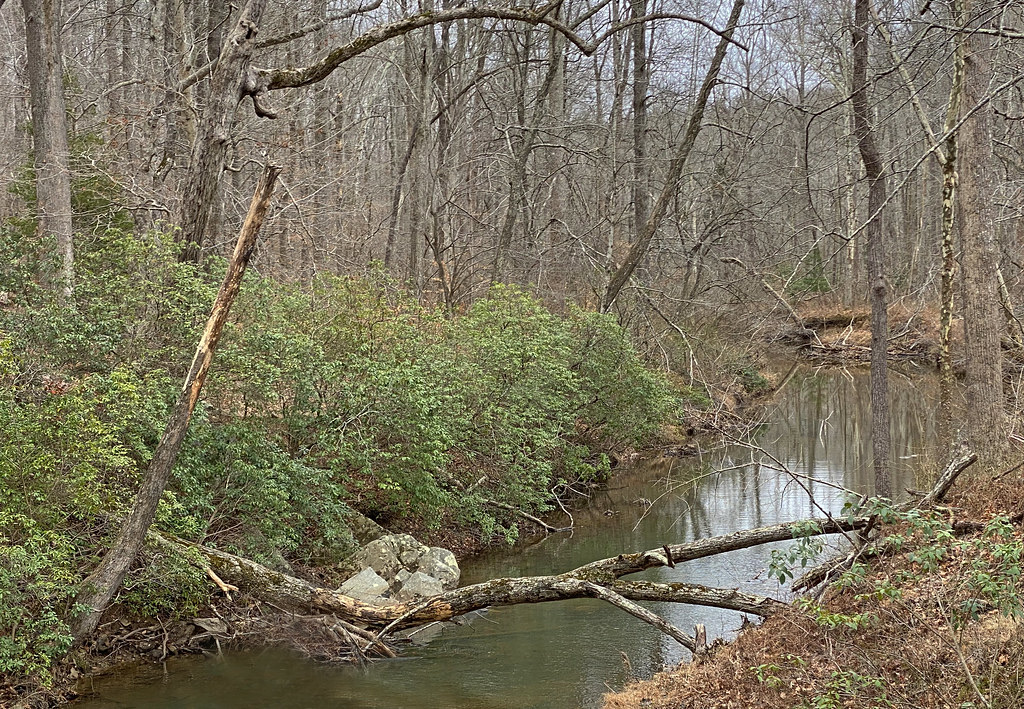
Reptiles and amphibians are easy to overlook. Most are small, secretive and active at night or underground, and many people notice them only when a snake crosses the trail. Yet Virginia is unusually rich in them. Its mountains are one of the world’s great centers of salamander diversity, its swamps and coastal plain hold southern reptiles at the northern edge of their range, and it has a healthy, mostly harmless snake fauna. This page covers snakes, salamanders and the one famous reptile Virginia does not (yet) have: the alligator.
Quick answer: Virginia has 32 snake species, and only three are venomous: the northern copperhead (found statewide), the timber rattlesnake (in the western mountains and, as the endangered canebrake rattlesnake, in the far southeast) and the eastern cottonmouth (in wet areas south and east of Petersburg). The eastern garter snake is the official state snake and the red salamander the state salamander. The Virginia Department of Wildlife Resources lists more than 50 salamander species in the state. American alligators live in northeastern North Carolina, at the northern limit of their range, but no wild population lives in Virginia; alligators found here have been escaped or released pets.[1][2][3][4][5]
Contents
- Reptiles and amphibians
- Virginia’s snakes
- The three venomous snakes
- Snakes in winter dens
- Living with snakes
- Snakes in trouble
- A salamander hotspot
- Salamanders found nowhere else
- Alligators at the border
- Escaped alligators in Virginia
- Frequently asked questions
Reptiles and amphibians
Reptiles, the group that includes snakes, lizards, turtles and crocodilians, have dry scaly skin and lay shelled eggs or bear live young. Almost all are cold-blooded, relying on the sun and warm surfaces to heat their bodies.[2] Amphibians, including salamanders, frogs and toads, have moist skin that breathes and usually lay jelly-coated eggs in water or damp places. Many amphibians live double lives, starting as aquatic larvae and later moving onto land. Because they absorb water and air through their skin, amphibians are especially sensitive to pollution, drying and habitat change.
Virginia’s snakes
DWR counts 32 species of snakes in Virginia, found everywhere from coastal marshes to mountaintops and even under buildings in cities.[2] The great majority are harmless to people. Common species include the eastern rat snake (often called the black snake), garter snakes, ring-necked snakes, northern water snakes, eastern hognose snakes, corn snakes and kingsnakes.
Snakes have no legs, ears or eyelids and only one working lung. They cannot hear airborne sound in the usual way but sense vibrations through the ground and air. Some lay leathery eggs, usually in May or June, while many others give birth to live young in late summer. All are carnivores; with two lower jaws joined by a stretchy ligament, they swallow prey whole, from insects and worms to fish, frogs, birds, eggs and rodents.[2] That diet makes them valuable pest controllers: DWR notes that snakes around a house often signal a rodent problem.[1]
The eastern garter snake (Thamnophis sirtalis sirtalis) is Virginia’s official state snake.[3] It is common, small and harmless, and lives in yards, fields and woods across the state.
The three venomous snakes
Only three of Virginia’s snakes are venomous:[1][2]
| Snake | Where it lives | Notes |
|---|---|---|
| Northern copperhead | Statewide | The most common venomous snake; rarely in houses but often in gardens and woodlots |
| Timber rattlesnake | Mountains of western Virginia; a small area of the extreme southeast | The southeastern population, the canebrake rattlesnake, is state endangered |
| Eastern cottonmouth (water moccasin) | South and east of Petersburg | Common only in wet areas |
Copperheads have hourglass-shaped bands of tan and reddish brown that blend perfectly into dead leaves. Timber rattlesnakes are heavy-bodied snakes of rocky, forested ridges. Cottonmouths live in swamps, creeks and wetlands of the southeastern Coastal Plain. Many harmless snakes, especially water snakes and young rat snakes, are mistaken for these three, and some harmless species vibrate their tails in dry leaves to imitate a rattle.
Venomous bites are uncommon and deaths are rare. None of Virginia’s venomous snakes chases people; they bite mainly when stepped on, cornered or handled, so watching where you put your hands and feet and leaving snakes alone are the best protection.
Snakes in winter dens
In the mountains, timber rattlesnakes and copperheads spend the winter in communal dens deep in rock crevices and talus slopes, often returning to the same den year after year and basking nearby on warm spring and fall days. These dens are vital and vulnerable: disturbing one or collecting snakes from it can wipe out a local population that took decades to build. When Skyline Drive was blasted along the crest of the Blue Ridge in the 1930s, construction crews sometimes uncovered such dens, to the alarm of men and snakes alike.
Living with snakes
DWR’s advice for homeowners is practical. Remove rock and brush piles, keep grass near the house mowed short, and seal gaps around foundations, pipes and vents, since a snake inside usually came looking for mice. If a harmless snake gets indoors, it can be guided into a bucket or wastebasket and carried outside. DWR staff do not remove snakes from homes; for that, residents can call a pest control company with the proper permit.[1]
State rules also protect snakes. Under Virginia regulations, it is generally unlawful to take, possess, sell or release wild animals unless specifically allowed, and people may keep at most one native reptile or amphibian per address for personal use, and never a threatened, endangered or specially protected species.[1]
Snakes in trouble
DWR calls humans the greatest predators of snakes: hundreds, perhaps thousands, are killed needlessly in Virginia every year by people who fear them.[2] Habitat loss, roads and the suppression of natural fires add to the pressure.
Fourteen of Virginia’s 32 snake species are listed in the state Wildlife Action Plan as Species of Greatest Conservation Need, including the canebrake rattlesnake and the northern pinesnake. The pinesnake was once considered common in parts of Virginia but has not been seen in about 25 years and is presumed extirpated, most likely because of fire suppression, habitat loss and persecution. A DWR-backed study found that suitable habitat still exists and that reintroduction would be feasible.[2]
A salamander hotspot
The southern Appalachians are the world capital of salamanders, and Virginia shares in that wealth. DWR’s guide to Virginia’s salamanders lists more than 50 species, grouped by habitat:[4]
- Forest salamanders that live on land, under logs, rocks and leaf litter, such as the eastern red-backed salamander and the slimy salamanders. Many in this group are lungless and breathe entirely through their skin.
- Seasonal-wetland salamanders such as the spotted, marbled, tiger and Jefferson’s salamanders, which migrate on rainy spring or fall nights to breed in temporary pools free of fish.
- Stream and seep salamanders such as the dusky, two-lined, spring and seal salamanders, which live along cold mountain streams.
- Fully aquatic salamanders, including the eastern hellbender (North America’s largest salamander), the common mudpuppy, the greater siren and the two-toed amphiuma.
The name “salamander” comes from an old belief that these creatures could live in fire; the reality, as DWR puts it, is that they are secretive animals of cool, damp places.[4] The red salamander (Pseudotriton ruber), a bright red-orange species of springs and seeps, is the official state salamander, and it appears on a DWR wildlife conservation license plate whose fees support wildlife programs.[3][4]
Salamanders found nowhere else
Some Virginia salamanders live on just one mountain or one range. DWR’s list includes the Shenandoah salamander, found only on a few peaks in Shenandoah National Park; the Peaks of Otter salamander, confined to a small area of the Blue Ridge near the Peaks of Otter; the Big Levels salamander of Augusta County; the Cow Knob salamander of Shenandoah Mountain on the West Virginia line; and the Dixie Caverns salamander, known from caves near Roanoke.[4] Species with such tiny ranges are especially vulnerable to climate change, disease and habitat damage, and several are listed as rare or endangered (see Endangered Species in Virginia).
Alligators at the border
The American alligator reaches the northern limit of its range in North Carolina, where it lives in patches along the coast. North Carolina’s wildlife agency explains that cold winters limit how fast alligators grow and how often they reproduce there, making northern populations more vulnerable to local die-offs than those farther south.[5] Alligators are state and federally threatened in North Carolina (federally because they look like endangered crocodilians).[5]
The northernmost colony lives at Merchants Millpond State Park in Gates County, North Carolina, just south of the Virginia line. Scientists long assumed it was too far north for alligators to breed, because an alligator’s sex depends on how warm the eggs are during incubation: eggs kept above about 93 degrees Fahrenheit hatch mostly males and those below about 86 degrees mostly females. In a cool northern summer, a colony might produce almost all females. As summers warm, that barrier may weaken.[6]
Whether alligators will eventually cross into the Great Dismal Swamp or Back Bay on their own is an open question. A warmer climate could allow it.
Escaped alligators in Virginia
Meanwhile, alligators do turn up in Virginia every few years, from Hampton Roads to Northern Virginia. With the nearest wild population across the state line, these are generally escaped or released pets, or animals that got loose in transit, rather than wild migrants. Captured animals usually end up in zoos, nature centers or reptile rescues. Virginia regulations make it unlawful to release wild animals except as specifically permitted, and a pet alligator turned loose is unlikely to survive a Virginia winter.[1]
North Carolina’s wildlife agencies, along with those of the other southeastern states where alligators live, promote the “GatorWise” rules for living with them: assume alligators may be present, keep your distance, and never feed them.[7]
Frequently asked questions
How many venomous snakes are in Virginia? Three: the northern copperhead, timber rattlesnake (including the canebrake population) and eastern cottonmouth.[2]
What is the state snake of Virginia? The eastern garter snake.[3]
What is the most common venomous snake in Virginia? The copperhead, found statewide.[1]
How many salamander species live in Virginia? DWR’s guide lists more than 50 species.[4]
Are there alligators in Virginia? Not in the wild. The nearest wild alligators live in northeastern North Carolina; those found in Virginia have been escaped or released pets.[5]
References
- Virginia Department of Wildlife Resources, “Problems with Snakes.” https://dwr.virginia.gov/wildlife/nuisance/snakes/
- Virginia Department of Wildlife Resources, “Celebrating Virginia’s Snakes in Honor of National Reptile Awareness Day.” https://dwr.virginia.gov/blog/celebrating-virginias-snakes-in-honor-of-national-reptile-awareness-day/
- Code of Virginia § 1-510, “Official emblems and designations.” https://law.lis.virginia.gov/vacode/title1/chapter5/section1-510/
- Virginia Department of Wildlife Resources, “A Guide to the Salamanders of Virginia.” https://dwr.virginia.gov/wildlife/salamanders/
- North Carolina Wildlife Resources Commission, “Alligator, American.” https://www.ncwildlife.gov/species/alligator-american
- April Smith, “Merchant’s Millpond and the American alligator,” North Carolina Science Trail, May 16, 2023. https://ncsciencetrail.org/science-blog/merchants-millpond-and-the-american-alligator/
- North Carolina Wildlife Resources Commission, “Yes, Alligators Live in North Carolina – Are You GatorWise?,” May 19, 2025. https://www.ncwildlife.gov/news/press-releases/2025/05/19/yes-alligators-live-north-carolina-are-you-gatorwise