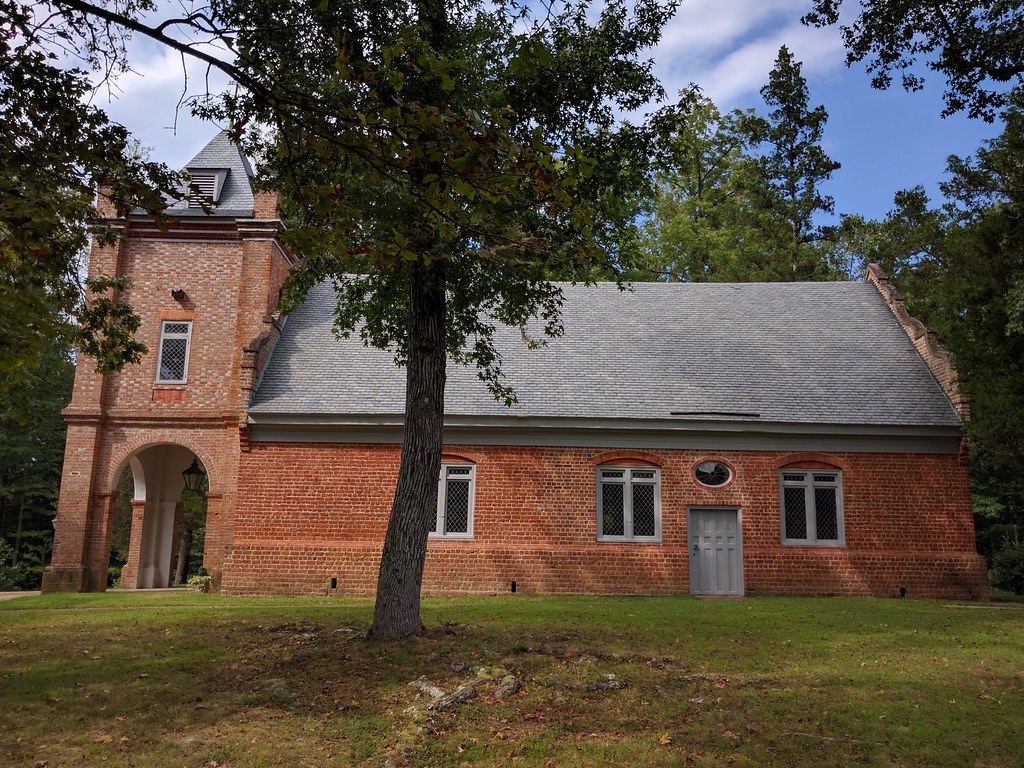
Religion has shaped Virginia since before the colony existed. Spanish Jesuits said the first Mass on the Peninsula in 1570. The English made the Church of England the colony’s official church for 169 years, then, led by Jefferson and Madison, replaced it with one of the world’s first laws guaranteeing full religious freedom. Baptists and Methodists grew into the largest churches of the 19th century, Black congregations became the backbone of African American community life, and in the last half-century immigration has brought mosques, temples and gurdwaras to the suburbs. This guide summarizes that history and links to every page on religion in Virginia.
Quick answer: Virginia’s first church was a Spanish Jesuit chapel (1570–1571). From 1607 to 1786 the Church of England was the established church, and Puritans, Quakers, Catholics and Baptists faced restrictions or persecution. The Virginia Statute for Religious Freedom of January 16, 1786, ended the establishment and inspired the First Amendment. Today Virginia is mostly Christian, with Baptists, Catholics, Methodists and nondenominational churches the largest groups, alongside growing Jewish, Muslim, Hindu, Buddhist, Sikh and Latter-day Saint communities and a rising share of people with no religious affiliation.[1][2]
Contents
- The colonial established church
- Dissenters and religious freedom
- The evangelical century
- Black churches
- Minority faiths and newcomers
- Latter-day Saints in Virginia
- Religion in Virginia today
- Colleges with a religious affiliation
- Religion in Virginia: A-Z
- Timeline
- Frequently asked questions
The colonial established church
Jamestown’s settlers worshipped according to the Church of England from their first days, and the colony’s laws soon required everyone to attend the parish church and pay parish taxes. Vestries of leading planters ran the parishes, which also cared for the poor and kept vital records. There was no bishop in America, so ministers had to travel to England for ordination, and many parishes went without one for years. The details are in the Anglican Church in Virginia and Virginia Colony religion; the surviving colonial church buildings are described in oldest churches in Virginia.
Dissenters and religious freedom
Other faiths were tolerated reluctantly, if at all. Puritan ministers were expelled in the 1640s, Quakers were fined and banished from 1660, Catholics were barred from office, and in 1689 Parson Waugh’s tumult in Stafford County turned fear of Catholics into near-insurrection (see religious toleration in colonial Virginia). From the 1720s the colony welcomed Protestant settlers who would fill the frontier: French Huguenots at Manakin Town, Germans at Germanna and in the Shenandoah Valley, Scots-Irish Presbyterians, Mennonites, Brethren and Quakers.
The Great Awakening of the 1740s and the rise of the Separate Baptists in the 1760s brought conflict, including the jailing of unlicensed Baptist preachers. In 1776 Article 16 of the Declaration of Rights declared the free exercise of religion, and on January 16, 1786, the General Assembly adopted Jefferson’s statute, guided through by Madison after the defeat of Patrick Henry’s plan for a tax to support Christian teachers.[1] See the Virginia Statute for Religious Freedom.
The evangelical century
Without state support, the former Church of England, reorganized as the Protestant Episcopal Church, shrank, while Baptists and Methodists, who broke away from the Episcopal Church as a separate denomination in 1784, grew rapidly in the revivals of the early 1800s. Camp meetings, circuit-riding preachers and local congregations made Virginia part of the evangelical South. Presbyterians remained strong in the Valley and among the educated elite, and Lutherans, Reformed, Mennonites and Brethren in German-settled areas.
Slavery divided the churches. In 1844–1845 the Methodists and Baptists split into northern and southern bodies, and the Southern Baptist Convention was founded in 1845. The Civil War hit churches hard: buildings were burned, congregations scattered, and peace churches faced conscription (see Amish, Mennonites and Brethren in Virginia).
Black churches
Enslaved Virginians adopted Christianity in large numbers during the revivals of the late 1700s and 1800s, often in Baptist and Methodist churches where they worshipped under white control. Some congregations, such as First Baptist Church in Williamsburg and Gillfield Baptist Church in Petersburg, trace their roots to the late 18th century. After Nat Turner’s revolt in 1831, Virginia law barred Black preachers from leading services without white supervision.
After emancipation, freedpeople left white-controlled churches and founded their own. Black Baptist and Methodist churches became centers of education, politics and mutual aid, and later of the civil rights movement. Virginia Union University in Richmond and the Virginia University of Lynchburg were founded by Black Baptists after the war.[3] See slavery in Virginia and race and Jim Crow in Virginia.
Minority faiths and newcomers
- Catholics. Barred from public worship until 1786, Catholics founded their first parish in Alexandria in 1795; the Diocese of Richmond dates from 1820 and the Diocese of Arlington from 1974 (see Catholics in Virginia).
- Jews. Richmond’s Kahal Kadosh Beth Shalome, founded in 1789, was one of the first six congregations in the United States (see Jewish history in Virginia).
- Quakers. Persecuted in the 1600s, Friends were the first Virginians to require members to free their slaves (see Quakers in Virginia).
- Huguenots. French Protestant refugees settled at Manakin Town in 1700 (see Huguenots in Virginia).
- Newer faiths. Since immigration laws changed in 1965, Northern Virginia, Richmond and Hampton Roads have gained large Muslim, Hindu, Buddhist, Sikh and Bahá’í communities, along with Korean, Vietnamese, Ethiopian, Latino and other immigrant churches. The suburbs of Washington, D.C., are now among the most religiously diverse places in the South.
Latter-day Saints in Virginia
Latter-day Saint missionaries reached Virginia in the 1830s. Jedediah M. Grant, who arrived in 1839, received more invitations to preach than he could accept, and by 1841 there were about 80 members in the state. After Joseph Smith was killed in 1844, membership in Virginia was probably more than 350, and many of these early converts moved west to Utah.[4]
Missionary work stopped during the Civil War and resumed in the 1870s. In 1883 missionaries baptized Peter Mason and his family, Native Americans in Rockbridge County, and their conversion led to a congregation in the Blue Ridge. The church created its first Virginia stake (a group of congregations) in Richmond in 1957 and grew rapidly in the 1970s and 1980s, especially in Northern Virginia. For decades Virginia members used the Washington D.C. Temple in Kensington, Maryland, dedicated in 1974; in 2018 the church announced a temple in the Richmond area. The church reports more than 90,000 members in Virginia, organized into 22 stakes.[4] Southern Virginia University in Buena Vista, a private college, embraces the church’s values.
Religion in Virginia today
Surveys such as the Pew Research Center’s Religious Landscape Study show that most Virginia adults identify as Christian, with evangelical Protestants, mainline Protestants, Catholics and members of historically Black Protestant churches the largest groups, and that the share of religiously unaffiliated adults has grown since the 2000s, as in the rest of the country.[2] Southern Baptists remain the largest Protestant denomination in much of rural and small-town Virginia, while Northern Virginia has more Catholics, non-Christian faiths and unaffiliated residents.
The principles of 1786 still shape public debate in Virginia over school prayer, public funding of religious schools, Sunday closing laws, religious displays and exemptions from state laws. The Constitution of Virginia guarantees free exercise of religion and forbids religious tests in Article I, Section 16.[5]
Colleges with a religious affiliation
Many of Virginia’s private colleges were founded by churches, and several keep a religious identity:
- Baptist roots: Averett University (Danville), Virginia Union University (Richmond), Virginia University of Lynchburg, Bluefield University, Liberty University (Lynchburg, founded by Jerry Falwell in 1971).[3][6]
- Methodist: Randolph-Macon College (Ashland), Emory & Henry University, Ferrum College, Shenandoah University (Winchester).[7]
- Presbyterian: Hampden-Sydney College, Mary Baldwin University (Staunton), Union Presbyterian Seminary (Richmond).[8]
- Episcopal: Virginia Theological Seminary (Alexandria), founded in 1823.[9]
- Catholic: Christendom College (Front Royal), Marymount University (Arlington).[10]
- Lutheran: Roanoke College (Salem).[11]
- Brethren: Bridgewater College; Mennonite: Eastern Mennonite University (Harrisonburg).[12]
- Disciples of Christ: University of Lynchburg; nondenominational evangelical: Regent University (Virginia Beach), founded by Pat Robertson.
- Latter-day Saint values: Southern Virginia University (Buena Vista).
Some historic church colleges, such as Washington and Lee (Presbyterian roots) and the University of Richmond (Baptist roots), are now independent. For the state’s oldest schools, see historic colleges and universities of Virginia.
Religion in Virginia: A-Z
- Amish, Mennonites and Brethren in Virginia – German pietists, the Civil War and today’s Amish.
- The Anglican Church in Virginia – the established church, 1607–1786, and the Episcopalians.
- Baptists and Presbyterians in Colonial Virginia – the Great Awakening and jailed preachers.
- Catholics in Virginia – from Ajacán to the dioceses of Richmond and Arlington.
- Huguenots in Virginia – French Protestant refugees at Manakin Town.
- Jewish History in Virginia – from Joachim Gans to today’s communities.
- Oldest Churches in Virginia – Jamestown, St. Luke’s, Aquia and more.
- Quakers in Virginia – persecution, peace and the fight against slavery.
- Religious Toleration in Colonial Virginia – dissenters, Catholics and Parson Waugh’s tumult.
- Virginia Colony Religion – parishes and church taxes in the colony.
- The Virginia Statute for Religious Freedom – disestablishment, George Washington’s views and the First Amendment.
Timeline
| Year | Event |
|---|---|
| 1570 | Spanish Jesuit mission at Ajacán |
| 1607 | Anglican worship begins at Jamestown |
| 1660 | Anti-Quaker laws |
| 1689 | Parson Waugh’s tumult; Toleration Act |
| 1700 | Huguenots settle Manakin Town |
| 1748 | Samuel Davies begins preaching in Hanover County |
| 1768 | Baptist preachers jailed in Spotsylvania |
| 1776 | Declaration of Rights, Article 16 |
| 1786 | Statute for Religious Freedom (January 16) |
| 1789 | Kahal Kadosh Beth Shalome founded in Richmond |
| 1795 | St. Mary’s, Alexandria, first Catholic parish |
| 1820 | Diocese of Richmond created |
| 1845 | Southern Baptist Convention founded |
| 1957 | First Latter-day Saint stake in Virginia |
| 1974 | Diocese of Arlington created |
Frequently asked questions
What is the main religion in Virginia? Christianity. Most Virginians who identify with a religion are Protestant, especially Baptist, Methodist or nondenominational, followed by Catholics.
Did Virginia have an official religion? Yes. The Church of England was Virginia’s established church from 1607 until the Statute for Religious Freedom of 1786 ended the establishment.
Why is Virginia important for religious freedom? Its 1786 Statute for Religious Freedom, written by Jefferson and passed with Madison’s leadership, was one of the first laws anywhere to guarantee full freedom of belief, and it shaped the First Amendment.
How many Latter-day Saints live in Virginia? The church reports more than 90,000 members in Virginia, organized into 22 stakes.
References
- [1] Free Speech Center at MTSU, First Amendment Encyclopedia: Virginia Statute for Religious Freedom – last checked 11/21/2026
- [2] Pew Research Center, Religious Landscape Study: Adults in Virginia – last checked 11/21/2026
- [3] Virginia Union University – last checked 11/21/2026
- [4] Latter-day Saint Church Newsroom, Virginia: Statistics and Church Facts – last checked 11/21/2026
- [5] Constitution of Virginia, Article I, Section 16 – last checked 11/21/2026
- [6] Liberty University – last checked 11/21/2026
- [7] Randolph-Macon College – last checked 11/21/2026
- [8] Hampden-Sydney College, History – last checked 11/21/2026
- [9] Virginia Theological Seminary – last checked 11/21/2026
- [10] Christendom College – last checked 11/21/2026
- [11] Roanoke College – last checked 11/21/2026
- [12] Bridgewater College and Eastern Mennonite University – last checked 11/21/2026