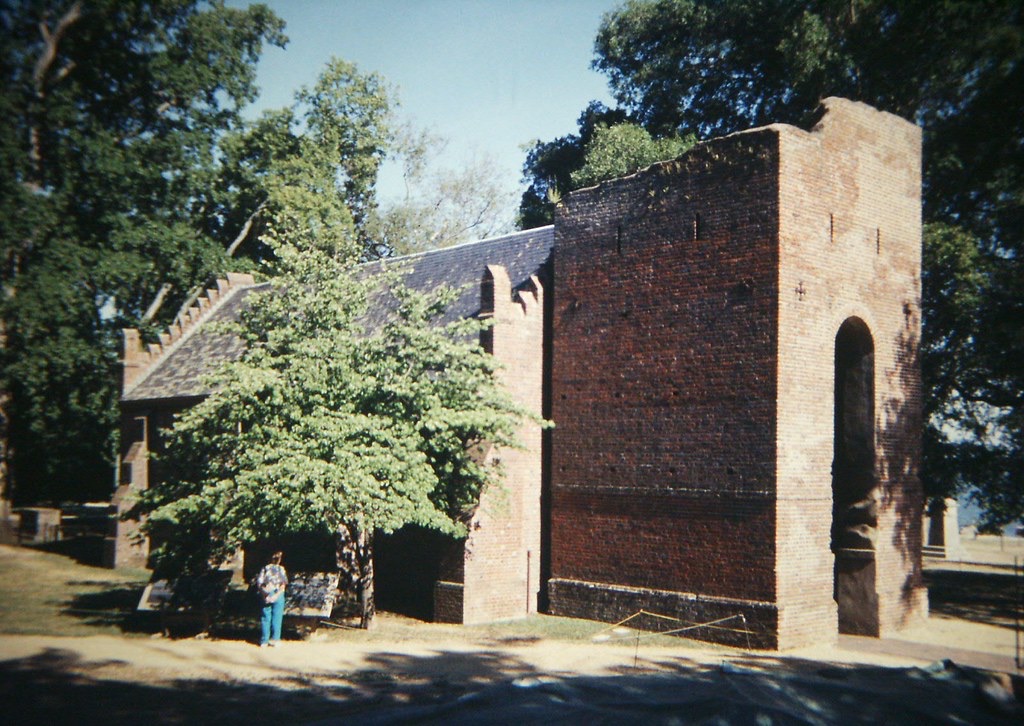
“Oldest church” can mean several things: the oldest congregation, the oldest site of worship, or the oldest building still standing. In Virginia the answers differ, and local pride has sometimes pushed the dates earlier than the evidence allows. The first chapel was Spanish and Catholic and has vanished. The first English churches, at Jamestown and Hampton, survive only as foundations and archaeology. The oldest standing church building is almost certainly St. Luke’s in Isle of Wight County, from the late 1600s, followed by a remarkable group of brick parish churches built in the early 1700s.
Quick answer: The first church in Virginia was a Spanish Jesuit chapel at Ajacán in 1570, now lost. The English held a service at Cape Henry on April 29, 1607, and built churches inside James Fort; the brick tower of the late-1600s Jamestown church still stands. St. John’s in Hampton traces its parish to 1610, the oldest continuous English-speaking parish in America, though its building dates from 1728. The oldest standing church building is St. Luke’s (Newport Parish Church) near Smithfield, probably dating from the closing decades of the 1600s. Other early survivors include St. Peter’s in New Kent (1701–1703), Yeocomico (1706, enlarged about 1730–1740), Christ Church in Lancaster County (completed by 1735) and Aquia Church (1751–1757). The 1657 date claimed for Merchant’s Hope Church is now considered too early.[1][2][3][4]
Contents
- The lost Spanish chapel, 1570
- Cape Henry and the first Jamestown churches
- The Jamestown church tower
- Hampton: the oldest continuous parish
- St. Luke’s: the oldest standing church
- Merchant’s Hope and the 1657 claim
- The great brick churches of the 1700s
- What happened after disestablishment
- Oldest churches of other faiths
- Visiting early churches
- Timeline
- Frequently asked questions
The lost Spanish chapel, 1570
The first Christian worship in what is now Virginia was Catholic. In September 1570 a Spanish ship from Cuba carried Father Juan Bautista de Segura and other Jesuits into the Chesapeake Bay with their guide Paquiquineo, known as Don Luis. The missionaries built a simple building, part house and part chapel, on the Virginia Peninsula. In February 1571 they were killed and the mission was abandoned.[5] No trace of the chapel has been found, and its exact site is unknown. See Virginia as an international frontier.
Cape Henry and the first Jamestown churches
When the English arrived in 1607, they landed at Cape Henry and set up a wooden cross on April 29; a granite cross now marks the spot at Fort Story in Virginia Beach. At Jamestown, the first services were held under an old sail hung between trees, with a bar of wood nailed between two trees as a pulpit.
The settlers soon built a church inside James Fort, which burned with most of the fort in January 1608 and was replaced. In 2010 archaeologists found the remains of a church of 1608 inside the fort, the earliest known Protestant church in North America, where Pocahontas and John Rolfe were married in 1614. In 2013 they excavated four graves in its chancel, the most honored burial place, belonging to the Reverend Robert Hunt, Captain Gabriel Archer, Sir Ferdinando Wainman and Captain William West.[1] A larger timber church was built in 1617–1619, and it hosted the first meeting of the General Assembly in 1619.
The Jamestown church tower
In the late 1630s a brick church began to replace the timber one. It was burned during Bacon’s Rebellion in 1676 and rebuilt on the same foundations, and about 1680 a brick tower was added. After the capital moved to Williamsburg in 1699, the town declined and the church fell into ruin, but the tower survived.[6] It is the only 17th-century structure still standing above ground at Jamestown. In 1907, for the 300th anniversary, the National Society of the Colonial Dames of America built a memorial church on the old foundations behind the tower. See Jamestown: why there?.
Hampton: the oldest continuous parish
In 1610, three years after Jamestown, settlers moved to the mouth of the James near the Kecoughtan town and founded a church there. St. John’s Church in Hampton traces its congregation to 1610 and calls itself the oldest English-speaking parish in America in continuous existence. The parish worshipped at four sites; archaeology completed in 2025 showed that its first church stood on the same ground as the second, on land now part of Hampton University. The present cruciform brick church was finished in 1728, survived the burning of Hampton in 1861 and was given the name St. John’s in 1830.[4]
St. Luke’s: the oldest standing church
St. Luke’s Church near Smithfield, originally the Newport Parish Church, is the oldest church building standing in Virginia and one of the oldest in the United States. With its buttressed walls, pointed windows and tracery, it is the purest Gothic church of English America. Tradition long dated it to 1632, but the Virginia Department of Historic Resources considers its construction date controversial and judges that it was most likely put up, together with its tower, in the closing decades of the 1600s; tree-ring dating has pointed to the early 1680s.[2]
After disestablishment St. Luke’s fell into ruin for most of the 19th century. A long restoration began in 1894, and the church is now a National Historic Landmark and museum.[2]
Merchant’s Hope and the 1657 claim
Merchant’s Hope Church in Prince George County, named after a 17th-century plantation, has often been called the oldest Protestant church in America, with a date of 1657 sometimes said to be carved into a roof timber. Jordan’s Parish, which it may have served, was established in 1655. The Department of Historic Resources notes, however, that nothing in the present building looks distinctly 17th century, and that its form and details fit the early to mid-1700s; a tree-ring study points to about 1743.[3] The plain brick church lost most of its interior during the Civil War.
The great brick churches of the 1700s
After 1700, wealthier parishes replaced their wooden churches with brick ones, many of which still stand:
- St. Peter’s, New Kent County. Built in 1701–1703 by carpenter William Hughes and bricklayer Cornelius Hall, with curved Jacobean gables; the tower was added in 1739–1741. George and Martha Washington are said to have married nearby, and the church was Martha Custis’s parish.[7]
- Yeocomico Church, Westmoreland County. Its brickwork bears the date 1706 and the initials of many workmen; a T-shaped wing was added about 1730–1740. Its side porch with a small “wicket” door cut into a larger one is unique in America.[8]
- Bruton Parish Church, Williamsburg. The parish dates from 1674, and the present church, designed in part by Governor Alexander Spotswood, was completed in 1715 and served the colonial capital.[9]
- St. John’s, Hampton (1728) and Christ Church, Lancaster County. Commissioned by Robert “King” Carter, the richest planter in Virginia, Christ Church was completed by 1735 and is unmatched among Virginia’s colonial churches in quality and preservation, with its original high-backed pews and three-decker pulpit.[10]
- Aquia Church, Stafford County. On a site used for worship since 1654, the cruciform church was begun in 1751, burned just three days before completion and was rebuilt within the walls by 1757. It keeps a rare three-tiered pulpit.[11]
- Pohick Church (1769–1774) and Christ Church, Alexandria (1767–1773), both in Fairfax County’s colonial parishes, were attended by George Washington, who served as a vestryman of Truro Parish.
What happened after disestablishment
When the Church of England lost its status after the Revolution, many parishes had no money and no ministers. In 1802 the General Assembly ordered vacant glebes sold for public purposes (see the Virginia Statute for Religious Freedom). Some colonial churches were abandoned, taken over by other denominations, used as barns or stables, or damaged in the Civil War. Most of those that survive were restored by Episcopal congregations in the 19th and 20th centuries. The Anglican Church in Virginia page explains the parish system that built them.
Oldest churches of other faiths
- Quaker: Hopewell Meeting House in Frederick County, begun in 1759, is one of the oldest houses of worship west of the Blue Ridge (see Quakers in Virginia).
- Presbyterian: the site of Polegreen Church in Hanover County, Samuel Davies’s meeting house of the 1740s and 1750s, destroyed in 1864 (see Baptists and Presbyterians in colonial Virginia).
- Catholic: St. Mary’s in Alexandria, founded in 1795, with its present church dedicated in 1827 (see Catholics in Virginia).
- Jewish: Kahal Kadosh Beth Shalome in Richmond, founded in 1789 (see Jewish history in Virginia).
- African American: Black Baptist congregations such as First Baptist Church in Williamsburg and Gillfield Baptist Church in Petersburg trace their roots to the 18th century and are among the oldest Black churches in the nation.
Visiting early churches
Most of these churches are still active Episcopal parishes and welcome visitors outside service times; some, such as St. Luke’s and Christ Church in Lancaster County, are run as museums with regular hours. Historic Jamestowne, managed by the National Park Service and Jamestown Rediscovery, shows the church tower and the excavated 1608 church site.
Timeline
| Year | Church or event |
|---|---|
| 1570 | Spanish Jesuit chapel at Ajacán |
| 1607 | Cross at Cape Henry (April 29); first church in James Fort |
| 1608 | Church rebuilt after the James Fort fire |
| 1610 | Parish founded at Kecoughtan (Hampton) |
| 1617–1619 | Timber church at Jamestown; first General Assembly (1619) |
| c. 1680 | Jamestown church tower; St. Luke’s most likely built about this time |
| 1701–1703 | St. Peter’s, New Kent County |
| 1706 | Date on Yeocomico Church |
| 1715 | Bruton Parish Church completed |
| 1728 | St. John’s, Hampton |
| by 1735 | Christ Church, Lancaster County |
| c. 1743 | Merchant’s Hope Church (tree-ring date) |
| 1751–1757 | Aquia Church |
| 1907 | Memorial church built at Jamestown |
Frequently asked questions
What is the oldest church in Virginia? The oldest standing church building is St. Luke’s near Smithfield, most likely built in the late 17th century. The oldest continuous parish is St. John’s in Hampton, founded in 1610, and the first church of any kind was a Spanish chapel of 1570.
Is Merchant’s Hope Church from 1657? Probably not. The Virginia Department of Historic Resources says the building looks early to mid-18th century, and tree-ring dating suggests about 1743.
What remains of the Jamestown church? The brick tower of about 1680, the foundations of earlier churches, and the 1608 church site found by archaeologists in 2010. A memorial church was built on the old foundations in 1907.
Which colonial church is best preserved? Christ Church in Lancaster County, completed by 1735 for Robert “King” Carter, is considered the best-preserved colonial church in Virginia.
References
- [1] Jamestown Rediscovery, Historic Jamestowne: Chancel Burials – last checked 11/21/2026
- [2] Virginia Department of Historic Resources, St. Luke’s Church – last checked 11/21/2026
- [3] Virginia Department of Historic Resources, Merchant’s Hope Church – last checked 11/21/2026
- [4] St. John’s Episcopal Church, Hampton, History – last checked 11/21/2026
- [5] EBSCO Research Starters, “Ajacan Mission” – last checked 11/21/2026
- [6] National Park Service, Historic Jamestowne: A Short History of Jamestown – last checked 11/21/2026
- [7] Virginia Department of Historic Resources, St. Peter’s Church – last checked 11/21/2026
- [8] Virginia Department of Historic Resources, Yeocomico Church – last checked 11/21/2026
- [9] Bruton Parish Church, History – last checked 11/21/2026
- [10] Virginia Department of Historic Resources, Christ Church, Lancaster County – last checked 11/21/2026
- [11] Virginia Department of Historic Resources, Aquia Church – last checked 11/21/2026